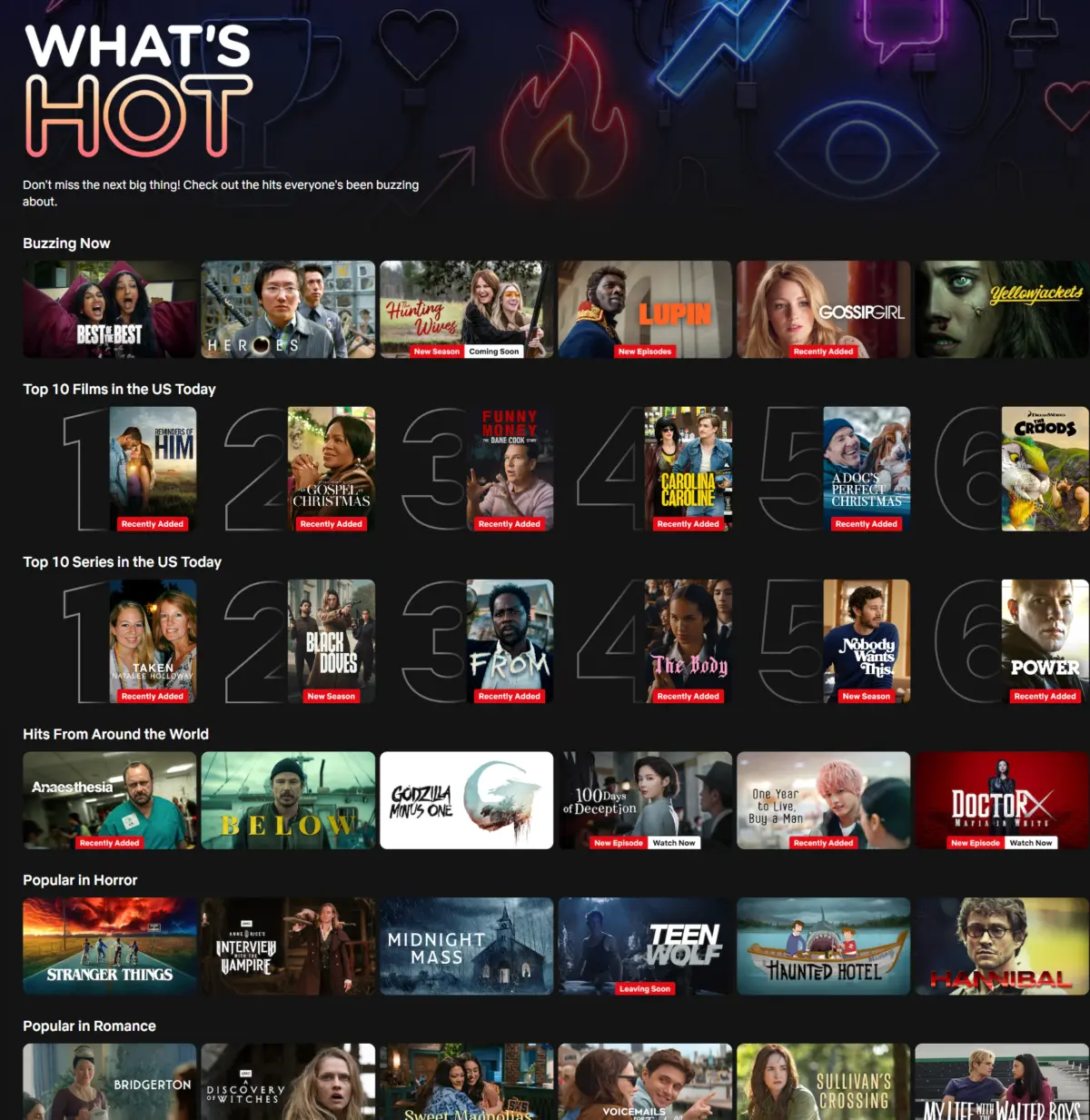
Netflix is expanding its interface capabilities with the introduction of a dedicated "What’s Hot" hub, marking a significant evolution in how the streaming giant organizes and surfaces trending media. Accessible via designated browsing paths and rolling out across television and mobile devices, the new section abandons traditional algorithmic mood-based curation in favor of raw popularity metrics, regional charts, and momentum-driven data. This strategic shift follows closely on the heels of specialized franchise-focused destinations, signaling a broader effort by the company to mitigate "choice paralysis" and redefine the modern television-watching experience.
Main Facts of the New Feature
The newly deployed hub operates primarily on objective audience metrics rather than personalized editorial recommendations. Prominently anchored by a bold orange "HOT" wordmark, the page compiles multiple data-backed rows that expand upon the foundational Top 10 lists introduced globally in 2020.
Unlike the standard homepage—which heavily relies on machine-learning predictions tailored to individual viewing histories—the What’s Hot hub aggregates collective consumption data. It features regional hits, genre-specific popularity charts, and momentum indicators such as "Buzzing Now."
Crucially, this architecture creates a more equitable visibility landscape for content. Netflix Originals and licensed acquisitions share equal prominence within the hub’s parameters. Popular licensed television series—ranging from long-running broadcast dramas to syndicated cable hits—appear alongside high-profile platform exclusives. Additional organizational flags, including "New Season," "New Episode," "Recently Added," and "Leaving Soon," provide temporal context to help users identify timely viewing opportunities.
Chronology and Recent Developments
The rollout of the What’s Hot hub is part of a rapid succession of interface modifications implemented by the streaming service throughout late 2026.
- Late 2019 to Early 2020: Netflix begins testing daily Top 10 lists regionally before officially rolling the feature out globally to provide users with a standardized measure of platform popularity.
- Early November 2026: Netflix launches specialized content destinations, beginning with the dedicated fan hub for KPop Demon Hunters, which aggregates the feature film, sing-along versions, lyric videos, choreography tutorials, and ancillary stop-motion programming into a single cohesive destination.
- Mid-November 2026: Initial user tests for the What’s Hot hub go live in select markets, most notably the United States, utilizing dedicated genre paths to aggregate data-driven rows.
- Ongoing (2026): Concurrent interface tests on smart television applications deploy modular sidebar menus, aligning closely with the categorical framework established by the new trending destinations.
Background and Context in Content Discovery
For over a decade, subscription video-on-demand (SVOD) platforms have grappled with the paradox of choice. As digital libraries expand to encompass thousands of titles, users frequently spend excessive amounts of time scrolling through homepages without selecting content—a phenomenon industry analysts refer to as "browse abandonment."
Historically, Netflix relied heavily on complex recommendation algorithms designed to match individual user taste profiles with specific content tags. While effective for niche discovery, this approach occasionally obscured broader cultural touchstones and breakout hits that were dominating global viewership but did not align with a specific user’s historical viewing patterns.
The introduction of the Top 10 lists in 2020 was the first major step toward leveraging social proof—the psychological phenomenon where people assume the actions of others in an attempt to reflect correct behavior for a given situation. The What’s Hot hub scales this concept horizontally, transforming isolated lists into a comprehensive directory of collective engagement. This methodology mirrors traditional broadcast television’s reliance on ratings blocks and cultural consensus, offering viewers a digital equivalent of water-cooler television.
Integration with Modern UI/UX Redesigns
The deployment of the trending hub coincides with ongoing user interface (UI) and user experience (UX) overhauls across television operating systems. Recent test builds of the Netflix television application emphasize structural "modules"—modular rows that group content by specific temporal or popularity metrics rather than endless vertical scrolls.
Industry observers note that a dedicated hub comprised entirely of popularity modules serves as a logical extension of these UI experiments. By grouping high-momentum assets into a single destination, Netflix reduces the cognitive load required to navigate disparate genres. However, media analysts have suggested that further refinements—such as global ranking indicators or granular regional popularity flags—could enhance the utility of these charts for international subscribers.
Industry Implications and Strategic Analysis
The strategic pivot toward dedicated hubs and popularity-driven directories reflects a maturing streaming market where user acquisition and retention strategies are shifting. As competition among major media conglomerates intensifies, platforms are increasingly prioritizing operational efficiency and immediate content gratification.
- Valuation of Licensed Content: By placing licensed acquisitions on equal footing with expensive original productions within high-visibility hubs, Netflix maximizes the return on investment for acquired library titles. Shows that experience secondary surges via syndication or social media momentum can be rapidly amplified without requiring custom marketing campaigns.
- Combating Subscriber Churn: Streamlined navigation directly correlates with user satisfaction. By minimizing the friction associated with finding popular cultural phenomena, platforms aim to reduce subscriber fatigue and subsequent cancellation rates.
- Ecosystem Fragmentation vs. Centralization: While specialized hubs like the KPop Demon Hunters destination cater to hyper-fandoms, broad aggregators like What’s Hot capture generalist viewers. Balancing these two distinct audience behaviors is critical for maintaining platform engagement across diverse demographic cohorts.
As Netflix continues to evaluate performance metrics from its initial regional tests, the future global rollout of the What’s Hot hub will likely influence broader interface design trends across the entire streaming sector. Whether these destination pages permanently alter viewing habits or remain supplemental browsing tools will depend heavily on user adoption rates in the coming months.