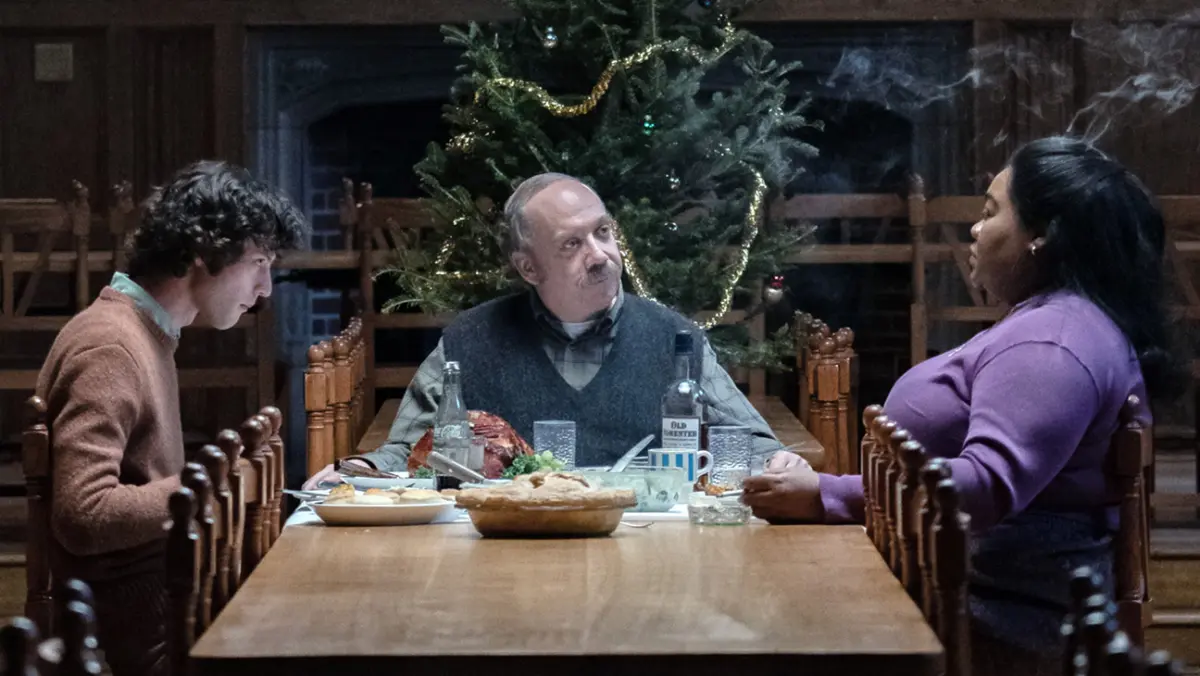
The legal action, initiated in a California federal court this Wednesday, represents a significant escalation in a simmering dispute over creative ownership within the film industry. Stephenson, a writer whose credits include Paddington 2 and The Electrical Life of Louis Wain, alleges that Payne and his collaborators misappropriated the structural, thematic, and specific narrative elements of his 2013 screenplay, titled Frisco, to construct the foundation of The Holdovers. The lawsuit names a broad array of defendants, including Payne, co-writer David Hemingson, producer Mark Johnson, various production entities such as Gran Via and Mirax, and distributors Focus Features and Universal Home Entertainment.
At the heart of the complaint is the assertion that the defendants utilized Frisco as a "blueprint" for their film. While copyright law explicitly does not protect general ideas—such as a story about a curmudgeonly teacher or a mentor-mentee dynamic—it does protect the specific expression of those ideas. Stephenson’s legal team, led by attorney Julia Cherlow, argues that the similarities extend far beyond common tropes, pointing to a sequence of events and idiosyncratic narrative habits that they claim prove direct plagiarism.
A Chronology of the Alleged Infringement
The timeline presented in the lawsuit suggests a long-standing familiarity between the accused director and the plaintiff’s work. Stephenson claims that his screenplay, Frisco—which earned a prestigious spot on the 2013 Black List, an industry index of the most liked unproduced screenplays—was first placed in front of Payne that same year. According to the court filings, Stephenson’s representatives facilitated the delivery of the script to Jim Burke, Payne’s long-time producing partner. At that time, Burke reportedly indicated that Payne "did like it but was not interested in producing or directing it."
The narrative of the lawsuit posits that the connection between the two works remained dormant until 2019, when the Frisco screenplay was allegedly submitted to Payne a second time through official channels on behalf of Netflix. It was during this period that Payne began working with screenwriter David Hemingson to develop the project that would eventually become The Holdovers. Stephenson contends that the transition from his original script to the final version of the Oscar-nominated film involved the application of "surface-level cosmetic changes" designed to obscure the underlying theft of his intellectual property.
Evidence of Stylistic Borrowing
The lawsuit leans heavily on what it describes as "stylistic traces" that purportedly link the two works. Perhaps the most peculiar piece of evidence cited involves a formatting quirk. In the screenplay for The Holdovers, scene transitions are introduced with the words "Under Black," which is technically a misnomer for the industry-standard term "Over Black." Stephenson’s legal filing argues that this is not a random error but a specific, idiosyncratic habit of his own writing style that manifested in the defendants’ work.
Furthermore, the complaint highlights a specific, unexplained line of dialogue in The Holdovers. In a scene where a character is searching for a hotel room, they state, "I understand it’s the holidays, but it’s kind of an emergency. I’m coming into the city for a medical conference." The lawsuit notes that the reference to a "medical conference" serves no narrative purpose in The Holdovers and is never mentioned again. However, in Stephenson’s Frisco, the protagonist is a pediatrician who travels to San Francisco specifically to speak at a medical conference. The presence of this vestigial plot point, the suit argues, is evidence that the defendants were working from the architecture of Frisco.
Additional similarities cited include the inciting incident for both protagonists: in both scripts, the main character is summoned to a superior’s office to face a reprimand for a conflict involving a U.S. senator or a high-profile political figure. These structural parallels, when viewed in aggregate, form the basis of the plaintiff’s claim of substantial similarity.
The Defense and Industry Context
Alexander Payne has historically maintained that the inspiration for The Holdovers was rooted in his appreciation for the 1935 French film Merlusse, which depicts a boarding school teacher overseeing students during a holiday break. Payne has stated that he had long harbored a desire to create a film set in a boarding school environment and tasked Hemingson, who had written an unproduced television pilot set in a similar setting, with crafting the screenplay.
The legal defense for Payne and his collaborators will likely center on the distinction between "scènes à faire"—the standard incidents and characters common to a genre—and original expression. In the realm of cinema, stories about lonely, intelligent men finding redemption through the care of a younger person are a well-established tradition. The defendants are expected to argue that any similarities are the result of these common storytelling conventions rather than an appropriation of Stephenson’s work.
The WGA Dispute and Prior Resolution Attempts
Before resorting to federal litigation, Stephenson attempted to resolve the matter through the Writers Guild of America (WGA). The dispute reached a critical point on the eve of the 2024 Academy Awards, where The Holdovers was nominated for five Oscars, including Best Original Screenplay. Stephenson presented documentation to the WGA intended to support his claims of plagiarism. However, the guild concluded that it lacked the jurisdiction to arbitrate copyright infringement claims, as these are matters of federal law rather than contractual disputes between writers and studios. This left the resolution of the matter in legal limbo until the filing of the current lawsuit.
The fact that both Payne and Stephenson were represented by Creative Artists Agency (CAA) at the time of the initial 2013 submission—with Hemingson represented by WME—adds a layer of complexity to the procedural history of the script’s circulation within Hollywood’s talent ecosystem.
Broader Implications for Copyright in Hollywood
The legal battle arrives at a time of shifting tides in how courts treat copyright claims against major film productions. Historically, defendants have found success in having such cases dismissed at the early stages by judges who determine that the works in question are not "substantially similar" as a matter of law.
However, recent rulings from federal appeals courts have begun to push back against this trend, cautioning judges against "early dismissal" and suggesting that questions of similarity are often better left to a jury. For example, in the case of Francesca Gregorini’s lawsuit against M. Night Shyamalan regarding the Apple series Servant, an appeals court reversed a dismissal, noting that "reasonable minds could differ" on the merits of the claim. This judicial shift has emboldened creators to pursue litigation, though the burden of proof remains dauntingly high.
Data from the past several years indicates that while lawsuits have become more frequent, successful outcomes for plaintiffs remain elusive. High-profile cases, including those against Disney’s Moana and Shyamalan’s Servant, ended in defense verdicts. The most notable exception in recent memory is the settlement reached in the case involving The Shape of Water, where the estate of author Paul Zindel alleged that the film infringed upon his play Let Me Hear You Whisper. That case was revived by an appeals court before the parties reached a private settlement.
Financial and Commercial Impact
The Holdovers has been a commercial and critical success, grossing approximately $46 million at the box office against a $30 million acquisition price paid by Focus Features during the Toronto International Film Festival. The film’s reach has been further extended through its availability on the Netflix streaming platform.
Stephenson is seeking unspecified damages, as well as an injunction that would prevent the further exploitation of the film. While a full withdrawal of the movie from distribution is statistically unlikely, the suit poses a significant reputational risk to the participants and could lead to a substantial settlement. As the case proceeds to discovery, the internal communications between the creative team and their representatives will likely come under intense scrutiny, potentially revealing more about the developmental process of the film and how it evolved from initial drafts to its final iteration.
For now, the industry is watching closely. The outcome of this case may set a new precedent for how "blueprints" for screenplays are protected and whether the nuances of character motivation and specific dialogue choices can serve as the smoking gun in the high-stakes environment of modern copyright litigation. The legal battle underscores the inherent tension between the standard creative process of drawing inspiration from existing media and the legal protections afforded to individual writers who claim their unique voices have been subsumed by more powerful industry players.