Acclaimed French filmmaker Alice Diop has stepped far beyond the boundaries of traditional cinema to curate her first-ever multidisciplinary art exhibition, titled Geste de Consolation (Gesture of Consolation). Set against the backdrop of the prestigious Art Basel Paris fair, the ambitious five-day project is sponsored by Italian luxury fashion house Miu Miu and hosted within the iconic Palais d’Iéna. Known internationally for her piercing cinematic examinations of race, culture, motherhood, and marginalization—culminating in her Venice Silver Lion-winning feature Saint Omer—Diop approaches this large-scale installation with the precise, methodical eye of a master director.
Rather than viewing the curatorial endeavor as a departure from her filmmaking, Diop treats the expansive exhibition space as a living film set. The project brings together a constellation of creative collaborators, intellectual touchstones, and artistic works that have shaped her artistic journey, creating an immersive environment that merges film, sculpture, performance, literature, and music.
A Cinematic Approach to Curating Space
The setting for Geste de Consolation is the Palais d’Iéna, a modernist architectural masterpiece constructed in the early 1940s. Famous for its sweeping, 60-meter-long uninterrupted central hall, the building serves as the regular venue for Miu Miu’s high-profile catwalk presentations. The fashion house brings the same uncompromising financial and logistical support to its annual artistic commissions, which previously included a massive mechanical conveyor belt and a cast of approximately 100 actors orchestrated by Polish artist Goshka Macuga during the 2024 edition.
For the 2025 iteration, Diop has structured the multi-part exhibition into four principal scenarios. Visitors entering the hall are immediately confronted by a poignant, intimate image by South African visual artist Zanele Muholi, depicting a woman looking at her own naked reflection in a mirror. Diop explains that Muholi’s work embodies the exhibition’s core ethos by granting visibility, dignity, and a distinct voice to those who have historically been pushed to the margins of society.
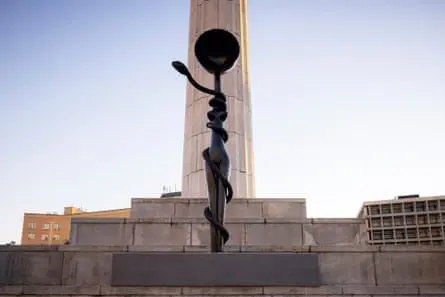
The journey through the space culminates with a towering presence: American sculptor Simone Leigh’s monumental work Mami Wata. The sculpture, which draws deeply from diasporic West African spirituality and mythology, anchors the vast hall.
“You will be able to see her from all over the hall,” Diop notes regarding Leigh’s striking installation. “Simone is a star in her native US, and has a huge retrospective coming to London in 2027. But she’s never had a show in France. This is an attempt to redress that.”
In addition to visual arts, Diop has curated a dedicated library within the Palais d’Iéna. This reading room houses the literary works and texts that have fundamentally informed her worldview and professional career, inviting visitors to sit, read, and reflect in a quiet sanctuary amid the bustling energy of Art Basel Paris.

Intellectual Recognition and Global Acclaim
Diop’s foray into the contemporary art world arrives on the heels of an intensive two-week academic celebration of her cinematic oeuvre organized by the French department at the University of California, Berkeley. Academics, film scholars, and students spent fortnight analyzing her extensive documentary work—including Nous (We) and Vers La Tendresse (Towards Tenderness)—alongside her narrative feature debut, Saint Omer.
Saint Omer marked a historic milestone for French cinema. Inspired by a real-life courtroom trial that Diop personally attended, the film chronicles the trial of a Senegalese immigrant accused of infanticide. Over a meticulously paced two-hour narrative, the film deconstructs the profound complexities of race, post-colonial identity, and motherhood within contemporary French society. The critically lauded drama secured the prestigious Silver Lion Grand Jury Prize at the 79th Venice International Film Festival in 2022 and was subsequently selected as France’s official submission for the Best International Feature Film category at the 95th Academy Awards, making it the first film by a Black female director to achieve the honor.
Reflecting on the academic retrospective in California, Diop expressed profound humility. “To be studied like that, in such a temple of intellectual resistance, I was bowled over,” she says. “As a filmmaker, it’s not up to me to analyze my work. But listening to them, it was good to feel understood.”
The Anatomy of Consolation: Collaborators and Influences
At the heart of Geste de Consolation is an intentional gathering of women whose creative labor has sustained, inspired, and healed Diop throughout her career. The multi-part installation acts as a physical manifestation of dialogue among prominent international artists and thinkers.
Among the key collaborators featured in the project are Marie Ndiaye, the acclaimed novelist and playwright with whom Diop frequently co-writes her screenplays; American poet Robin Coste Lewis; and Chicago-based jazz composer and instrumentalist Angel Bat Dawid. These contemporary voices are placed in conversation with historical figures of intellectual resistance, most notably writer Virginia Woolf.
Diop’s own contribution to the exhibition takes the form of a split-screen video installation. The piece weaves together archival imagery and historical film clips that constitute what she describes as her personal "cinematic image bank."
“Some of them are quite troubling, violent,” Diop observes. “In others, I have found consolation.” In the cinematic universe constructed by Diop, historical trauma and emotional solace are inextricably linked.
Deepening the Dialogue with Miu Miu Women’s Tales
The partnership between Diop and Miu Miu is part of an ongoing creative relationship. In 2025, Diop contributed to Miu Miu’s long-running Women’s Tales series, which commissions established and emerging female directors to explore contemporary femininity and fashion.

Her 20-minute short film, Fragments for Venus, serves as a conceptual precursor to the themes explored in Geste de Consolation. In the film, actor Kayije Kagame wanders through the cavernous, history-laden galleries of the Louvre, gazing fixedly at classical paintings featuring Black subjects. The narrative then pivots geographically and tonally to a vibrant Brooklyn street, where actress Séphora Pondi and a community of women exude profound agency, autonomy, and vitality. Characters like Kagame and Pondi mirror Diop’s own artistic persona: that of the still, deeply observant witness absorbing the world around her.
Despite her deep engagement with visual arts and curation, Diop maintains a nuanced perspective on her primary medium. While she acknowledges that she reads voraciously—often consuming more literature than cinema—she views filmmaking as her truest vernacular.
“Maybe I make films because I’m a frustrated writer,” Diop reflects, adding that cinema grants her a level of structural and emotional precision that literature alone cannot always capture. “From the moment I agreed to take on this project, I decided it had to be another opportunity to pursue all the questions that I ask in my films.”
Broader Implications for the Art and Film Sectors
The collaboration between luxury fashion houses and high-profile auteurs has become an increasingly prominent fixture of major international art fairs like Art Basel Paris. By funding ambitious installations that bridge the gap between cinema, contemporary art, and fashion, entities like Miu Miu provide a vital financial and institutional platform for artists to execute visions that might otherwise remain confined to traditional cinema screens or academic discourse.
Furthermore, Diop’s exhibition addresses significant institutional gaps within the European art market. By introducing figures like Simone Leigh to Parisian audiences on a grand scale, the project challenges historical blind spots in major European cultural institutions regarding Black female artists from the global diaspora.
As Geste de Consolation opens its doors to the public during Art Basel Paris, it stands as a testament to Alice Diop’s expanding artistic vocabulary. By translating her rigorous cinematic grammar into a physical, architectural space, she continues to push the boundaries of how stories of marginalization, resilience, and emotional healing are told and experienced.