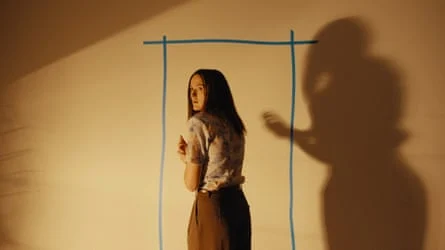
When architect-turned-furniture store owner Clark, portrayed by Chiwetel Ejiofor, stumbles upon a portal to a mysterious realm of “backrooms” in his showroom’s basement, his attempts to articulate the experience to his therapist, Dr. Mary Kline (Renate Reinsve), highlight the profound disorientation at the heart of A24’s latest thriller, Backrooms. The seemingly innocuous phrase, "I found a place…," belies the chilling architectural horror conjured within the film, a journey into the liminal spaces that exist in the ambiguous voids between our everyday realities.
The Genesis of a Digital Nightmare: From YouTube Shorts to Feature Film
Backrooms is the brainchild of 20-year-old director Kane Parsons, making him the youngest filmmaker to collaborate with the acclaimed studio A24. His feature-length debut draws directly from a series of viral YouTube shorts he produced using the free 3D software Blender and Adobe After Effects. These original shorts, which garnered significant online attention for their unsettling atmosphere and inventive concept, have now been expanded into a feature film. Crucially, the movie retains the distinct visual language and conceptual framework of its digital origins, a testament to Parsons’s singular vision. The film’s rapid ascent from independent web series to a major studio production underscores the burgeoning influence of digital creators and the increasing appetite for novel forms of horror storytelling.
Defining the "Liminal Space": A Concept Resonating in Modernity
The film’s exploration of “liminal spaces” taps into a concept that has gained traction in academic and popular discourse. These are transitional or in-between places, often feeling abandoned or existing outside the normal flow of time and human interaction. Philosopher Marc Augé famously described such locations as "non-places," spaces that "cannot be defined as relational, or historical, or concerned with identity." Architect Rem Koolhaas, in his seminal essay "Junkspace," characterized these environments as the byproduct of advanced modernism, where uniformity and a dissolution of distinct "place" led to the proliferation of neutral, often meaningless locales like airports and sprawling department stores.
Parsons himself articulated this connection on the A24 podcast, stating, "We have been trending for a few centuries into a spiral of industrialism. We’re kind of getting stuck in this monoculture." This sentiment directly informs the film’s aesthetic and thematic core. The "backrooms" themselves are a fictional expansion pack of the early 2000s’ dead malls, a potent symbol of retail obsolescence and the eerie quiet that descends upon once-bustling commercial hubs. The phenomenon of liminal spaces gained significant online traction around 2003, with early discussions often stemming from images of abandoned or undergoing renovation spaces, such as a furniture store in Oshkosh, Wisconsin, which became an early touchstone for the concept. As these 20th-century architectural relics of urban modernization – the airports, supermarkets, and particularly malls – fall into disuse, they become even more estranged from their surroundings, stripped of human traces, transforming from mere "junkspace" into profoundly unsettling "liminal spaces."
A World Built on Monotony and Bureaucracy
Backrooms constructs an entire cinematic world from this disquieting concept. "There is probably no better symbol for that kind of monoculture than a drop ceiling," Parsons observed, highlighting the ubiquitous, sterile architectural element that defines the film’s primary setting. The endlessly replicating, fluorescent-lit rooms become a labyrinth for Clark and Dr. Kline as they attempt to understand the origin and control of this unsettling dimension. Parsons, who expresses a keen interest in "the laws of the universe that resulted in our consciousness being the way it is," sought to translate the feeling of infinite, impenetrable bureaucracy onto the screen.

The horror in Backrooms is generated not by overt threats, but by absence and the unknown. What entities govern these endless spaces? What lies beyond the nondescript doorways and corridors? What inscrutable set of rules dictates this existence? This deliberate ambiguity is a cornerstone of the film’s unsettling power.
Echoes of Giallo and the Institutional Uncanny
The film’s approach to horror draws parallels with the Italian giallo genre, particularly the works of Dario Argento, such as Suspiria and Inferno. In these films, the architecture itself becomes a menacing entity, embodying a latent spirit or evil without fully revealing its nature. Much like Backrooms, Argento’s films often unfold within labyrinthine, nondescript rooms that disrupt a viewer’s ability to construct a coherent mental map of the on-screen environment. Clark’s futile attempts to map the backrooms mirror this disorientation, amplifying the suspense.
Architect Damjan Jovanovic’s concept of the "institutional uncanny" further illuminates the film’s thematic resonance. This term describes "the aesthetic name for what it feels like to live inside a world that has been brought into being by paperwork rather than by stories." This notion aligns with the work of artists Mat Dryhurst and Holly Herndon, who coined "protocol art" to describe practices engaging with the underlying rules and infrastructures that govern cultural production in the digital age – algorithms, AI, computer protocols, and platforms. The sterile drop ceilings, the monotonous wallpaper, and the yellow-tinged fluorescent lighting in Backrooms all evoke feelings of absence, liminality, nostalgia, and bureaucratic sterility, creating an atmosphere that is both eerily familiar and deeply alienating.
This resonates with the ambition of Fritz Lang’s 1927 silent film classic Metropolis, which sought to grapple with the profound psychological effects of a rapidly dehumanized built environment. As architect Juhani Pallasmaa notes in his writings on Alfred Hitchcock’s Rear Window, "The artistic stages of architecture are… primarily mental spaces. Architecture, too, leads our imagination to another reality." Backrooms masterfully constructs a cinematic "building" that embodies these feelings of liminality, drawing the audience into its unsettling embrace.
A Modern Take on Existential Dread: The Unanswered Questions
The horror experienced in Backrooms is rooted in the unsettling fusion of the mundane and the eerie, a trope seen in contemporary television series like Severance, Stranger Things, and Dark. In these narratives, a portal or unexplained phenomenon ushers characters into worlds where the rules are unclear, and a governing force, though unseen, is undeniably present. The film, much like these shows, prompts questions about the nature of this reality: Is it a clandestine government operation? A product of interdimensional entities? The result of corporate secret technology? Or perhaps a temporal experiment, an MKUltra-esque laboratory, or a UFO program? The film deliberately offers few concrete answers, leaving the audience to ponder the origins and controllers of this unsettling domain, with the enigmatic Asych company offering little in the way of explanation to Clark.
The Enduring Romance Between Architecture and Horror
Backrooms taps into a long-standing fascination within cinema where architecture plays a pivotal role in generating fear and unease. From haunted houses to oppressive cityscapes, the built environment has consistently served as a powerful vehicle for exploring psychological dread. By transposing the vast, infinite liminal spaces conjured from internet lore onto the silver screen, Kane Parsons’s Backrooms continues this enduring romance between horror and architecture, inviting audiences to confront the unsettling spaces that lie just beyond the edge of our perception. The film’s journey with Clark into the mysterious construction beneath his store is not just a narrative exploration but a palpable descent into a meticulously crafted architectural nightmare.