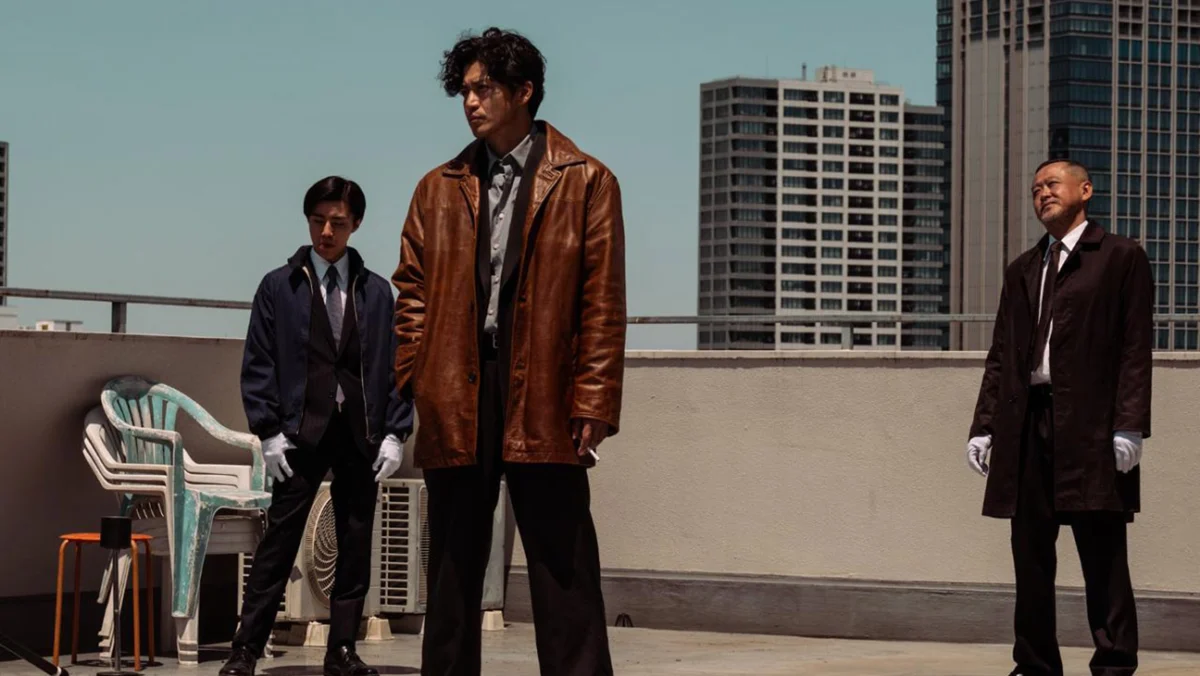
A New Chapter in a Storied Franchise
The "Bad Lieutenant" franchise is historically defined by its exploration of police corruption and spiritual decay. Abel Ferrara’s 1992 original, starring Harvey Keitel, set a gritty, grounded precedent, while Werner Herzog’s 2009 follow-up, Bad Lieutenant: Port of Call New Orleans, pushed the concept into the realm of surrealist, gonzo experimentation with Nicolas Cage.
Bad Lieutenant: Tokyo attempts to bridge these two styles but finds itself leaning closer to the narrative machinations of the Ferrara original without capturing its raw psychological depth. At the center of this installment is Yabuki, played by Shun Oguri, a detective whose life is defined by a deep-seated meth addiction, crushing gambling debts, and a series of erratic associations with yakuza syndicates. Unlike his predecessors, whose arcs were characterized by a desperate, drug-fueled quest for redemption, Yabuki remains a largely static, cynical figure, drifting through a Tokyo landscape that is as indifferent to his survival as he is to the law he is sworn to uphold.
Narrative Architecture and Character Dynamics
The plot follows a fragmented trajectory. Yabuki’s personal life is a vacuum; his marriage has dissolved, and his children have been removed from his orbit, a reality he accepts with a chilling lack of emotional engagement. Professionally, he exists on the periphery of the Tokyo Metropolitan Police, utilizing his extensive knowledge of the yakuza underworld not to maintain order, but to leverage information for his own financial benefit.
The central conflict arises when the police discover the corpse of a tattooed gangster, his neck cleanly snapped. Yabuki, recognizing the victim, deliberately suppresses the information to exploit the situation for debt relief. Parallel to this, the film introduces Ishizuka (Shotaro Mamiya), a disenfranchised yakuza soldier recently released from prison. Ishizuka’s path of vengeance serves as the film’s most "Miike-esque" element, characterized by graphic violence and a surrealist dark humor that momentarily snaps the viewer out of the otherwise sluggish pacing.
The narrative scope broadens—and arguably loses its focus—with the introduction of FBI agent Gwen Birgssen, portrayed by Lily James. Birgssen is dispatched to Tokyo to locate a missing American socialite, Megan (played by professional wrestler Liv Morgan), who has disappeared into the city’s drug-and-crime-riddled underbelly. This subplot, intended to introduce international stakes, serves as the primary point of friction in the film’s execution. The dynamic between Birgssen and Yabuki is burdened by a difficult-to-parse linguistic barrier and a script that fails to utilize their professional intersection, opting instead for a contrived romantic entanglement that feels detached from the core mystery.
Analysis of Directorial Approach and Production
Takashi Miike is a director whose filmography, ranging from Audition to 13 Assassins, is marked by an ability to blend operatic violence with precise aesthetic control. In Bad Lieutenant: Tokyo, however, the pacing is notably erratic. The film, which clocks in at one hour and 48 minutes, suffers from a lack of dialogue-driven substance. When characters do interact, the sound design frequently muddies the exchange, making critical plot points difficult to discern.
The film’s screenplay, penned by Daisuke Tengan, attempts to juggle too many plates: the shifting dynamics of the yakuza clans, the missing person case, Yabuki’s gambling debts, and the intersecting interests of the Chinese mob and the FBI. The result is a series of plot resolutions that feel rushed and unearned. While the visual aesthetic—leveraging the neon-soaked, claustrophobic alleys of Shinjuku’s Kabukicho district—is impeccably realized, the visual flair cannot compensate for the lack of narrative tension.
Critical Reception and Industry Context
The premiere at the Toronto International Film Festival has elicited a mixed response from critics. While there is a consensus regarding Shun Oguri’s magnetic screen presence—his ability to carry the film despite a lackluster script is frequently noted—the production is widely viewed as the weakest entry in the Bad Lieutenant lineage.
Industry analysts point to the challenges inherent in transposing a Western-centric "bad cop" trope into the rigid, hierarchical structure of Japanese law enforcement and the specific cultural nuances of the yakuza. The film’s attempt to cater to an international audience by importing an American FBI agent appears, by many accounts, to be a miscalculation that undermines the grounded, localized threat that the yakuza syndicates represent.
Furthermore, the performance of Lily James, particularly her adoption of a Southern-inflected accent, has been flagged by critics as a distracting element that disrupts the film’s immersion. Despite the inclusion of high-profile actors and a director with an international cult following, the film’s reliance on tropes—such as the "fight-and-f*ck" trope—suggests a lack of innovation in a subgenre that relies heavily on character subversion to remain relevant.
Implications for the Franchise
The future of the Bad Lieutenant franchise, as a planned series of international sequels, now faces a period of evaluation. The "Tokyo" installment demonstrates the risks of prioritizing atmosphere and branding over a tightly woven screenplay. For a franchise to successfully span multiple continents and cultures, it must find a way to honor the core themes of institutional failure and individual moral decay without defaulting to the stylistic crutches of its predecessors.
Bad Lieutenant: Tokyo succeeds only in moments of isolated spectacle, such as the virtuoso car-chase sequence in the third act, which highlights Miike’s enduring talent for kinetic action. However, as a total work of cinema, it lacks the electricity required to sustain interest. For dedicated followers of Takashi Miike, the film provides a brief, sporadic glimpse into his penchant for the macabre and the absurd. For the general audience and fans of the Bad Lieutenant series, the film serves as a cautionary tale about the difficulty of maintaining a narrative legacy when the heart of the story—the moral crisis of the protagonist—is left largely unexplored.
As the film moves through the festival circuit, the primary takeaway for industry observers is the necessity of strong, dialogue-driven development in neo-noir, even when the setting is as visually rich as Tokyo. Without a clear narrative anchor, even the most magnetic lead performance cannot prevent a film from drifting into the shadows of its own ambition.