In late October 1980, just days before Ronald Reagan ascended to the presidency, a contingent of 20 prominent scientists, economists, legal scholars, and philosophers gathered at a secluded beachfront hotel in Florida. Tasked by the United States Congress with a mandate of unprecedented urgency, their mission was to confront the burgeoning, yet still largely unpublicized, threat of fossil fuel emissions on global climate stability. Their ultimate goal was singular: synthesize their diverse expertise into a definitive, actionable statement for lawmakers. Nearly half a century later, that pivotal, albeit flawed, gathering has been resurrected on the silver screen in A Statement, a masterclass in dramatic tension directed by Academy Award-winner Tom McCarthy.
The Genesis of a Historic Conclave
The origins of the 1980 Florida conference trace back to a nascent scientific awakening regarding the accumulation of carbon dioxide in Earth’s atmosphere. At a time when global climate change lacked the omnipresent public urgency it commands today, a handful of forward-thinking legislators recognized the need for cross-disciplinary insight. Congress summoned specialists not merely from climatology, but from energy sectors, constitutional law, philosophy, and political science.
Every word spoken during four marathon sessions across 36 intense hours was meticulously captured by a stenographer. This preserved record forms a dense, hundreds-of-page historical artifact. It depicts a bygone era when intellectual expertise commanded institutional trust, long before corporate lobbying, political polarization, and coordinated disinformation campaigns mired discussions of rising atmospheric CO2 in decades of delay and legislative paralysis.
Bringing the Transcript to the Screen
Translating a conference room of specialists debating over overhead projectors into cinematic entertainment presents an extraordinary challenge. Yet McCarthy, alongside co-screenwriters Noé Debré and Thomas Bidegain, accepted this risk. Their approach relies on an audacious structural choice: every line of dialogue spoken within the conference room—comprising roughly half of the film’s runtime—is pulled verbatim from the original stenographic transcript, as documented in Nathaniel Rich’s acclaimed 2019 book Losing Earth.
Rather than manufactured Hollywood drama, the circular arguments, semantic dead ends, and frustrating policy spirals depicted on screen reflect reality. The screenplay honors the natural friction that occurs when 20 distinct minds, burdened by professional obligations and personal convictions, confront an existential global crisis. The film avoids simplistic hero-villain tropes, opting instead to examine the human element of policy-making.
A Masterclass in Ensemble Acting
McCarthy, renowned for his work on the critically acclaimed journalistic drama Spotlight, returns to familiar territory: exploring the mechanics of professional competence under pressure. While the real-world participants ultimately failed to reach a definitive consensus—resulting in no official statement being issued—the cinematic portrayal captures the integrity of their earnest efforts.
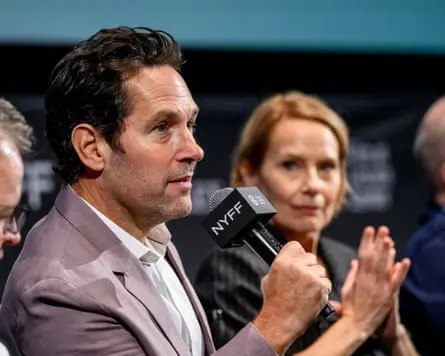
The film’s efficacy is bolstered by a meticulously cast ensemble of character actors. Paul Rudd anchors the narrative with awkward, earnest charm as the conference moderator striving for harmony. Paul Giamatti delivers a commanding performance as a curmudgeon from the Department of Energy, offering pragmatic pushback against environmental alarmism. John Turturro brings a touch of existential gravity and eccentric wit as a scientist who has stared directly into ecological ruin.
Meanwhile, Evan Peters portrays Rafe Pomerance—often described as the Paul Revere of climate change—channeling a fiery, boyish idealism that serves as the film’s moral compass. Tatiana Maslany disappears completely into the role of a nervous law professor wielding legalese like a shield, while supporting players like Amy Ryan, Zach Woods, and Mary Catherine Garrison round out an impeccably calibrated cast.

Chronology and Historical Context
To fully grasp the weight of A Statement, one must examine the geopolitical and scientific landscape of late 1980. The Carter administration was in its twilight weeks, and the impending Reagan presidency signaled a sharp ideological shift favoring deregulation, economic growth, and the expansion of domestic energy production.
- Early 1970s: Pioneering climate models begin to accurately project the long-term warming effects of carbon dioxide emissions, largely spearheaded by scientists like Syukuro Manabe and James Hansen.
- 1979: The National Academy of Sciences publishes the Charney Report, the first authoritative scientific consensus document warning that a doubling of atmospheric CO2 could lead to a global temperature increase of 1.5°C to 4.5°C.
- Late October 1980: Congress convenes the 20 experts at the Florida beachfront hotel to draft recommendations based on the Charney Report’s alarming implications.
- November 1980: Ronald Reagan defeats Jimmy Carter, shifting national political priorities away from environmental regulation and conservation initiatives.
- Present Day: Tom McCarthy adapts the historical record into A Statement, premiering at major fall film festivals to widespread critical acclaim.
Supporting Data and Scientific Realities
The urgency that permeated the 1980 conference room is validated by decades of subsequent data collection. According to historical records from the National Oceanic and Atmospheric Administration (NOAA) and the Scripps Institution of Oceanography, the concentration of atmospheric carbon dioxide in October 1980 hovered around 338 parts per million (ppm).
Fast forward to contemporary measurements, and global CO2 concentrations consistently exceed 420 ppm—a staggering increase that underscores the prescience of the scientists who gathered in Florida. Despite warnings issued more than four decades ago, global fossil fuel emissions have continued to rise, reinforcing the tragic irony of the conference’s failure to issue a unified warning to the incoming Reagan administration.
Institutional Responses and Critical Reception
Industry analysts and film critics have drawn stark contrasts between A Statement and other contemporary cinematic treatments of environmental catastrophe, such as Adam McKay’s satirical Don’t Look Up. Where McKay’s film relies on broad slapstick and cynical caricature, McCarthy’s work opts for grounded, empathetic realism.
Cultural commentators have praised the film for acknowledging that scientific facts alone are rarely sufficient to drive political action. As illustrated in the fictionalized nighttime interludes outside the formal conference sessions—where characters forge fragile personal bonds over drinks and late-night phone calls—human emotion, ego, and interpersonal dynamics ultimately dictate the trajectory of public policy.
Broader Impact and Implications
A Statement transcends its historical framing to offer a profound meditation on modern institutional inertia. By revisiting the exact moment when the United States had a clear opportunity to alter its energy trajectory, the film poses uncomfortable questions about collective responsibility and foresight.
The conference may have dissolved without producing the mandated statement, and history proceeded down a path of unchecked fossil fuel dependency. Yet, McCarthy’s cinematic postmortem provides a strange form of comfort. It reminds contemporary audiences that while systemic failure is often frustratingly human, the pursuit of truth and the earnest attempt to collaborate in the face of insurmountable odds remain defining characteristics of the human condition.