A Glimpse into Early 1980s Japanese Youth Culture
The early 1980s in Japan represented a fascinating period of economic prosperity juxtaposed with underlying social anxieties and a burgeoning youth counter-culture. While the nation was rapidly asserting itself as a global economic powerhouse, a segment of its youth grappled with feelings of alienation, societal pressures, and a search for identity outside conventional norms. This era saw the rise and solidification of distinct youth subcultures, most notably the bosozoku (motorcycle gangs) and the tsuppari and sukeban phenomena. Tsuppari referred to rebellious male and female youth who deliberately defied social conventions, often through distinctive appearances and anti-establishment attitudes. Sukeban, specifically, denoted female delinquent gangs, characterized by their modified school uniforms (often longer skirts, shaved eyebrows, and dyed hair), aggressive behavior, and a strong sense of internal solidarity. These groups became potent symbols of youthful defiance against perceived adult hypocrisy and rigid societal expectations.
"Blow the Night" serves as a vivid, albeit unromanticized, cinematic document of this specific cultural moment. It delves into the lives of these young people, exploring their motivations, their desperate search for connection, and their often destructive outlets for frustration. The film’s release in 1983 coincided with the peak of public fascination and concern regarding these delinquent subcultures, making it particularly resonant at the time. It offered a raw, unflinching look into a world that many adults struggled to comprehend, positioning itself not merely as entertainment but as a commentary on a societal fissure.
Chusei Sone’s Vision and the Birth of Film Workers
Chusei Sone, the visionary director behind "Blow the Night," had already carved a formidable reputation in Japanese cinema, particularly within the realm of genre films. Known for his prolific output, often working within the pinku eiga (pink film) genre, Sone was a master of exploiting societal taboos and pushing thematic boundaries. His earlier works were characterized by a blend of gritty realism, exploitation elements, and a keen eye for human psychology, albeit often within the confines of adult-oriented cinema.
The establishment of Film Workers in 1983 marked a significant turning point in Sone’s career. After years of working within established studio systems and genre constraints, the formation of his own production company signaled a desire for greater artistic autonomy and control over his projects. Film Workers was conceived as a vehicle to produce films that might not fit neatly into commercial categories, allowing Sone to pursue more personal and challenging narratives. "Blow the Night" became the inaugural feature under this new banner, demonstrating Sone’s commitment to exploring complex social themes with an unvarnished approach. This move allowed him to break free from some of the commercial pressures and expectations that typically accompanied genre filmmaking, enabling a more independent and experimental creative process. The co-writing credit with Reiko Nakata also suggests a collaborative approach to script development, potentially broadening the film’s perspective on youth delinquency.
The Authentic Core: Namie Takada and The Street Sliders
The most compelling aspect of "Blow the Night," and indeed a primary source of its lasting notoriety, lies in the audacious casting of Namie Takada. Takada was not a professional actress but a real-life delinquent schoolgirl, plucked from the very subculture the film sought to depict. This casting choice was a deliberate and calculated risk by Sone, aimed at injecting an unparalleled level of authenticity into the narrative. The promotional materials of the time leaned heavily into Takada’s actual background, detailing her reported history of smoking, thinner sniffing, reckless riding, fighting, and sexual misconduct. This strategy presented the film not merely as a fictional drama but as a "hard documentary-style drama" – a term designed to emphasize its raw, unflinching portrayal of a girl precariously balanced between childhood and the harsh realities of adulthood.
This non-professional casting strategy was not entirely new in Japanese cinema, with some directors occasionally employing non-actors for specific roles to enhance realism. However, Takada’s prominent role and the deliberate emphasis on her "real" background were particularly striking. Her presence on screen was intended to blur the lines between fiction and reality, giving the audience the impression of witnessing genuine experiences rather than a mere performance. This decision undoubtedly contributed to the film’s controversial reception but also cemented its reputation for daring realism.
Adding another layer of cultural authenticity and appeal was the integration of the rock band The Street Sliders. Formed in 1983, the same year the film was produced, The Street Sliders were rapidly gaining traction in the Japanese rock scene with their distinctive blend of blues-rock and raw, energetic performances. Their music, characterized by sharp guitar riffs and rebellious lyrics, resonated deeply with the disillusioned youth of the era. The band’s music and live performance sequences are prominently featured in "Blow the Night," linking the entire endeavor directly to the pulsating youth culture of the period. While the relationship between rock music and delinquency might appear somewhat uneasy, their presence underscored the film’s commitment to capturing the complete zeitgeist, where music often served as an anthem for rebellion and a communal outlet for pent-up frustrations. The Street Sliders’ involvement transcended a simple soundtrack; they became an integral part of the film’s texture, providing an auditory backdrop that mirrored the chaotic energy of its characters.
Namie’s Narrative: Drifting, Provocation, and Despair
The story of "Blow the Night" unfolds with the arrival of 15-year-old Namie Takada in a provincial city near Tokyo. Her physical appearance immediately sets her apart from her new middle school environment: frizzy red hair, shaved eyebrows, and an unusually long skirt – all visual markers of the sukeban identity. She is an outsider within the traditional school system, but her defiant demeanor and appearance allow her to be swiftly accepted by the local biker gangs, finding a sense of belonging among fellow outcasts.
From the outset, Namie’s existence is defined by a relentless cycle of drifting, provocation, and a flirtation with danger. Her days are punctuated by smoking, the dangerous act of sniffing thinner (a common form of substance abuse among delinquent youth at the time), engaging in violent confrontations with other girls, and navigating spaces where adults are conspicuously absent, demonstrably useless, or utterly incapable of comprehending the turmoil unfolding before them. This portrayal of adult helplessness is a recurring motif, highlighting the generational chasm.
Namie’s solitary world takes on an additional emotional dimension when she becomes drawn to Naoya Kido, a delinquent boy who embodies a similar spirit of defiance. Kido refuses to submit even after being brutally beaten by other students, his resilience mirroring Namie’s own. Their relationship, however, is far from an innocent romance. Instead, it is presented as another raw expression of impulse, profound loneliness, and the pervasive confusion that characterizes their adolescence. The bond is visceral and immediate, born out of shared alienation rather than tender affection.
The narrative takes a painful turn when Kido eventually abandons Namie, moving on to her younger sister, Natsuko. Namie’s reaction to this betrayal is depicted with harrowing intensity: she burns photographs of their time together, a symbolic destruction of memories, and presses burning cigarettes into her own wrist. This self-harm is a stark, visceral manifestation of her internal torment, perfectly capturing the film’s potent mixture of incandescent anger, emotional numbness, and an almost unbearable solitude. It underscores the profound vulnerability beneath her tough exterior and the desperate measures she takes to cope with abandonment.
Institutional Failure and the Collapse of Communication
Perhaps the most impressive and critically resonant aspect of "Blow the Night" is its sophisticated presentation of delinquency. It refutes the simplistic notion that youth rebellion is merely a moral failing on the part of the individual. Instead, the film masterfully frames it as a tragic consequence of a broader, systemic collapse in communication and responsibility within society.
The adult figures in Namie’s world are depicted as fundamentally inept and disengaged. Parents appear utterly lost, seemingly unaware of their children’s activities, motivations, or how to effectively intervene. Their presence is often peripheral, their attempts at guidance either absent or utterly futile. Teachers fare little better; they are frequently overwhelmed by the pervasive chaos within the school environment. Even when they summon the courage to respond, their words are depicted as either outdated, shallow, or utterly incapable of reaching the students. The film goes further, showing teachers resorting to physical violence out of frustration, or conversely, being paralyzed by fear, highlighting their own institutional helplessness and moral compromise.
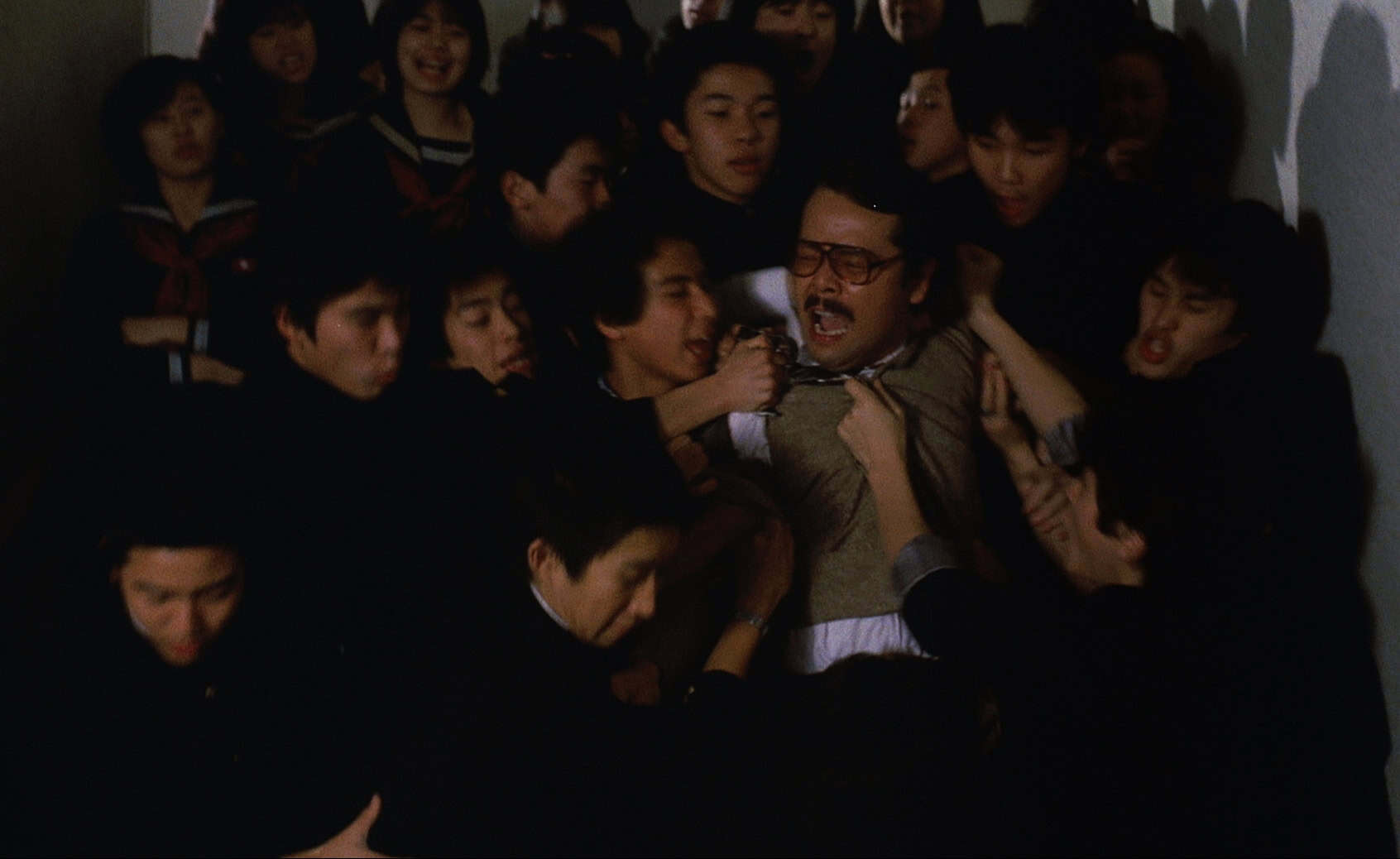
In this sense, "Blow the Night" transcends the typical delinquent drama to become a powerful indictment of institutional failure. It suggests that the rebellion of the youth is not an isolated phenomenon but a direct reaction to a vacuum of guidance, understanding, and effective authority. The inability of the adult world to connect with, discipline, or even comprehend the struggles of these adolescents creates an environment where delinquency flourishes as a desperate cry for attention and control.
The Climax: A Festival of Destruction
This theme of institutional breakdown reaches its explosive zenith in the film’s climax. What begins as a relatively minor classroom incident swiftly escalates into an all-out student revolt. The carefully constructed façade of order within the school crumbles entirely. Rock music, often a soundtrack to rebellion, blasts through the hallways, igniting the students’ collective rage. Hated teachers are attacked, barricades are hastily formed, and the school building itself is transformed into a chaotic battlefield.
For Namie, this escalating disorder is not merely an act of destruction; it is presented as the closest approximation to a "festival" she has ever experienced. It is a moment of profound, cathartic release where all the suppressed rage, boundless energy, and festering frustration that have defined her existence finally erupt in a torrent of anarchic exhilaration. The sequence is intentionally excessive, ugly, and utterly chaotic, yet it simultaneously reveals the strange, almost intoxicating thrill that the movie associates with acts of destruction. This climax serves as a powerful metaphor for the desperation of youth seeking an outlet, even if that outlet is self-destructive and violent. It is a raw expression of their desire to be seen, heard, and to exert some form of agency, however fleeting, in a world that has otherwise rendered them invisible and powerless.
An Uncomfortable Truth: Sone’s Detached Approach
"Blow the Night" is undeniably a deeply uncomfortable work, a characteristic that defines its enduring impact. Its scenes of thinner sniffing, graphic violence, casual sexual encounters, and young girls associating with older or unknown men are not merely difficult to watch due to their content but also because of the film’s steadfast refusal to soften them with conventional melodrama. Director Chusei Sone’s approach is remarkably dry and frequently detached, almost clinical. He deliberately avoids explicit moral judgments or emotional manipulation, allowing the viewer to observe the characters and their actions without being directly instructed on how to feel about them.
This stylistic choice imbues the work with a potent, almost documentary-like power. The absence of a clear moral compass or a redemptive arc forces the audience to confront the raw reality of the depicted events without the comfort of easy answers. However, this detachment also creates a profound sense of moral ambiguity that can be profoundly alienating for some viewers. The film doesn’t offer heroes or villains in a traditional sense, but rather individuals caught in a web of complex circumstances, making it a challenging yet intellectually stimulating viewing experience. It compels the audience to grapple with the uncomfortable truths it presents, rather than offering palatable resolutions.
A Time Capsule of Rebellion: Tsuppari and Sukeban Culture
Beyond its narrative and thematic depth, "Blow the Night" functions as an invaluable cultural artifact – a vivid product of its specific historical era. The fashion choices, the behavioral patterns, and the distinct language employed by the delinquent students firmly situate the film within the burgeoning tsuppari and sukeban culture of early 1980s Japan. This historical texture is one of its most fascinating and enduring aspects for contemporary audiences.
What once appeared immediate and utterly contemporary to its initial viewers – the exaggerated hairstyles, the long skirts, the defiant stances, the specific slang – now often looks dirty, loud, and abrasive from a modern perspective. However, this very temporal distance contributes significantly to its current fascination. The film meticulously captures a specific social and cultural atmosphere that has largely faded from public consciousness, offering a unique window into a bygone era. It vividly illustrates how youth identities during this period were intricately shaped by a potent blend of visual image, popular music, acts of rebellion, and the collective performance of group affiliation. It is a sociological snapshot, revealing the intricate ways young people constructed their identities in defiance of mainstream society, utilizing fashion and behavior as powerful statements of nonconformity.
Artistic Merit: Performance, Cinematography, and Editing
Namie Takada’s central performance is pivotal to the film’s authentic impact. She does not deliver a conventional, polished acting performance, and this intentional rawness is precisely the point. Her screen presence is characterized by its unvarnished quality – raw, often awkward, fiercely defiant, and at times strangely blank. This gives the profound impression of someone not merely acting out delinquency but rather embodying and carrying its weight within her. This remarkable authenticity lends the most intense scenes a visceral shock that a conventionally trained actress might not have achieved with the same degree of impact. Providing a crucial narrative and emotional contrast is Kazumi Kawai, who portrays a more ordinary Tokyo schoolgirl. Her presence helps to underscore the vast chasm between everyday adolescence and the volatile, dangerous world that Namie inhabits, allowing the viewer to gauge the extraordinary nature of Namie’s existence.
Masaru Mori’s cinematography plays a crucial role in shaping the film’s gritty realism, making strong and deliberate use of long takes. This technique allows scenes to unfold with a rough, almost observational quality, immersing the viewer in the unfolding drama without excessive cuts or stylistic embellishment. The camera often appears less concerned with aesthetically beautifying the characters or their environment than with intimately trapping them within the claustrophobic confines of classrooms, the harsh realities of city streets, the sweaty energy of live music venues, and cramped interior spaces. The cumulative result is a visual style that feels dry, restless, and at times abrasive, perfectly mirroring the volatile and uncomfortable world inhabited by the characters.
Complementing this visual approach, Shinji Yamada’s editing contributes significantly to the film’s unique rhythm. His cuts help create the powerful impression of a life constantly oscillating between moments of suffocating boredom and sudden, explosive outbursts of energy. The strategic placement of music sequences, particularly those featuring The Street Sliders, alongside scenes of intense delinquent behavior, gives the movie a jagged, unpredictable rhythm that mirrors the erratic emotional landscape of its young protagonists. The sound design, including the pervasive rock music, is among the most memorable elements, lending the film an undeniable energy and a direct connection to the rebellious rock culture of the era. While at times the movie risks becoming almost a showcase for the band, slightly altering the focus of the drama, this is arguably not a flaw but an essential characteristic. The potent combination of delinquency and rock music is fundamental to the film’s identity, even if the two cultural expressions do not always appear perfectly aligned.
Legacy and Enduring Impact
"Blow the Night" is not an easy or cleanly satisfying movie experience. It is messy, noisy, frequently unpleasant, occasionally crude, and often frustrating in its refusal to offer straightforward resolutions. Nevertheless, it remains a profoundly fascinating work, functioning both as a searing delinquent drama and as an invaluable, unvarnished snapshot of early 1980s Japanese youth culture.
Chusei Sone steadfastly refuses to romanticize Namie’s world. There is no attempt to soften the edges of her harsh reality or imbue her actions with undue heroism. Crucially, however, he also refrains from simply condemning it. Instead, Sone meticulously presents a bleak and unforgiving landscape where young people desperately search for release – whether through acts of violence, fleeting sexual encounters, the catharsis of loud music, or the self-destructive spiral of substance abuse. Throughout this, the adult figures who are ostensibly meant to guide them stand by helplessly, utterly incapable of intervention or understanding.
The result is a raw, memorable, and ultimately powerful movie. Its enduring impact and critical relevance lie precisely in its uncompromising refusal to conform to conventional cinematic expectations or to become respectable. "Blow the Night" challenges its audience, forcing them to confront the uncomfortable truths of youth alienation and societal failure, cementing its place as a significant, albeit challenging, piece of Japanese cinematic history. Its depiction of an unvarnished reality continues to resonate, offering a potent, unblinking look at a segment of society often overlooked or misrepresented.