The promotional campaign for Boots Riley’s highly anticipated second feature film, I Love Boosters, has entered a new phase with the release of a specialized technical featurette titled "Big Idea to the Big Screen." Produced in collaboration between Panavision and the film’s distributor, NEON, the video offers an exhaustive look into the meticulous craft behind the production. The featurette serves as a strategic piece of marketing, emphasizing the film’s reliance on practical effects, custom-engineered optics, and a distinct visual language designed specifically for theatrical exhibition. Scheduled for a wide release on May 22, 2026, the film follows a group of professional shoplifters who target a high-fashion mogul, blending Riley’s signature surrealist social commentary with a high-stakes heist narrative.
The Technical Philosophy of the Big Screen Experience
The core thesis of the newly released featurette is established early by Riley, who asserts the necessity of creating cinema that demands a large-format environment. This sentiment aligns with a growing movement among contemporary auteurs to differentiate theatrical releases from the burgeoning volume of direct-to-streaming content. According to the featurette, the production of I Love Boosters utilized a combination of traditional and experimental techniques to achieve its "zany" and "funky" aesthetic.
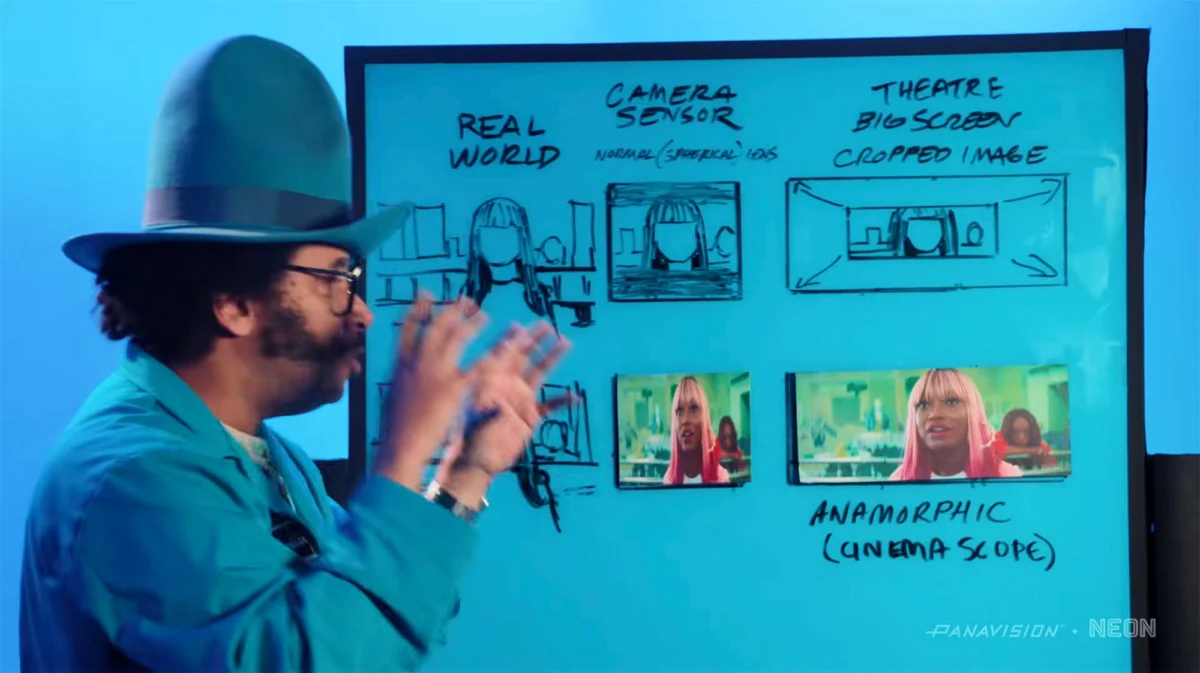
Central to this visual identity is the work of cinematographer Natasha Braier, ASC, and Dan Sasaki, Panavision’s Senior Vice President of Optical Engineering. The collaboration involved the development of custom prototype lenses built specifically for the film. These lenses were designed to introduce specific "imperfections"—flares, textures, and chromatic aberrations—that deviate from the clinical sharpness of modern digital sensors. By utilizing anamorphic cinematography, the team aimed to create a wider, more immersive field of view that maximizes the real estate of theater screens.

Braier, known for her evocative work on The Neon Demon and Honey Boy, explains in the video how the lighting and color palettes were calibrated to complement these custom optics. The use of saturated colors and high-contrast lighting schemes is intended to mirror the vibrant, chaotic world of the "boosters" while providing a sharp contrast to the sterile, high-fashion environments they infiltrate.
Production Design and Practical Artistry
While the cinematography focuses on the capture of light, the physical world of I Love Boosters was constructed through a mix of hand-drawn storyboards and miniature sets. Production designer Christopher Glass, whose previous credits include large-scale world-building in projects like The Jungle Book, worked closely with Riley to translate the director’s "mind palace" into tangible environments.
The decision to use miniatures is particularly notable in an era dominated by Computer Generated Imagery (CGI). Riley and Glass argue that miniatures provide a sense of tactile reality and "weight" that digital environments often lack. This approach extends to the film’s costumes and physical props, which are essential to a plot centered on the fashion industry. The featurette highlights how the textures of the stolen garments and the architectural rigidity of the fashion maven’s headquarters were designed to create a visual conflict that mirrors the narrative’s class-based tensions.
Chronology of Development and Release
The journey of I Love Boosters began shortly after the critical success of Riley’s 2018 debut, Sorry to Bother You, and his subsequent 2023 Prime Video series, I’m a Virgo. Principal photography took place primarily in Atlanta, Georgia, a hub for major studio productions that provided the logistical infrastructure necessary for the film’s complex set pieces.

The film’s public timeline reached a significant milestone in March 2026, when it premiered at the SXSW Film Festival. The festival circuit reception was instrumental in building the "hype" that NEON is currently leveraging. Critics at the premiere noted the film’s technical ambition, which the current featurette now seeks to quantify for a general audience. Following the festival debut, the marketing campaign shifted toward the theatrical experience, culminating in the upcoming May 22nd release date. This timing positions I Love Boosters as a primary independent alternative to the traditional blockbusters that dominate the early summer movie season.
Defining the "Booster" Culture
A significant portion of the film’s identity is rooted in the subculture from which it takes its name. As defined within the film’s promotional materials, a "booster" is an individual who steals high-end clothing from retail stores to sell them at discounted prices within their community. Riley describes this act as a form of "community service," a perspective that frames the criminal activity through a lens of economic redistribution.
This thematic framework is a hallmark of Riley’s work, which frequently explores the intersections of labor, race, and capitalism. By centering the story on a "ragtag group of shoplifters," the film sets up a David-versus-Goliath dynamic against a "cutthroat fashion maven." The narrative is expected to use the fashion industry as a microcosm for broader societal critiques, much like how Sorry to Bother You utilized the telemarketing industry to examine corporate dehumanization.
The Ensemble Cast and Creative Team
The film features a diverse ensemble of high-profile talent, many of whom have established reputations for participating in genre-bending or socially conscious projects. Keke Palmer leads the cast, continuing a career trajectory that has increasingly focused on bold, auteur-driven cinema following her acclaimed performance in Jordan Peele’s Nope. She is joined by LaKeith Stanfield, who previously starred in Riley’s Sorry to Bother You, marking a reunion between the actor and director.

The supporting cast includes:
- Naomi Ackie: Known for her roles in Whitney Houston: I Wanna Dance with Somebody and Star Wars: The Rise of Skywalker.
- Demi Moore: Who recently saw a career resurgence with the body-horror hit The Substance.
- Don Cheadle: A veteran actor whose presence adds significant dramatic weight to the ensemble.
- Eiza González and Will Poulter: Bringing international appeal and experience in high-octane genre films.
- Taylour Paige and Poppy Liu: Rising stars known for their work in contemporary indie hits like Zola and Hacks.
The production is backed by a seasoned team including Allison Rose Carter, Jon Read, Aaron Ryder, and Andrew Swett. The involvement of NEON as a distributor is also a key factor; the studio has become synonymous with elevated independent cinema, having successfully handled the domestic releases of Parasite, Anatomy of a Fall, and Longlegs.
Industry Implications: The Rise of the "Filmmaking Breakdown"
The release of this featurette is part of a broader industry trend where studios utilize technical transparency as a marketing tool. This strategy was notably employed by Ryan Coogler for his 2025 film Sinners and by the directors of the upcoming Project Hail Mary. By showcasing the specific film formats, projection options, and lens choices, studios are attempting to educate the audience on the "value proposition" of a movie theater ticket.
In an age where home viewing technology is increasingly sophisticated, the "Big Screen" argument is no longer just about size; it is about the specific aesthetic qualities—such as anamorphic depth and custom lens textures—that cannot be replicated on a standard television or smartphone. Boots Riley’s featurette serves as a manifesto for this movement, arguing that the technical choices made during production are inextricable from the emotional and narrative impact of the film.

Market Analysis and Expectations
Industry analysts suggest that I Love Boosters is positioned to be one of the most significant independent releases of 2026. The combination of Riley’s established cult following, a star-studded cast, and the backing of NEON creates a strong foundation for both critical and commercial success.
The decision to premiere at SXSW rather than a more traditional "prestige" festival like Cannes or Venice suggests a strategy aimed at a younger, more genre-focused demographic. This audience is traditionally more receptive to Riley’s blend of comedy, social commentary, and visual experimentation. Furthermore, the focus on the "booster" subculture taps into contemporary conversations regarding economic inequality and the ethics of retail, potentially providing the film with a level of cultural relevancy that transcends the screen.
As the May 22nd release date approaches, the "Big Idea to the Big Screen" featurette stands as a testament to the complexity of modern independent filmmaking. It highlights a shift away from "content" toward "cinema," emphasizing that for creators like Boots Riley, the medium—and the specific hardware used to capture it—remains a vital part of the message. Whether this technical rigor translates into box office success remains to be seen, but the groundwork laid by Panavision and NEON suggests a film that is as much a feat of engineering as it is a work of narrative fiction.