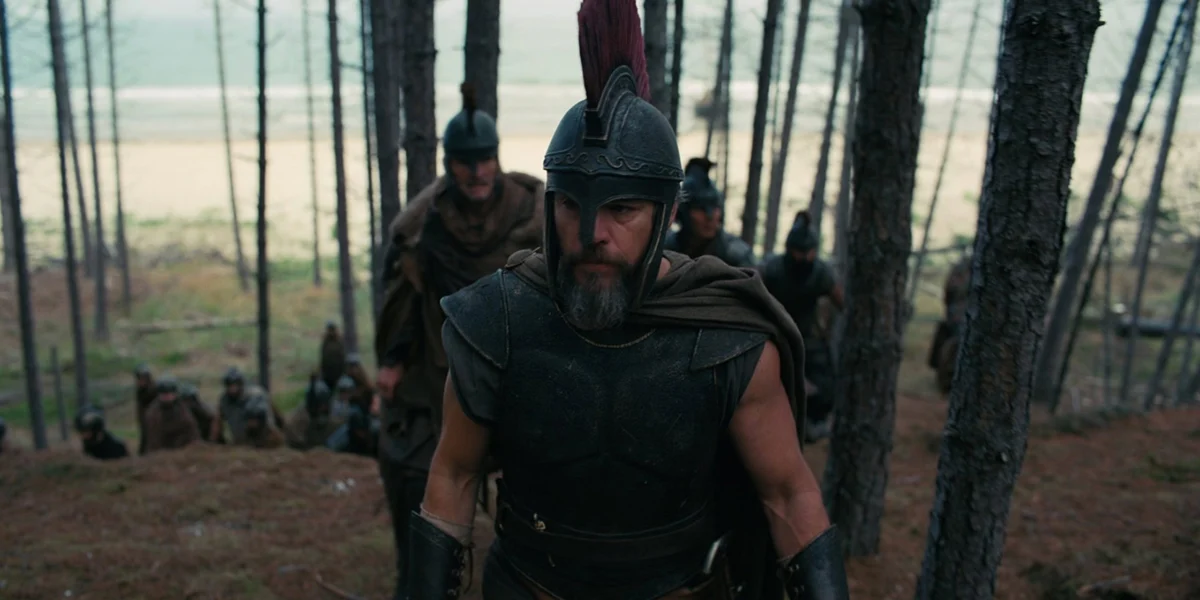
Following the historic success of the 2023 biographical thriller Oppenheimer, which earned over $975 million at the global box office and secured multiple Academy Awards, director Christopher Nolan has transitioned from the dawn of the atomic age to the foundations of Western literature. His latest feature, The Odyssey, represents a $250 million gamble by Universal Pictures, marking one of the most expensive and ambitious productions in the history of the studio. Written and directed by Nolan and produced alongside his longtime partner Emma Thomas, the film is a 173-minute epic that reimagines Homer’s ancient Greek poem through the lens of grounded realism and nonlinear narrative structure.
The production serves as a technical milestone, having been shot entirely with newly developed IMAX cameras. This allows the film to maintain a consistent 1.43:1 aspect ratio throughout its duration, eliminating the shifting formats that characterized Nolan’s previous works like The Dark Knight and Interstellar. By leveraging the immense "goodwill" generated by Oppenheimer, Nolan has secured the creative freedom to adapt a story often deemed "unfilmable" due to its scale, mythological elements, and sprawling chronology.
Narrative Structure and Plot Overview
The Odyssey follows King Odysseus, portrayed by Matt Damon, as he attempts to return to his home in Ithaca following the decade-long Trojan War. While the source material is nearly three millennia old, Nolan’s adaptation focuses heavily on the psychological toll of warfare and the existential dread of a man who no longer recognizes the world he fought to protect. The film utilizes a fragmented timeline, jumping between three primary perspectives: Odysseus’s treacherous voyage across the Mediterranean, his son Telemachus’s (Tom Holland) coming-of-age in a besieged Ithaca, and various flashbacks to the Trojan War that contextualize Odysseus’s moral failings.
In Ithaca, Queen Penelope (Anne Hathaway) and Telemachus struggle to maintain order as a group of aggressive suitors, led by the opportunistic Antinous (Robert Pattinson), attempt to seize the throne. The narrative explores the tension between Penelope’s unwavering hope and the pragmatic reality of a kingdom that has been without a leader for nearly twenty years. The film’s third act converges these threads into a high-stakes climax that emphasizes catharsis and the restoration of order, albeit at a significant human cost.
Technical Execution and Practical Filmmaking
True to his established directorial style, Nolan eschewed traditional digital effects in favor of practical solutions. The production commissioned the construction of a fully functioning Bronze Age-style ship, which was utilized for the majority of the sea-bound sequences. This commitment to "in-camera" storytelling extends to the depiction of the story’s more fantastical elements. Rather than utilizing high-fantasy CGI for monsters like the Cyclops or the sea creature Scylla, the production utilized a combination of animatronics, perspective photography, and intricate makeup design.
Cinematographer Hoyte van Hoytema, a frequent Nolan collaborator, employed a visual palette that emphasizes the harshness of the natural world. While some early screenings have drawn comparisons to the shadowy, visceral action of Batman Begins, the use of natural light and practical environments aims to immerse the audience in the physical reality of the Mediterranean. However, the film’s "pragmatic" approach to mythology has sparked debate among purists; for instance, the Sirens are depicted through haunting sound design and psychological manipulation rather than literal avian-human hybrids.
Chronology of Production and Release
The development of The Odyssey followed a specific timeline that highlights the film’s rapid ascent from concept to screen:
- Late 2023: Following the critical peak of Oppenheimer, Nolan begins drafting a screenplay focused on the themes of "survivor’s guilt" and "the burden of leadership" within a mythological framework.
- Early 2024: Universal Pictures greenlights the project with a $250 million budget, the largest ever granted to a Nolan-directed film. Casting begins for a massive ensemble.
- Late 2024 – Mid 2025: Principal photography takes place across various Mediterranean locations, including coastal regions of Greece and Malta, utilizing specialized IMAX rigs.
- Early 2026: The film undergoes an extensive post-production phase focused on Ludwig Göransson’s score and complex sound mixing.
- Summer 2026: The Odyssey premieres globally, marketed as a "theatrical event" designed specifically for large-format screens.
The Ensemble Cast and Character Analysis
The Odyssey features one of the most high-profile ensembles in recent cinematic history. Matt Damon’s Odysseus is characterized not as an invincible warrior, but as a man suffering from profound PTSD. His performance has been noted for its vulnerability, echoing the "masculine yet broken" archetypes seen in historical epics like Gladiator.
Supporting performances provide the film’s moral and thematic weight:
- Tom Holland (Telemachus): Holland’s role is a significant departure from his work in the Marvel Cinematic Universe, offering a mature portrayal of a prince forced to navigate political treachery.
- Anne Hathaway (Penelope): Hathaway provides the emotional core of the film, depicting Penelope as a strategist rather than a passive victim.
- Lupita Nyong’o (Helen of Troy/Clytemnestra): Nyong’o appears in a dual role that explores the "original sin" of the Trojan War. Her casting generated significant online discourse regarding historical accuracy, though scholars have noted that "The Odyssey" is a work of myth rather than a historical record.
- John Leguizamo (Eumaeus): Representing the common man’s loyalty, Leguizamo’s performance has been highlighted as a standout for its warmth and adherence to the film’s central philosophical themes.
- Robert Pattinson (Antinous): Pattinson plays the primary antagonist with a "calculated restraint," serving as a foil to Odysseus’s rugged leadership.
Philosophical Underpinnings: Zeus’ Law and Murphy’s Law
A recurring thematic element in the film is the concept of "Zeus’ Law," or Xenia—the ancient Greek custom of hospitality. In Nolan’s interpretation, this law serves as a metaphor for the social contracts that hold civilization together. The violation of this law by the suitors in Ithaca and by Odysseus’s own men during their journey leads to what the film frames as "divine punishment" or the "inevitable collapse of order."
This mirrors Nolan’s previous exploration of "Murphy’s Law" in Interstellar. While Interstellar suggested that "whatever can happen, will happen," The Odyssey asks whether humanity’s destruction is a result of fate or a gradual abandonment of moral principles. The film posits that the deception of the Trojan Horse changed the world forever, ending an era of trust and ushering in a world defined by fear and survivalism.
Industry Implications and Financial Data
The release of The Odyssey is a significant litmus test for the viability of the big-budget "prestige epic." With a $250 million production budget and an estimated $100 million marketing spend, the film requires a global box office return of at least $700–$800 million to reach break-even status.
Industry analysts suggest that Universal’s investment is based on the "Nolan Brand," which has consistently proven that audiences will seek out intellectually demanding content if it is presented as a visual spectacle. The film’s 173-minute runtime limits the number of daily screenings, a factor that previously affected the box office trajectory of films like Killers of the Flower Moon. However, the exclusive IMAX 70mm engagements are expected to drive high per-screen averages, similar to the "event" status of Oppenheimer.
Critical and Official Responses
Official statements from Universal Pictures have emphasized the film’s role in "preserving the theatrical experience." Donna Langley, Chairman of NBCUniversal Studio Group, remarked during the film’s press junket that Nolan’s commitment to practical filmmaking "reminds the world why the cinema remains the ultimate venue for storytelling."
Initial critical reactions have been largely positive, praising the film’s "thematic richness" and "jaw-dropping craft," though some reviewers have noted that the film’s dedication to realism occasionally clashes with the inherent "magic" of the source material. The decision to use American accents and contemporary dialogue (such as the use of the word "dad") has been a point of contention among some critics, though others argue it makes the ancient text more accessible to a 2026 audience.
Broader Impact on Modern Cinema
The Odyssey stands as a culmination of Christopher Nolan’s career-long fascinations: the malleability of time, the weight of memory, and the consequences of monumental decisions. By stripping away the "sword-and-sandal" clichés often associated with the genre, Nolan has created a film that functions as both a blockbuster and an introspective character study.
The film’s success or failure will likely dictate the future of high-budget adaptations of classical literature. If The Odyssey achieves financial success comparable to Nolan’s previous works, it may signal a shift away from franchise-based "cinematic universes" and toward standalone, auteur-driven epics. Regardless of its final box office tally, the film has already established itself as a vital standout in the contemporary cinematic landscape, reinforcing Christopher Nolan’s position as a director capable of commanding the world’s attention through the sheer scale of his vision.