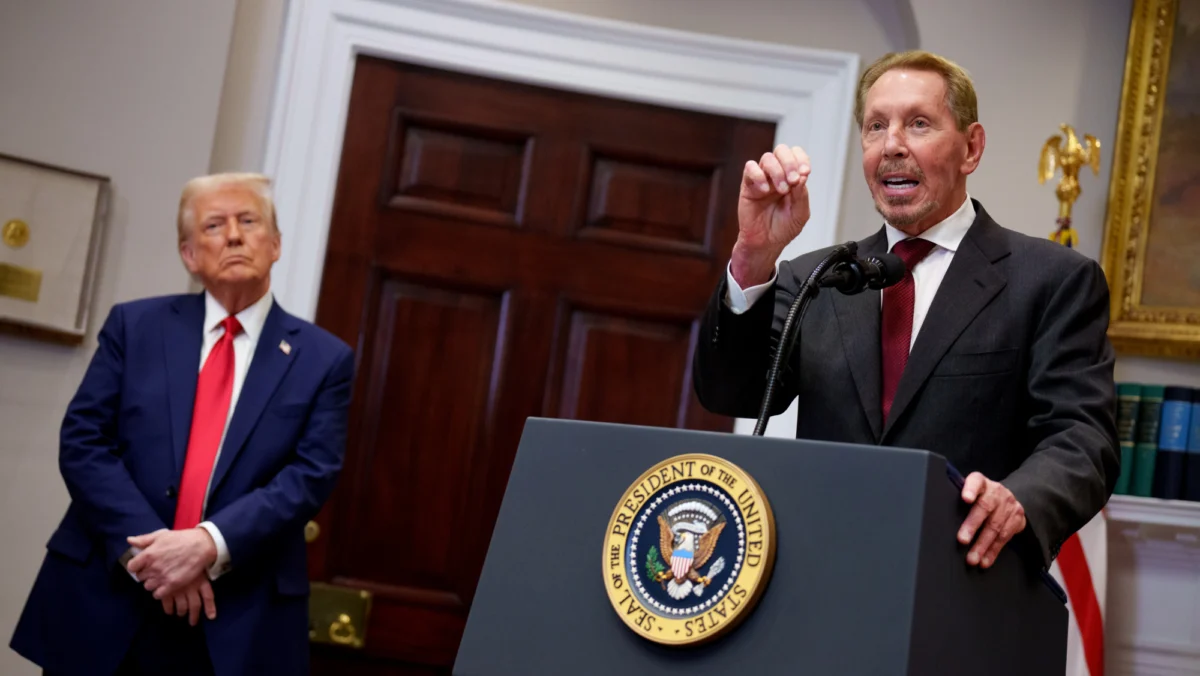
A group of Paramount Global shareholders has filed a significant lawsuit in the Delaware Chancery Court, seeking to halt the company’s ambitious bid to acquire Warner Bros. Discovery. The legal action, the fourth of its kind, levels explosive allegations against David Ellison, his father, Oracle co-founder Larry Ellison, and several members of the Paramount Board of Directors. At the heart of the complaint is the claim that the Ellisons orchestrated an illegal "quid pro quo" arrangement with President Donald Trump to secure regulatory approval for the massive media consolidation, potentially exposing the company to unprecedented legal and financial risks.
The lawsuit alleges that the Ellisons promised sweeping editorial changes at CNN—one of Warner Bros. Discovery’s crown jewels—as a condition for the administration’s blessing of the merger. Furthermore, the investors point to a series of financial transactions they characterize as thinly veiled political payoffs, including a $16 million settlement for a lawsuit filed by the President against CBS and an alleged commitment of $20 million in free advertising for conservative causes.
The Allegations of Political Interference and Fiduciary Breach
The complaint filed on Tuesday paints a picture of a merger process compromised by personal political interests rather than the pursuit of shareholder value. According to the plaintiffs, the Ellisons utilized their acquisition of Paramount Global as a platform to curry favor with the executive branch. The lawsuit specifically names David Ellison, the CEO of Skydance Media, and Larry Ellison, whose financial backing was instrumental in Skydance’s takeover of Paramount earlier this year.
"The Ellisons’ actions not only harm the reputations of the news outlets they currently own, which are hemorrhaging viewers, but they are latent liabilities waiting to be triggered by a future administration," the complaint states. The plaintiffs argue that by involving the company in partisan political maneuvers, the board has committed a breach of fiduciary duty, creating "enormous financial and legal risk" for the entity.
Central to the shareholders’ argument is the assertion that the Ellisons promised to remake CNN in a more conservative image to satisfy the President’s long-standing grievances with the network. This alleged agreement, the lawsuit claims, was a primary factor in the administration’s willingness to remove regulatory barriers that might otherwise have stymied a merger of this magnitude.
The $16 Million Settlement and the "Side Deal" Controversy
The timeline of the alleged quid pro quo centers around a near-midnight announcement on July 1, 2024. At that time, Paramount Global disclosed it would pay $16 million to settle a lawsuit brought by President Trump. The original litigation stemmed from an interview conducted by the CBS news program 60 Minutes with Kamala Harris, which the President alleged had been deceptively edited.
While Paramount framed the payment as a standard resolution to a legal dispute, the shareholder lawsuit characterizes it as a "payoff" for regulatory cooperation. The complaint also highlights reports of a "side deal" involving up to $20 million in programming and advertising support for conservative causes. Although Paramount has publicly denied knowledge of such terms, the lawsuit notes that the President himself later claimed to have received millions in advertising value from the "new owners" of the studio.
Mary Thomas, a lead attorney for the investors, wrote in the complaint: "After receiving regulatory approval, the Ellisons proceeded to remake CBS in the President’s image, bought properties he enjoyed, and even hosted events to honor him. This helped the Ellisons, but it appears to have hurt Paramount and its media outlets."
Regulatory Scrutiny and the Role of the FCC
The lawsuit arrives amid deepening scrutiny of the Federal Communications Commission (FCC) and its oversight of the Paramount-Skydance deal. Recent reports from investigative outlets like ProPublica have highlighted potential ethical lapses within the commission. Specifically, the reports allege that FCC Chairman Brendan Carr and Republican Commissioner Olivia Trusty received gifts from Paramount, including high-value tickets to the Kennedy Center Honors, a prestigious event televised by CBS.
The FCC has played a pivotal role in the studio’s recent history, having already signed off on the transfer of broadcast licenses required for Skydance’s acquisition of Paramount Global. Currently, the commission is reviewing a request that would allow Gulf sovereign wealth funds to hold a 49.5 percent stake in the combined Paramount-Warner Bros. Discovery entity. While these funds would reportedly lack governance rights, the high level of foreign investment in a primary American news and entertainment conglomerate has raised national security and regulatory concerns.
The shareholders argue that the appearance of impropriety regarding the FCC gifts, combined with the alleged political deals, makes the merger a target for future congressional investigations and Department of Justice probes, particularly under a different administration.
Operational Decline and Talent Exodus at CBS News
Beyond the legal and regulatory risks, the lawsuit highlights a sharp decline in the performance of Paramount’s existing media assets. The complaint alleges that the editorial shifts implemented by the Ellisons have alienated the core audience of CBS News.
According to data cited in the filing, CBS News is currently experiencing its lowest ratings in 25 years. The lawsuit attributes this decline to a perceived loss of journalistic independence and a pivot toward coverage that mirrors the President’s political agenda. This "remaking" of the network has reportedly triggered an exodus of top-tier journalistic talent, further weakening the brand’s competitive position in the broadcast news landscape.
The plaintiffs contend that if similar changes are forced upon CNN following a merger with Warner Bros. Discovery, the resulting damage to the network’s credibility and market share could be catastrophic for shareholders.
A Growing Coalition of Opposition
This shareholder lawsuit is not the only legal hurdle facing the Paramount-Warner Bros. Discovery merger. It follows a wave of litigation and formal opposition from various sectors:
- State Attorneys General: A coalition of 12 state attorneys general has sued to block the merger, citing antitrust concerns and the potential for reduced competition in the media market.
- The Writers Guild of America (WGA): The union representing screenwriters has voiced strong opposition, arguing that further consolidation in the industry will lead to fewer opportunities for creators and lower wages.
- Paramount+ Subscribers: A separate class-action lawsuit from streaming subscribers alleges that the merger will lead to increased subscription costs and a reduction in content variety.
The cumulative weight of these legal challenges suggests that even if the Ellisons maintain the support of the current administration, the path to a completed merger remains fraught with obstacles.
Chronology of the Merger Bid
- Early 2024: Skydance Media, led by David Ellison and backed by Larry Ellison, begins negotiations to acquire a controlling stake in Paramount Global from Shari Redstone’s National Amusements.
- May 2024: Reports surface that the Ellisons are eyeing a secondary deal to merge the newly acquired Paramount with Warner Bros. Discovery to create a "mega-studio."
- July 1, 2024: Paramount announces a $16 million settlement with President Trump regarding the 60 Minutes lawsuit. Reports of a $20 million "side deal" for conservative advertising emerge.
- August 2024: The FCC approves the transfer of broadcast licenses to Skydance, effectively greenlighting the Paramount acquisition.
- September 2024: ProPublica reports on gifts given to FCC commissioners by Paramount executives.
- October 2024: Ratings for CBS News hit a 25-year low amid reports of internal friction over editorial direction.
- Late 2024: Multiple lawsuits, including the latest Delaware Chancery Court filing, are consolidated as the merger bid enters a critical regulatory review phase.
Broader Impact and Industry Implications
The outcome of this lawsuit could have far-reaching implications for the future of media consolidation and the intersection of corporate interests and political power. If the Delaware court finds merit in the shareholders’ claims of a "quid pro quo," it could establish a landmark precedent regarding the limits of executive influence in private corporate mergers.
For the media industry, the case highlights the increasing volatility of news organizations as they become pawns in larger corporate and political strategies. The alleged "remaking" of CBS and the potential transformation of CNN represent a shift in the traditional "church and state" separation between newsrooms and corporate owners.
Financial analysts suggest that the ongoing litigation may force Paramount to reconsider the terms of the Warner Bros. Discovery bid or perhaps abandon it entirely if the legal costs and regulatory risks become too burdensome. As of Wednesday morning, Paramount Global has not issued a formal response to the latest allegations, though the company has previously maintained that all its transactions and settlements have been conducted transparently and in accordance with the law.
As the Delaware Chancery Court prepares to hear arguments, the eyes of the media world remain fixed on the Ellisons, whose vision for a consolidated entertainment empire now faces its most significant challenge yet.