The burgeoning landscape of low-budget filmmaking, particularly within the science fiction genre, is currently experiencing a significant surge in attention. This phenomenon is underscored by the recent prominence of films like Backrooms and Obsession, which have ignited robust discussions about the financial realities of movie production, the enduring commercial viability of horror, and the often-opaque distribution of profits within the industry. While the definition of "low budget" remains inherently subjective, the success of projects with reported budgets of $10 million (Backrooms) and $750,000 (Obsession) respectively, prompts a closer examination of what truly constitutes an accessible entry point for aspiring filmmakers.
This broader conversation about budget constraints is particularly relevant when considering films born from necessity, rather than strategic investment. Many filmmakers who achieve breakout success do not begin with Hollywood’s perception of a modest budget. For instance, Curry Barker, director of Obsession, previously created a slasher film for a mere few hundred dollars. Similarly, Kane Parsons, the director behind Backrooms, cultivated an audience and honed his craft by producing an entire series on YouTube before attracting mainstream attention. These examples highlight a crucial point: the ingenuity and creative output of filmmakers operating with minimal resources, often limited to basic camera equipment and editing software, are frequently overlooked in traditional industry discourse. The narrative of these nascent creators often begins with resourcefulness, leveraging whatever tools are at hand, sometimes even extending to the use of personal vehicles.
Brothers Elliot and Zander Weaver, hailing from Birmingham, England, embody this spirit of independent creation. Their cinematic journey began in childhood, evolving into a serious professional pursuit after completing their secondary education. Their artistic aspirations lean towards ambitious, earnest science fiction, citing influential works like E.T. (1982) as formative. However, the production demands of such grand narratives typically necessitate substantial financial backing, presenting a stark contrast to the more easily achievable aesthetics of found footage or slasher films, which often thrive on minimal budgets.
The Weavers initially attempted to bring their script for Encounter to fruition, a process that spanned several years. The inherent risk associated with investing millions of pounds in unknown filmmakers, however, proved to be a significant hurdle. During this period of seeking funding, they established a small production company and gained valuable experience producing science and history documentaries for television. The constant refrain of being told they needed to prove their feature film capabilities before securing funding for a larger project led them to re-evaluate their approach. Inspired by the pioneering low-budget success of Robert Rodriguez’s El Mariachi (1992), which was made for a few thousand dollars with an amateur cast, the Weavers decided to embark on a project that aligned with their immediate resource limitations.
Their brainstorming process for Cosmos centered on maximizing the assets they possessed. These included a Blackmagic Pocket Cinema Camera capable of 1080p resolution, a mother with experience in television hair and makeup, an array of computer equipment, their father’s station wagon, and a friend’s garage that could be transformed into a makeshift soundstage. Crucially, the production was underpinned by an immense reservoir of patience, a prerequisite for any film made with virtually no financial capital.
The operational crew for Cosmos was remarkably lean, comprising only five individuals: the Weaver brothers, their mother Lesley for hair and makeup, composer Chris Davey for the soundtrack, and two credited production assistants. Their father had intended to contribute but sadly passed away before filming commenced. This core team was responsible for every facet of production. Elliot and Zander Weaver undertook the entirety of the writing, storyboarding, set construction, directing, filming, editing, color grading, sound design, and visual effects. While this necessity-driven approach stemmed from their inability to afford external hires, even among industry professionals they knew, it evolved into an invaluable, comprehensive learning experience across all aspects of filmmaking.
This distributed workload, while fostering skill development, naturally led to certain production inefficiencies. For instance, a significant portion of the film is set within a car parked in a wooded area at night. To circumvent the logistical challenges of shooting in such an environment, they utilized a friend’s garage as a daytime soundstage for the interior car scenes. However, since the car was their family vehicle, they were required to drive it to and from the garage daily, necessitating the daily setup and breakdown of the interior set.
Prior to viewing Cosmos, the reviewer was unaware of these behind-the-scenes realities. Their initial research was hampered by the film’s title, which makes online searches challenging. The knowledge of the film’s micro-budget origins might have influenced their viewing experience, though their critiques focused on narrative shortcomings rather than production quality, which they found to be surprisingly clean and professional.
The Premise of Cosmos
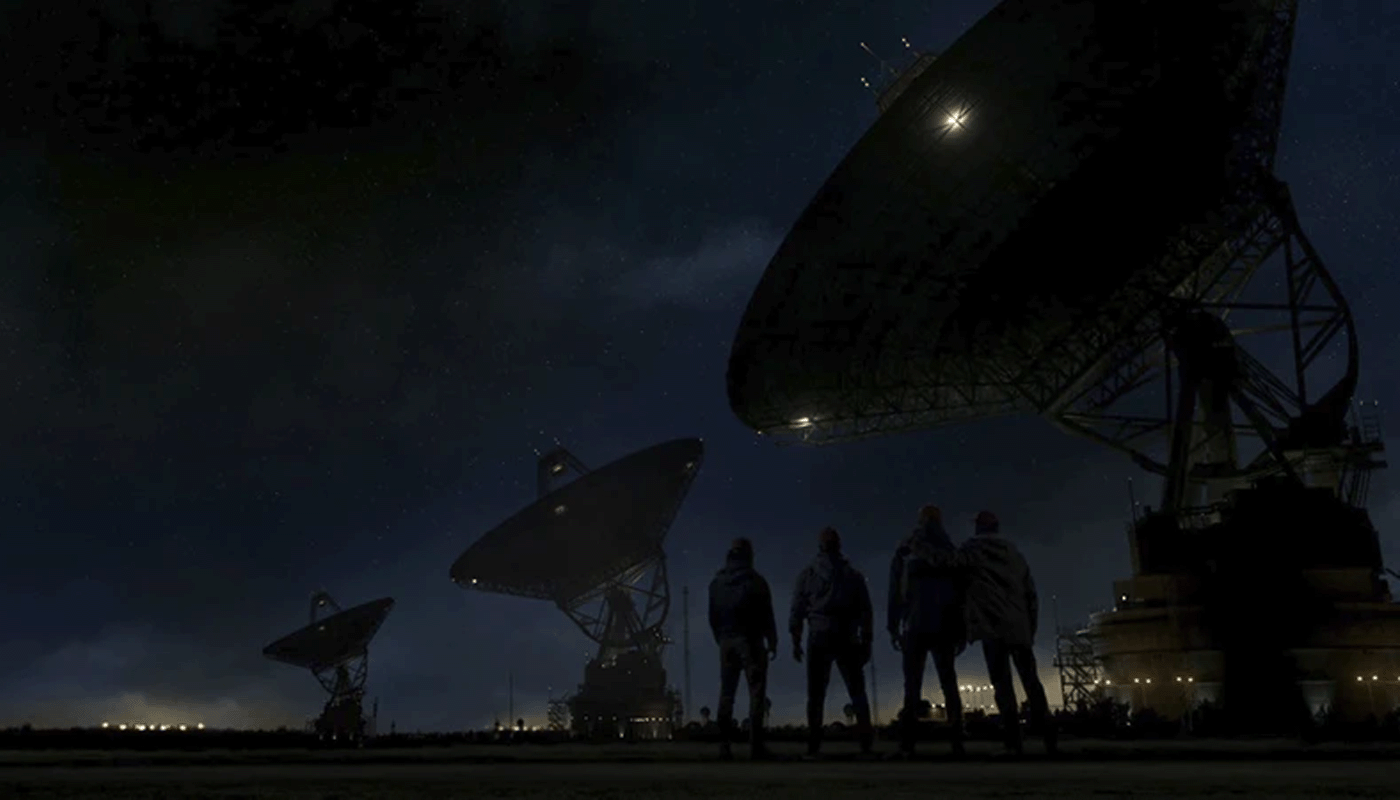
Cosmos centers on three amateur astronomers who venture into the woods for a night of stargazing. Each character is employed within the aerospace industry: Harry (Joshua Ford) and Roy (Arjun Singh Panam) are former colleagues, while Mike (Tom England) joins them in hopes of validating his data processing system for radio telescopes, thereby securing continued funding for his project. Their initial hours are spent setting up their equipment and preparing for a night of observation and data collection.
The narrative takes a significant turn when Mike detects an unusual signal on his radio telescope, described as umbrella-sized and seemingly an actual umbrella prop. This signal falls within the "water hole" of radio frequencies, a scientifically significant band between 1420 MHz and 1666 MHz where cosmic noise is relatively low. Despite the signal’s initial lack of discernible meaning, Mike impulsively sends a half-serious "Welcome to Earth" message in response. Concurrently, a satellite being tracked by Roy momentarily vanishes from view, an anomaly they attribute to equipment malfunction.
Their curiosity intensifies when Mike’s message is returned, distorted and fragmented. The trio explores various potential explanations, such as signal reflections, but no simple solution emerges. Mike contacts a colleague at a nearby radio telescope array, played by Ben Vardy, to ascertain if anyone else is detecting anomalies. Their findings indicate that they appear to be the sole recipients of this peculiar transmission.
Narrative Development and Pacing Issues
It is at this juncture that the film’s narrative structure begins to encounter difficulties. While some pacing issues and awkward characterizations were present earlier, they were not critical impediments. The reviewer found themselves engaged by the unfolding events, from Mike’s initial detection of the strange signal through the rational attempts to explain it away, culminating in the realization that they were uniquely receiving it.
The reviewer’s engagement, however, was largely driven by the inherent strangeness of the situation. The fact that amateur astronomers could detect a signal that a sophisticated radio telescope array, located mere miles away and operating on the same frequency, could not, is perplexing. The satellite’s disappearance and the distorted nature of the returned message further contribute to this sense of unease. The damage inflicted upon Mike’s computer setup adds another layer of mystery. These peculiar occurrences fostered a feeling of an uncanny, perhaps targeted, event unfolding around the three protagonists. This perception was amplified when Roy and Harry venture into the woods for better signal acquisition, in a sequence deliberately filmed to evoke a creepy atmosphere, leading the reviewer to anticipate a close encounter or a spooky twist.
The Unfulfilled Promise of Setup
Regrettably, this anticipation was not met. The film, in the reviewer’s assessment, set up "Chekhov’s gun" – in this case, perhaps "Chekhov’s alien encounter in the forest" – but failed to fire it. Once it became apparent that the elaborate setup would not be utilized, the reviewer’s interest significantly waned.
The characters eventually decipher that the distorted message contains a secondary signal. This binary signal is quickly identified as a response to the Arecibo message, a powerful binary signal transmitted from the Arecibo Observatory in 1974. They also deduce that Roy’s satellite is being obscured by an object in closer orbit. Finally, Mike’s colleague confirms that similar unusual phenomena are being observed globally.
Climax and Narrative Disappointment
The final twenty to thirty minutes of Cosmos devolve into what the reviewer describes as a "silly and wholly unnecessary race to preserve their discovery before power runs out." The logic behind this frantic endeavor is questioned, particularly given that the entire world is now aware of extraterrestrial contact. The urgency to be the first to prove the signal’s existence feels, in this context, extremely trivial. This anticlimactic resolution is seen as a disappointment, especially considering the film’s effective setup.
While the reviewer endeavors to evaluate films on their own terms, they express a strong sentiment that Cosmos missed an opportunity to achieve something more profound. The film’s strengths lie in its meticulously crafted atmosphere of a spooky space mystery encountered by ordinary individuals in isolation. The narrative, prior to the climax, is not without flaws but could have been elevated by a payoff that was strange, unexpected, and uniquely tied to the characters’ experiences and their anxieties on that particular night.
Contextualizing Creative Choices
Understanding that Cosmos originated as a proof-of-concept project for the filmmakers to hone their craft does not excuse the narrative shortcomings of the climax. However, it does provide context for the creative decisions made. The reviewer expresses a wish for a bolder, stranger direction in the final act, one that would have offered a satisfying resolution to the well-built tension of the characters’ investigative process.
The Weaver brothers appear to be continuing their exploration of micro-budget science fiction. Online sources indicate that they have several projects in various stages of production. Notably, a film described as a fusion of folk legends and UFO visitations, shot on 16mm film, is anticipated. This project, with its enticingly eerie atmosphere, suggests a promising evolution in their filmmaking style and narrative approach, and it will undoubtedly be followed with keen interest.
Conclusion and Future Outlook
The emergence of films like Cosmos from filmmakers with limited resources highlights the democratizing power of accessible technology and the enduring appeal of science fiction as a genre capable of exploring profound themes. While the narrative execution of Cosmos may have fallen short of its potential, the underlying ingenuity and dedication of the Weaver brothers serve as a testament to the creative spirit thriving outside the traditional studio system. Their journey from childhood filmmaking to professional documentary work, and now to ambitious independent sci-fi, offers a compelling case study in perseverance and artistic growth. The continued exploration of micro-budget filmmaking, particularly in genres that have historically been perceived as requiring massive investment, promises to yield further innovations and storytelling breakthroughs.
The reviewer concludes by posing a question to the audience regarding their thoughts on Cosmos and this particular brand of sci-fi born from minimal resources. The following week’s discussion is set to feature Beyond the Infinite Two Minutes, an example of a micro-budget Japanese film employing the nagamawashi technique, edited to appear as a single, continuous shot.