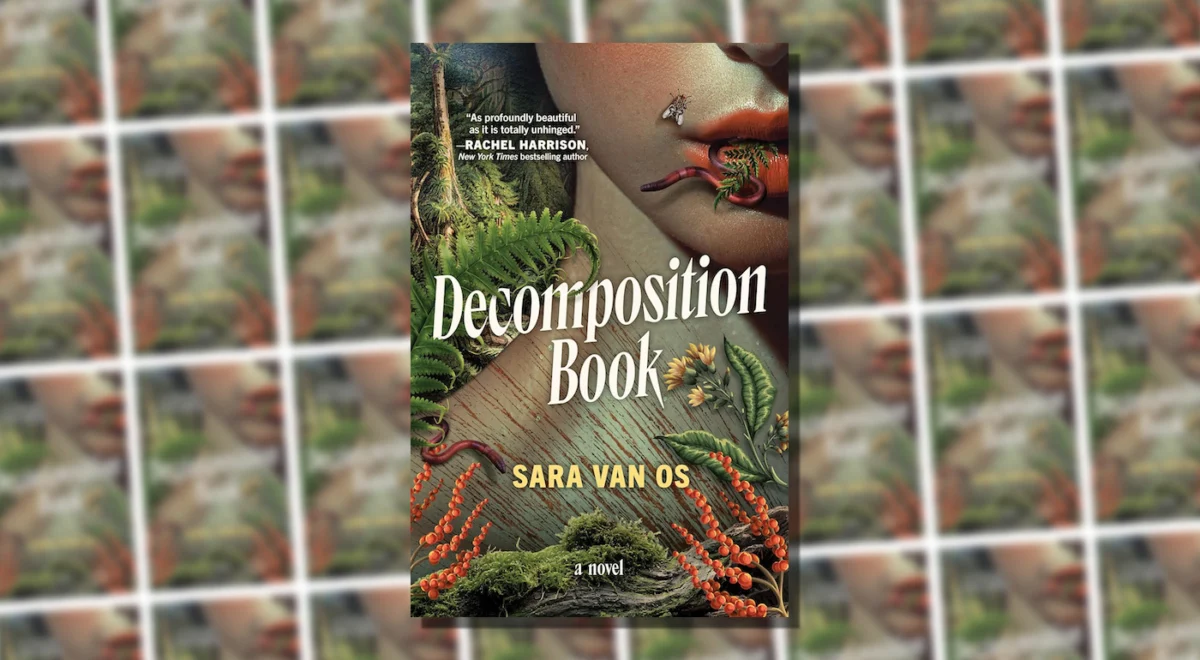
Sara van Os’s debut novel, Decomposition Book, plunges readers into the chilling depths of isolation and the profound impact of unresolved trauma, weaving together the parallel narratives of two young women whose lives become inextricably linked by a shared fate in the unforgiving wilderness. The novel, named for the journal Savannah discovers, serves as a stark examination of mental illness, the complexities of identity, and the desperate human need for connection, even in the face of death.
The story unfolds in the stark winter landscape of upstate New York, where Savannah is recuperating at her parents’ lake house. The retreat follows a severe breakdown during her final year of university, an event marked by a traumatic experience that included a devastating breakup with her best friend. Now, Savannah is grappling with the aftermath of this personal crisis, compounded by the isolation and the challenges of managing her unmedicated Obsessive-Compulsive Disorder (OCD). Her coping mechanisms are fraught with danger, as she dangerously mixes excessive alcohol consumption with nightly sedatives.
Months prior to Savannah’s current predicament, another narrative was unfolding in the vast expanse of the Adirondack Mountains. Ava, along with her colleagues Megan and Chad, embarked on a camping trip. This excursion took a perilous turn when Chad’s "competitive masculinity" led them off the marked trails and into the unforgiving wilderness. By January, the chilling reality is that Ava is the sole survivor, still lost and struggling for survival. The novel immediately establishes a somber tone by revealing Ava’s fate from the outset; readers encounter her as a corpse. Yet, her journal entries, chronicling the harrowing days leading up to her death, imbue the narrative with an inescapable sense of sadness and pathos. These entries serve as a poignant testament to the lives of two young women whose journeys were tragically cut short, a consequence, the novel suggests, of a man’s overconfidence and misplaced authority.
One unsettling night, Savannah awakens in the woods behind her parents’ home with no recollection of how she arrived there. Her disorientation is shattered by the sight of a dead woman propped against a tree. The initial shock gives way to a morbid curiosity, and Savannah inspects the bag beside the corpse. Inside, she discovers a journal that reveals the identity of the deceased woman and the horrific circumstances that led to her demise.
The journal, the titular Decomposition Book, becomes the second narrative thread of the novel, offering Ava’s story in her own words. These entries, penned towards the end of her life, recount the camping trip that devolved into a nightmare. Savannah, whose intrusive thoughts manifest as the taunting voice of her former best friend, Michelle, grapples with the decision of whether to report the discovery. Instead, she chooses to read Ava’s journal first. This act of immersion allows Savannah to begin to understand who Ava was, transforming the anonymous corpse into a figure of empathy and even friendship. She visits the body daily, sitting with it as she reads Ava’s story, a ritualistic act of connection in her profound isolation.
Driven by a burgeoning sense of connection, Savannah returns home and researches Ava online. She discovers that Ava was an opera singer, piecing together her personality from her digital footprint and the intimate details of her journal. While this behavior could easily be perceived as macabre, van Os masterfully portrays Savannah’s actions as a desperate cry for connection, a painful illustration of her profound loneliness and her yearning for loving intimacy.
Savannah’s journey is not solely defined by the trauma of her recent breakdown but also by her ongoing struggle with an unmedicated mental disorder. Her OCD does not manifest as the stereotypical compulsions of cleaning; rather, it is characterized by relentless intrusive thoughts, a form of mental torment she wishes she could trade for a more tangible compulsion. Reading about Savannah’s internal landscape is a jarring experience, particularly for neurodiverse readers who may recognize the self-inflicted cruelty, the devastating internal dialogue, and the insidious ways the mind can spiral into unhealthy depths. Her narrative is a heartbreaking portrayal of a young woman tearing herself down, internalizing the cruel pronouncements of her former friend, Michelle, as absolute truths about herself.
Savannah’s internal monologue reveals a complex relationship with the world and her own capacity for empathy. She grapples with the notion that the constant exposure to violence and tragedy in modern media—from 9/11 to live-streamed wars and graphic online content—has desensitized her. "Corpses have been walking in and out of my life as long as I can remember," she reflects, citing a litany of traumatic events that have become normalized background noise in her life. However, with Ava, Savannah begins to experience a genuine emotional response. Ava is "not just a story; she was a life. I have her voice. I have her handwriting. I have her body. I have something real, for once, in a world where everything unpleasant can just be scrolled past." This realization marks a pivotal shift in Savannah’s understanding of herself and her connection to the deceased woman.
The novel’s exploration of Savannah’s OCD is particularly insightful. Her condition is deeply rooted in a desperate pursuit of certainty, a desire to control the uncontrollable. In Ava’s deceased body, Savannah finds a peculiar form of certainty. Ava is no longer capable of judgment, of the hurtful pronouncements that Michelle inflicted upon Savannah, labeling her as "always spilling out over [her] own edges." Ava’s physical decomposition mirrors the slow unraveling of Savannah’s own psyche as she attempts to understand herself and confront her intrusive thoughts. The line between reality and Savannah’s perception blurs, highlighting a young woman so consumed by fear and loneliness that she relies on the spectral presence of a stranger to guide her toward self-discovery.
Ava, portrayed as a more experienced and confident gay woman, grounded in her identity, emerges as Savannah’s unexpected catalyst. As Savannah reconstructs Ava’s life and personality, Ava’s physical form continues its descent into decay, a stark and visceral contrast to the burgeoning life and identity Savannah is finding within herself. The graphic descriptions of Ava’s decomposition, such as becoming "Las Vegas for maggots… feasting at the all-you-can-eat buffet that is her corpse… a blanket so thick that I can barely see her underneath," underscore the novel’s unflinching engagement with the physical realities of death and decay.
A central theme that resonates throughout Decomposition Book is Savannah’s profound loneliness. This isolation is multifaceted, stemming from her struggle with a debilitating mental illness, the complexities of navigating her sexual identity, the healing process from trauma, and the physical solitude that feels safer than human interaction. Her dark humor and rapid mental spirals are potent signals of deep grief and fear, sharply contrasted with Ava’s narrative, which depicts her steadfastness and security even when facing life-threatening physical dangers.
One aspect that requires a degree of suspension of disbelief is the prolonged period during which three adults remain lost in the wilderness with no apparent search or discovery. Given their existing families, friends, and colleagues, the lack of any trace or any organized search effort for months stretches credulity. The sheer immensity of the Adirondacks might account for some difficulty, but the complete absence of any search, including the use of sniffer dogs or helicopters, presents a notable narrative challenge. However, this improbable element does not fundamentally detract from the novel’s powerful emotional impact and its capacity to deliver horrific moments in unexpected and deeply affecting ways.
The narrative structure, alternating between Savannah’s first-person perspective and Ava’s journal entries, creates an intimate and immersive reading experience. By placing readers directly inside the minds of both women, van Os amplifies the sense of shared grief, trauma, and, ultimately, love. Decomposition Book defies easy categorization, functioning simultaneously as a body horror thriller, a coming-out and coming-of-age novel brimming with queer longing, a profound examination of a debilitating invisible mental illness, and a young woman’s determined effort to move beyond a trauma that she refuses to let define her. The novel suggests that the path to self-discovery can be long and arduous, often illuminated by the echoes of the people we might have been, guiding us toward who we are truly meant to become.
Decomposition Book is published by Hanover Square Press.
Read an excerpt.