The upcoming Netflix crime drama Unabomber is generating significant anticipation ahead of its scheduled streaming debut on September 25. Directed by acclaimed filmmaker Janus Metz Pedersen and written by the collaborative screenwriting duo Sam Chalsen and Nelson Greaves, the feature film explores one of the most complex and harrowing chapters in modern American law enforcement history. Headlined by a prominent cast that includes Academy Award winner Russell Crowe, Jacob Tremblay, Annabelle Wallis, and Shailene Woodley, the production aims to dissect the psychological deterioration and subsequent domestic terror campaign orchestrated by Ted Kaczynski.
Rather than relying solely on a conventional linear narrative, the film adopts a structural approach that alternates between two distinct timelines. The first centers on Kaczynski’s formative years as a remarkably gifted student attending Harvard University, examining the intellectual and social pressures that contributed to his eventual isolation from society. The second timeline shifts decades forward, focusing on the exhaustive and prolonged manhunt led by federal authorities to capture the elusive serial bomber before he could claim more victims. In anticipation of the film’s release, director Janus Metz Pedersen sat down for an in-depth interview to discuss the intricate creative processes, logistical challenges, and thematic responsibilities involved in bringing this dark chapter of American history to the screen.
Background Context And The Real-World Terror Campaign
The historical framework underpinning Unabomber is rooted in a nearly two-decade campaign of terror that profoundly altered public perception of domestic security, mail handling, and privacy within the United States. Between 1978 and 1995, Ted Kaczynski mailed or hand-delivered a series of increasingly sophisticated explosive devices to targets across the country, primarily focusing on universities and airlines—giving rise to the FBI’s internal case designation, UNABOM (University and Airline Bomber).
Over the course of 16 bombings, Kaczynski’s attacks resulted in three fatalities and injured 23 others, leaving many victims with permanent, life-altering physical disabilities. The targets were often academics, scientists, and corporate executives whom Kaczynski held responsible for advancing modern technology and industrial civilization, which he viewed as a destructive force eroding human freedom and the natural environment.
For the Federal Bureau of Investigation and the United States Postal Inspection Service, the investigation evolved into one of the longest, costliest, and most frustrating manhunts in American history. Despite establishing the UNABOM Task Force in 1978, investigators struggled for years to develop viable suspects due to the meticulous precautions Kaczynski took to avoid leaving forensic evidence. The case ultimately turned in 1995 when Kaczynski compelled major media outlets, including The New York Times and The Washington Post, to publish his 35,000-word manifesto, titled Industrial Society and Its Future. Upon reading the published text, David Kaczynski recognized the distinct ideological phrasing and worldview of his estranged brother Ted, subsequently tipping off federal authorities and leading to Kaczynski’s arrest at his remote cabin in Lincoln, Montana, in April 1996.
Chronology And Structural Design Of The Film
The decision by director Janus Metz Pedersen and writers Sam Chalsen and Nelson Greaves to utilize a dual-timeline structure serves a critical narrative purpose, allowing the audience to trace the psychological trajectory of Ted Kaczynski from an academic prodigy to a radicalized recluse.
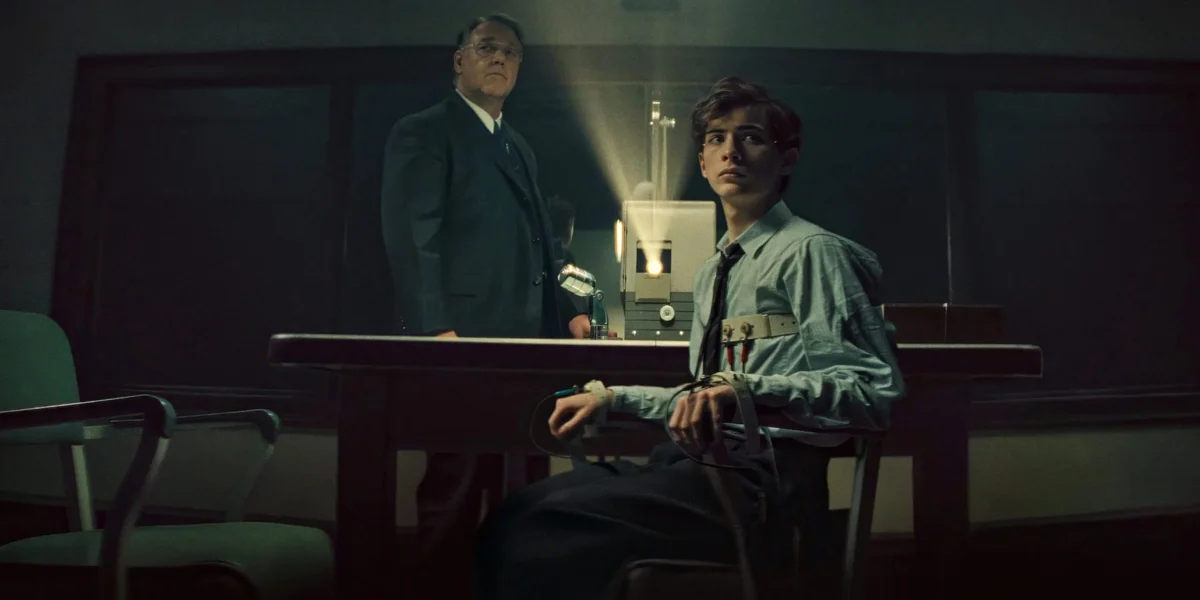
In the early timeline, the film explores Kaczynski’s exceptional intellect, which allowed him to enter Harvard University at the remarkably young age of 16. Biographical accounts and historical records note that Kaczynski was subjected to intense academic environments and participated in psychological studies during his undergraduate years, experiences that biographers and forensic psychiatrists have frequently cited as contributing factors to his profound alienation and growing resentment toward societal institutions.
Decades later, the narrative shifts to the grueling federal investigation. This timeline highlights the institutional hurdles faced by law enforcement agencies, the psychological toll the manhunt took on investigators, and the mounting public anxiety as the bomb plots continued unabated through the late 1980s and early 1990s. By juxtaposing the brilliant, highly functional young student against the isolated, paranoid hermit hunted by the state, the film aims to provide a comprehensive, multi-dimensional portrait of a domestic terrorist without glorifying his actions or reducing the narrative to a simple cat-and-mouse procedural.

Cast Dynamics And Performances
The casting choices for Unabomber have drawn considerable attention from industry analysts and film critics, particularly regarding the central portrayal of Ted Kaczynski by Jacob Tremblay. Known for his critically acclaimed performances in dramatic films such as Room and Wonder, Tremblay takes on the daunting challenge of depicting a deeply troubled historical figure across critical transitional phases of his life.
Opposite Tremblay, veteran actor Russell Crowe brings his considerable gravitas to the production. While specific details regarding Crowe’s character role have been tightly guarded by production studios to preserve narrative twists, his involvement underscores the high-stakes, prestige nature of the project. Furthermore, the inclusion of Annabelle Wallis and Shailene Woodley rounds out an ensemble cast designed to bring emotional depth and diverse perspectives to the supporting storylines, which encompass the lives affected by the bombings and the tireless efforts of the investigative teams.
During discussions about working with such a high-caliber cast, director Janus Metz Pedersen emphasized the immense dedication required from the actors to handle sensitive and psychologically demanding subject matter. Directing performers of the caliber of Crowe and Tremblay necessitated an environment of trust and rigorous preparation, ensuring that the heavy emotional weight of the material was handled with both artistic integrity and historical responsibility.
Production Insights From Director Janus Metz Pedersen
In his recent interview with the Next Best Picture Podcast, Janus Metz Pedersen elaborated on the vision behind Unabomber and the unique obstacles he encountered while translating a real-world tragedy into a cinematic narrative. Pedersen, widely recognized for his work on critically acclaimed projects such as Borg McEnroe and True Detective, noted that the primary challenge lay in maintaining objectivity while examining a deeply divisive and painful subject.
Pedersen highlighted the importance of avoiding exploitation, ensuring that the victims and the profound societal impact of the bombings remained central to the emotional core of the film. Recreating the stark contrast between the intellectual pressure cookers of 1950s academic institutions and the rugged, isolated wilderness of 1990s Montana required extensive collaboration with the film’s cinematography, production design, and historical research teams. The director credited the cast for their collaborative approach to developing complex character motivations, noting that translating complex ideological manifestos into compelling visual drama demanded nuanced performances capable of communicating internal turmoil without relying solely on exposition.
Broader Impact And Industry Implications
As Netflix prepares for the global streaming release of Unabomber on September 25, the film enters a crowded market of true-crime dramas and psychological thrillers. However, industry observers suggest that the pedigree of the creative team, combined with the timeless public fascination surrounding the FBI’s pursuit of Kaczynski, positions the project as a major contender for audience engagement and critical discourse.
The release also arrives at a time of heightened cultural sensitivity regarding the depiction of real-life criminals and domestic terrorists in media. Filmmakers tackling such subjects face intense scrutiny to ensure that their works do not inadvertently romanticize or sensationalize violent extremism. By focusing on the meticulous investigative processes of law enforcement and the structural failures that allowed the terror campaign to persist for nearly two decades, Unabomber aims to offer a cautionary historical examination rather than a conventional thriller.
The convergence of top-tier talent, a rigorous investigative narrative framework, and an unflinching look at the roots of domestic radicalization ensures that Unabomber will be one of the most closely watched streaming releases of the autumn season. Audiences and critics alike will soon have the opportunity to evaluate how successfully Pedersen and his team have navigated the delicate balance between historical accuracy and dramatic art when the film becomes available on Netflix later this month.