The tradition of First Contact narratives in science fiction has long served as a mirror for human curiosity, probing fundamental questions about our place in the cosmos, the mechanics of communication, and the boundaries of sapient understanding. While global speculative fiction has frequently approached extraterrestrial encounters through Western philosophical and scientific frameworks—typified by works such as Carl Sagan’s Contact and Arthur C. Clarke’s Rendezvous with Rama—African speculative fiction has developed a distinct, deeply historical lineage. By mapping the mechanics of alien encounters onto the lived realities of colonization, cultural negotiation, and post-independence sociopolitical shifts, African authors have subverted traditional genre tropes. Examining these texts reveals a rich continuum of thought experiments that utilize the unknown to interrogate identity, power, and historical memory.
Chronological Evolution of African Speculative Fiction
Scholarship surrounding African speculative and fantastical fiction (SFF) highlights a four-tiered historical progression spanning nearly a century of literary output. Understanding the emergence of African First Contact narratives requires contextualizing them within these distinct eras:

- The Early Period (1930s to 1960s): Characterized by nascent works heavily influenced by colonial encounters. Early writers often utilized the arrival of technologically superior outsiders as metaphors for European imperialism, creating a unique anthropological viewpoint shaped by subjugation and cross-cultural friction.
- The Post-Independence Flourish (1960s to Early 2000s): Marked by national liberation movements, a reassertion of indigenous worldviews, and a blending of traditional beliefs with imported scientific thought. Satire and political allegory emerged as primary vehicles for critiquing nascent postcolonial governance.
- The Internet Age and Genre Boundary Expansion (Early 2000s to 2011): Driven by digital publishing platforms, increased global connectivity, and a dismantling of rigid genre boundaries, allowing younger authors to blend cybernetic concepts with indigenous cosmologies.
- The Current Period of Increasing Global Recognition (2011 to Present): Defined by mainstream international acclaim, major literary awards, and a confident assertion of Africanfuturism and Africanjujuism as dominant global literary movements.
Within this historical framework, several foundational texts stand out for their profound contributions to the First Contact subgenre, bridging the gap between historical trauma and speculative imagination.
1. Nnanga Kon by Jean-Louis Njemba Medou (1932)
Published in Cameroon in the native Bulu language before receiving a French translation, Jean-Louis Njemba Medou’s Nnanga Kon holds a foundational place in the historical database of African speculative fiction. Translated roughly as "white ghosts," the narrative chronicles an initial encounter between the Bulu people and European missionaries and colonists. Crucially, the colonizers are depicted as technologically advanced supernatural beings.
As a historical artifact, the novel reflects the complex sociopolitical environment of its creation. Medou, writing as a self-declared loyal servant to the French Empire, infused portions of the text with colonial propaganda tropes—depicting indigenous populations as passive recipients saved by benevolent, superhuman figures equipped with incomprehensible technology. Despite these ideological constraints, Nnanga Kon functions as an early structural blueprint for First Contact fiction, seamlessly blending supernatural interpretations with techno-scientific power differentials. Literary historians note that the novel’s impact resonated deeply within local oral traditions, spawning new folktales across Cameroon and establishing a precedent for blending folklore with speculative realism that persists in contemporary African literature.

2. Jazz and Palm Wine by Emmanuel Dongala (1982)
Shifting from the colonial era to the post-independence flourish, Emmanuel Dongala’s 1982 short story collection Jazz and Palm Wine uses satire and allegory to explore ideological friction points. While the collection broadly investigates the collision between traditional Congolese belief systems and imported scientific rationalism, its title story serves as a brilliant thematic centerpiece for First Contact literature.
In Dongala’s satirical narrative, an extraterrestrial species lands in the Congo and is met with a defensive, frightened response from local populations. The aliens retaliate by initiating a global planetary invasion, forcing an emergency summit of Earth’s governments. While major superpowers propose conventional, militaristic escalations, a Kenyan delegate successfully advocates for a diplomatic alternative: dispatching a delegation of human elders to negotiate with their alien counterparts. The crisis is ultimately resolved not through military might, but through an exchange of art and culture—specifically, listening to avant-garde jazz by artists like John Coltrane and Sun Ra while consuming palm wine. Dongala’s narrative uses the framework of an alien invasion to critique international sociopolitics, offering a sophisticated commentary on artistic creation as an instrument for global harmony and cross-cultural coexistence.
3. Lagoon by Nnedi Okorafor (2014)
Entering the contemporary era of increased global recognition, Nnedi Okorafor’s 2014 novel Lagoon represents a landmark contribution to Africanfuturist literature. The plot initiates when a sentient extraterrestrial object crashes into the Atlantic Ocean off the coast of Lagos, Nigeria. From the depths emerges a shapeshifting alien woman, subsequently named Ayodele, who intersects with the lives of a diverse trio: a secular marine biologist, a famous rapper, and a disillusioned soldier.

Okorafor developed Lagoon partly as a direct response to external cinematic depictions of alien encounters in African settings, shifting the narrative focus from victimization to active agency and transformation. Structurally, the novel mirrors the chaotic, high-energy environment of Lagos itself. However, its primary intervention in the First Contact subgenre lies in its integration of indigenous cosmologies. Rather than treating the alien arrival as a purely secular scientific event, the narrative acknowledges the immediate reality of traditional deities, marine spirits, and spiritual forces. By embedding extraterrestrial contact within a worldview where the supernatural is an accepted facet of daily life, Lagoon expands the epistemological limits of science fiction.
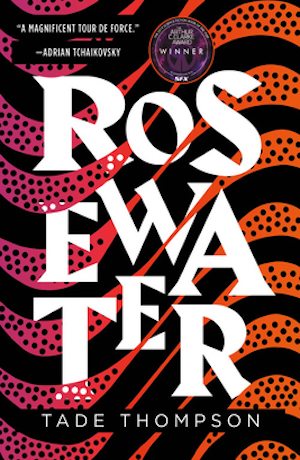
4. Rosewater by Tade Thompson (2016)
Tade Thompson’s 2016 novel Rosewater approaches the alien invasion trope through an intricate blend of biopunk, cyberpunk, and psychological thriller mechanics. Set in a near-future Nigeria, the novel centers on a small community that has spontaneously formed around a subterranean alien organism housed within a mysterious biodome. The entity emits microscopic spores that establish a telephonic collective consciousness known as the "xenosphere," accessible only to a select group of human telepaths called "sensitives."
The protagonist, Karoo, operates as a government security agent and a sensitive with a shadowy criminal past. As fellow agents begin dying under mysterious circumstances, Karoo navigates a fragmented, non-linear narrative landscape filled with corporate espionage, government corruption, and nomadic activists. Thompson subverts traditional First Contact structures by placing the alien presence firmly in the background as an environmental and economic catalyst, rather than an immediate conversational partner. The resulting narrative offers a rigorous examination of techno-colonialism, bodily autonomy, and the psychological toll of invasive technological integration.
5. Triangulum by Masande Ntshanga (2019)
Masande Ntshanga’s 2019 novel Triangulum reconfigures the conventions of First Contact by filtering an interstellar event through the lens of a personal coming-of-age mystery and a dystopian corporate thriller. Presented in the form of a discovered manuscript, the narrative is framed in the year 2040 by Dr. Naomi Buthelezi, who decodes transmissions indicating an imminent global collapse by 2050 unless systemic changes are enacted.
The core narrative follows an anonymous mathematical prodigy growing up in post-apartheid South Africa, haunted by the unresolved disappearance of her mother and recurring visions of a strange triangular machine. As she drifts through educational institutions and a society increasingly dominated by corporate surveillance and techno-colonial exploitation, the machine eventually links her consciousness to an intelligence originating from the real Triangulum Galaxy. Ntshanga synthesizes historical reflection, epistolary fragmentation, and cosmic dread to explore how historical injustices echo into technological futures.
Broader Implications and Sociological Impact
The evolution of these five texts underscores a vital shift in global speculative fiction. By utilizing First Contact narratives not merely as exercises in xenobiology or technological extrapolation, but as mirrors reflecting historical traumas, colonial legacies, and indigenous epistemologies, African authors have fundamentally expanded the scope of the genre.

Whether examining Jean-Louis Njemba Medou’s early colonial metaphors, Emmanuel Dongala’s satirical jazz diplomacy, Nnedi Okorafor’s spiritual integration, Tade Thompson’s biopunk xenospheres, or Masande Ntshanga’s cosmic dystopias, these works demonstrate that encounters with the unknown are ultimately exercises in self-examination. As contemporary authors continue to infuse African philosophies—such as Sankofa (learning from the past to shape the future) and Ubuntu (human interconnectedness)—into speculative frameworks, the First Contact narrative remains an essential tool for imagining alternative futures and reckoning with the enduring legacies of the past.