In the bi-weekly "Front Lines and Frontiers" series, Alan Brown delves into classic science fiction and fantasy, examining works that explore the realms of soldiers, spacers, scientists, engineers, explorers, and adventurers—narratives rich with "alarums and excursions," battles, chases, and thrilling encounters. This installment focuses on Pierre Boulle’s seminal novel, Planet of the Apes, and its enduring impact, particularly in relation to the iconic 1968 film adaptation.
The author’s recent discovery of movie tie-in books at a used bookstore sparked a reflective journey into stories first encountered on screen before their literary origins were explored. This personal connection resonates with many science fiction enthusiasts who have been introduced to foundational narratives through cinematic interpretations, often without immediate familiarity with the original written works. Examples such as H.G. Wells and Jules Verne, whose stories are widely known through adaptations despite a lack of direct reading experience with their novels, highlight this phenomenon. Planet of the Apes serves as a prime case study for this dynamic, bridging the gap between popular cinema and literary science fiction.
Genesis of a Dystopian Vision: Pierre Boulle and His Literary Roots
Pierre Boulle (1912-1994), a prolific French author, crafted over twenty novels and numerous short stories throughout his distinguished career. His literary journey gained significant momentum with the publication of The Bridge Over the River Kwai in 1952. This novel, deeply influenced by his wartime experiences as a secret agent for the Free French in Indochina and subsequent imprisonment, was adapted into a highly successful 1957 film that garnered seven Academy Awards, including Best Picture and Best Actor for Alec Guinness.
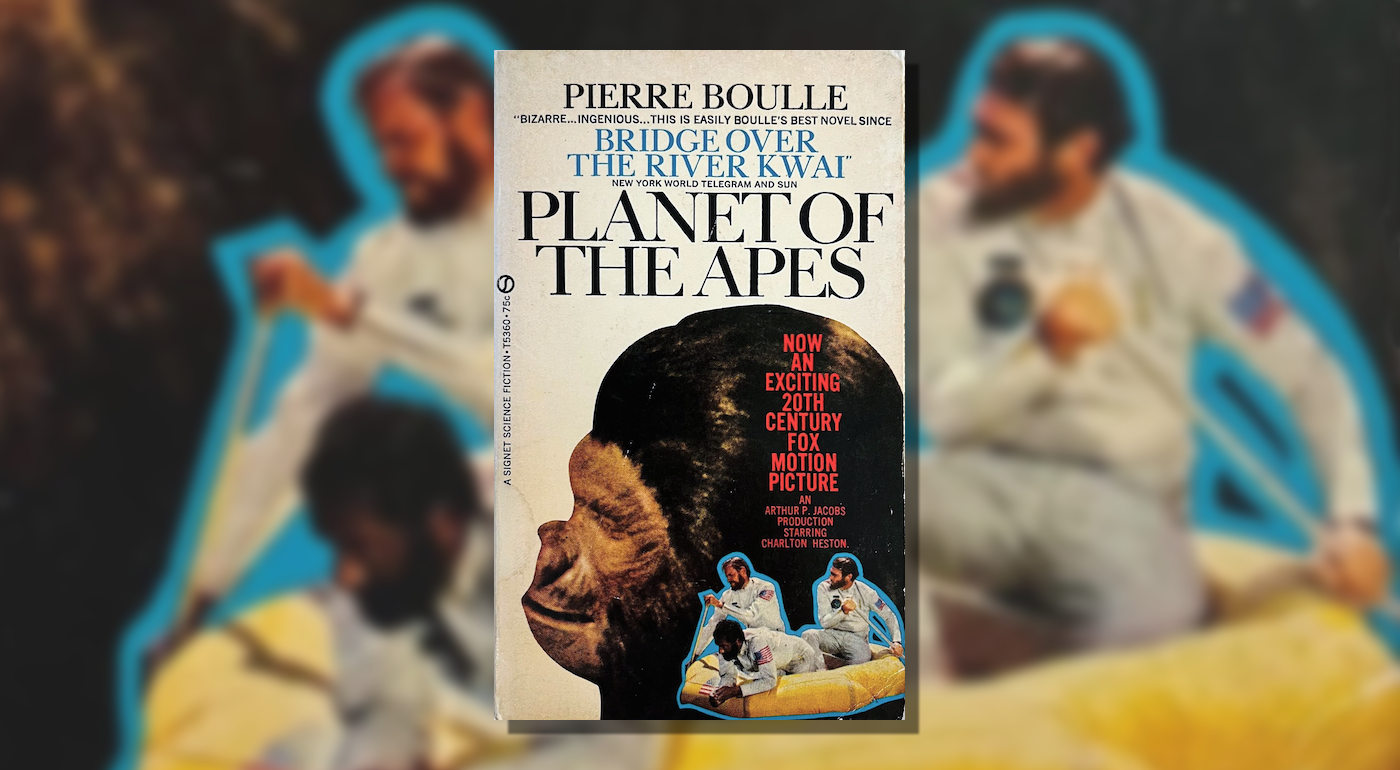
Boulle’s subsequent widespread acclaim arrived with Planet of the Apes, a science fiction novel that presented a stark vision of a world ruled by intelligent apes and a primitive, subjugated human race. The novel’s profound social satire drew comparisons to Jonathan Swift’s Gulliver’s Travels, underscoring its ambition to provoke thought and challenge societal norms through imaginative fiction. Published initially in hardcover by Vanguard Press in 1963, the novel was later released in paperback by Signet in 1964. The review copy, a Signet paperback, featured illustrations derived from the film, indicating a conscious effort to leverage the movie’s visual impact for broader book sales, even if the cover copy itself did not explicitly mention the film.
The Cinematic Spectacle: Planet of the Apes (1968)
The author’s recollection of experiencing the 1968 film Planet of the Apes is deeply intertwined with the sensory memories of a grand, albeit unnamed, movie theater in Rockville, Connecticut. This establishment, described as a stately old brick building adorned with velvet-cushioned seats, brass rails, a balcony, and ornate gilt detailing, provided an immersive environment for cinematic consumption. The reviewer, then thirteen years old, positioned himself in the front rows, seeking an enveloping experience where the screen dominated his perception, making him feel part of the unfolding action.
The film’s opening sequence, depicting a spaceship in uncontrolled descent, astronauts awakening from hibernation amidst the crisis, and the grim discovery of a deceased crewmate, is vividly recalled. The futuristic yet believable spaceship design was reportedly influenced by NASA’s lunar program, grounding the science fiction elements in contemporary technological advancements. This detail speaks to the era’s burgeoning space race and its pervasive influence on popular imagination.
Even at this young age, the reviewer exhibited a critical eye, a characteristic often found among dedicated science fiction fans. Questions arose regarding the crew’s gender distribution for species perpetuation, and a practical assessment of the astronauts’ seemingly inefficient backpacks. Charlton Heston’s intense portrayal of Taylor, marked by a nihilistic edge, dominated the initial scenes, overshadowing his crewmates, Landon and Dodge. The stark, desolate landscape of the alien planet enhanced the subsequent discovery of a verdant oasis and the astronauts’ palpable relief in reaching it. Their joy, however, was short-lived, giving way to confusion and shock as their belongings were lost and they were attacked by ape forces.
The film’s triumph lay in its convincing depiction of the apes, achieved through groundbreaking makeup and prosthetics, meticulously designed costumes, weaponry, and the architectural style of their society. The narrative’s progression, following Taylor’s perilous existence as a laboratory animal and his growing bond with Nova, maintained audience engagement. The performances of Kim Novak as the compassionate chimpanzee scientist Zira and Roddy McDowall as the earnest Cornelius were particularly noted for their charm. The screenplay skillfully balanced suspense, horror, humor, and pointed social commentary, which resonated strongly with the cultural zeitgeist of the late 1960s. The film’s narrative arc culminated in an archaeological discovery that unveiled the planet’s true history, capped by a now-legendary twist ending. This powerful combination of storytelling, visual innovation, and thematic depth contributed to the film’s immense success and cemented its status as a beloved classic.
The Literary Counterpart: Boulle’s Planet of the Apes Novel
In contrast to the cinematic immediacy, Pierre Boulle’s novel, Planet of the Apes, adopts an older narrative style, beginning with a framing story. A married couple aboard a private space yacht discovers a message in a bottle, which contains the main narrative penned by journalist Ulysse Mérou. Mérou recounts his journey alongside inventor Professor Antelle and his assistant Arthur Levain, accompanied by their pet chimpanzee, Hector. Their vessel, of Antelle’s design, embarks on a voyage to Betelgeuse. Notably, the novel avoids the cinematic ambiguity of the planet potentially being Earth; its destination is explicitly a distant star system.
The narrative glosses over the expedition’s funding, omitting any mention of governmental or space agency involvement, a departure from the film’s NASA-inspired context. The concept of time dilation is introduced, with the two-year journey from the crew’s perspective translating to centuries passing on Earth. The crew’s surprising lack of concern for those they left behind reflects a common trope in early science fiction, prioritizing the adventure over personal ties.
Upon reaching Betelgeuse, the explorers discover a habitable planet, christened Soror, which bears an unlikely and remarkable resemblance to Earth, complete with a similar atmosphere, geology, flora, and fauna. They descend to the planet via shuttlecraft, bypassing the crash landing depicted in the film. The idyllic discovery of a swimming hole leads to their encounter with a young woman, nicknamed Nova, who communicates non-verbally. Their initial attempts at interaction are shattered when Nova violently attacks and kills their pet chimpanzee, Hector. This violent act foreshadows the arrival of gorilla hunters who decimate Nova’s tribe and capture most of the group.
Societal Structures and Scientific Inquiry: A Deeper Dive in the Novel
The novel’s plot begins to align more closely with the film’s narrative at this juncture. Levain is killed, while Mérou, Antelle, and Nova are taken captive and caged as experimental subjects, studied by a chimpanzee scientist named Doctor Zira. The novel elaborates on the societal hierarchy of the apes: gorillas serve as leaders and hunters, orangutans function as bureaucrats and priests, and chimpanzees are the scientists. Unlike the film, which suggested a relatively primitive ape society due to budget constraints, Boulle’s novel portrays an ape civilization as advanced as contemporary human society.
The apes actively encourage their captive humans to reproduce. Mérou grapples with the prospect of mating with the seemingly unintelligent Nova, ultimately acquiescing to avoid her being given to another man. Mérou’s intellectual capabilities are eventually recognized as he learns their language and convinces the apes of his sentience, leading to his conditional freedom. He later finds Professor Antelle, who has regressed to a pre-verbal state under the psychological strain of his experiences and is now contentedly partnered with another human captive.
Mérou encounters Cornelius, Zira’s fiancé and a fellow scientist, who finds Mérou’s existence fascinating. Cornelius takes Mérou to an archaeological dig where they unearth a talking human doll—a scene faithfully recreated in the film. This artifact suggests a preceding age of intelligent humans, a notion that deeply unsettles the ape leadership. The revelation that Nova is pregnant intensifies their anxiety about the potential resurgence of intelligent humans.
A harrowing chapter details Mérou’s visit to a chimpanzee scientist conducting experimental brain surgery on humans. The scientist’s research explores the effects of brain manipulation on cognitive function, using electrical stimulation to induce mimicry rather than genuine intelligent speech. One subject, however, exhibits the ability to access "racial memories"—a concept that, while scientifically implausible by today’s standards, is a recurring theme in science fiction. Through this subject, the narrative reveals the gradual decline of human ambition and engagement, their increasing reliance on domesticated apes for responsibilities, which eventually led to an ape revolt and their displacement from human cities.
Escape, Revelation, and Societal Reflection
The birth of Nova and Mérou’s highly intelligent child prompts Zira and Cornelius to devise a plan for escape. They intend to substitute Mérou, Nova, and their infant for human test subjects on an experimental space flight. This strategy would allow them to reach Professor Antelle’s ship and return to Earth, implying that Mérou had acquired piloting skills during his initial journey. Their successful return to Earth concludes with a double twist ending, incorporating the re-emergence of the framing narrative.
Boulle’s novel functions as a sophisticated morality tale, inviting readers to re-examine the facets of their own society through an altered lens. While the film remains largely faithful to the novel’s themes and narrative arc, it injects a greater degree of action and conflict, characteristic of Hollywood filmmaking.
The Planet of the Apes Franchise: An Enduring Cultural Phenomenon
The immense success of the 1968 film propelled Planet of the Apes into a sprawling and enduring media franchise. The original movie was followed by four direct sequels: Beneath the Planet of the Apes (1970), Escape from the Planet of the Apes (1971), Conquest of the Planet of the Apes (1972), and Battle for the Planet of the Apes (1973). While these films expanded the narrative universe, a noticeable decline in quality occurred towards the end of the original series. The 1970s also saw the proliferation of live-action and animated television shows, alongside a series of comic books, further embedding the Apes saga into popular culture.
An attempt to reboot the film series in 2001 by director Tim Burton, while visually ambitious, did not achieve the critical or commercial resonance of the original films. A more successful revival began in 2011 with Rise of the Planet of the Apes, a prequel set in the near future. This new cinematic arc continued with Dawn of the Planet of the Apes (2014), War for the Planet of the Apes (2017), and concluded with Kingdom of the Planet of the Apes (2024), exploring the escalating conflict between humans and apes. The franchise’s reach has extended beyond film, encompassing further comic book series, tie-in novels, video games, and an array of merchandise. The Planet of the Apes narrative has become deeply ingrained in global popular culture, with its core concepts widely recognized across various media forms.
Concluding Thoughts: A Dual Legacy
The reviewer regards the 1968 film Planet of the Apes as one of his all-time favorite cinematic achievements and a classic that transcended the science fiction genre to become a mainstream cultural touchstone. The novel, in its own right, offers an enjoyable and more contemplative reading experience. It is a testament to the power of storytelling that both the book and the film, despite their differences in medium and execution, offer satisfying and impactful narratives. Each version provides a unique perspective on the core themes, making both the novel and the film worthy of exploration for anyone interested in the evolution of science fiction and its enduring impact on popular consciousness. The comparative analysis highlights how different artistic interpretations can enrich and expand upon a singular creative vision, ensuring its continued relevance and appeal across generations.