The latest episode of Paramount+’s critically acclaimed science fiction series Star Trek: Strange New Worlds has once again ignited passionate discussions across the fandom, not merely for its high-concept temporal mechanics and alternate-reality storytelling, but for a pair of fleeting cameo appearances. As the series continues to lean into the rich tapestry of the broader Star Trek franchise, sharp-eyed viewers have identified background characters that directly reference the lesser-known 1970s animated era of the space-faring property. These subtle nods have prompted widespread analysis regarding franchise continuity, timeline placements, and the deliberate world-building choices made by the production team.
Main Facts and Background Context
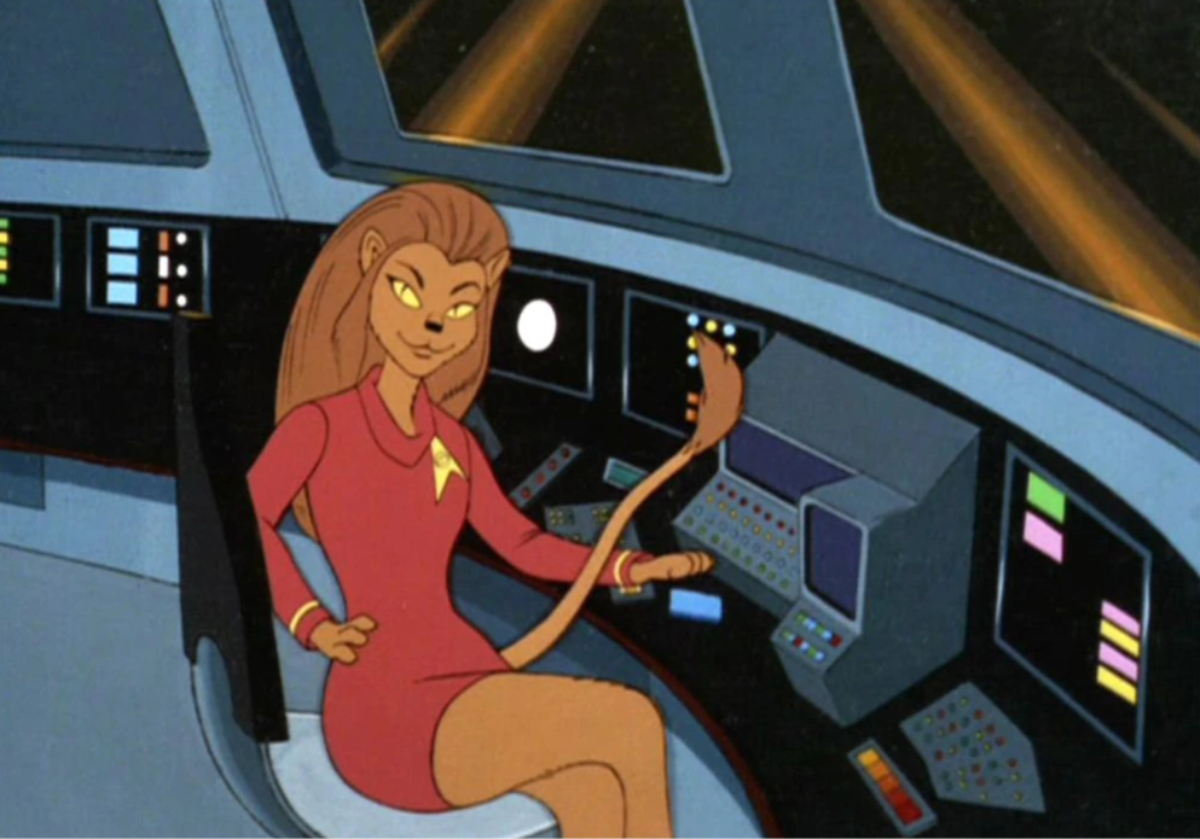
During a sequence in the recent episode where Communications Officer Nyota Uhura prepares for an extravehicular spacewalk, eagle-eyed fans utilizing high-definition streaming platforms paused the footage to inspect the bustling environment of the USS Enterprise shuttle bay. Standing among the personnel is a towering feline humanoid figure dressed impeccably in a Starfleet uniform. This visual inclusion strongly points toward Lieutenant M’Ress, a Caitian officer who originally appeared in Filmation’s Star Trek: The Animated Series (TAS), which aired from 1973 to 1974.
Voiced originally by actress Majel Barrett-Roddenberry, M’Ress served as a relief communications officer and relief science officer under Captain James T. Kirk. In the animated continuity, M’Ress was frequently called upon to step into duty when Uhura was indisposed or when Commander Spock was away on hazardous planetary excursions. Her presence in Strange New Worlds, even as a background extra, marks a rare live-action acknowledgment of the animated series, which has historically occupied a nebulous space in official franchise canon.
Further compounding the excitement for dedicated continuity historians, a second background character appeared in close proximity during the same sequence. Observers identified a tall, avian-like humanoid exhibiting the characteristic yellow plumage of an Aurelian. This visual design heavily mirrors Aleek-Om, an alien diplomat and scholar who previously featured in the seminal TAS episode "Yesteryear," a foundational story that explored Spock’s childhood on Vulcan.
Chronology and Timeline Discrepancies
The inclusion of these characters has led to intricate debates regarding the established Star Trek timeline. Within official lore, Strange New Worlds is generally understood to take place during the early 2260s—specifically hovering around the year 2259 at the outset of the series—under the command of Captain Christopher Pike. Conversely, The Animated Series is canonically situated approximately five years later, running concurrently with or shortly after the final season of Star Trek: The Original Series (TOS) around 2269.
If the events of the current episode are mapped onto the late 2260s, the physical presence of Lieutenant M’Ress aboard the Enterprise presents a minor chronological anomaly. Critics of the timeline argue that M’Ress should not theoretically be assigned to the flagship during Pike’s tenure, or at least not prior to her documented service under Captain Kirk. However, production staff and showrunners have frequently demonstrated a willingness to play fast and loose with exact calendar dates to honor deep-cut legacy characters, prioritizing fan service and visual world-building over rigid adherence to decades-old reference books.
Moreover, narrative ambiguity exists as to whether the figures seen on screen are definitively M’Ress and Aleek-Om or merely members of their respective species. Because Caitians and Aurelians are established multi-system races within the United Federation of Planets, the production team has successfully built-in a canonical safety valve. This allows the creative leads to acknowledge classic designs without strictly boxing themselves into absolute biographical constraints for individual legacy personnel.
Supporting Data and Franchise Evolution
The integration of animated-era elements into modern live-action Star Trek reflects a broader corporate and creative strategy by Paramount and executive producers like Akiva Goldsman and Henry Alonso Myers. Over the past several years, the franchise has systematically bridged the gap between its various iterations. Shows such as Star Trek: Lower Decks have fully integrated animated properties into the contemporary canon, while live-action crossover events—such as the hybrid live-action and animated episode featuring Lower Decks characters in Strange New Worlds season two—have normalized the cross-pollination of different eras.
Historically, The Animated Series was declared non-canon by executive producer Gene Roddenberry during the development of Star Trek: The Next Generation. However, subsequent reference guides, novels, and later series like Star Trek: Lower Decks and Star Trek: Prodigy have steadily worked to reintegrate TAS concepts, species, and historical events back into the primary timeline. The appearance of Caitians and Aurelians in high-budget live-action television serves as definitive validation for a series that was sidelined by the studio for decades.
Official Responses and Creative Intent
While neither showrunners nor the episode’s director have released an official point-by-point breakdown explaining the exact identities of the background actors, interviews regarding the production design of Strange New Worlds consistently highlight a deep reverence for franchise history. The set decoration and background casting departments are known to populate Federation starships with familiar alien races to reward long-term viewers who examine every frame for hidden details.
In the case of the Aleek-Om lookalike, the character’s thematic ties to temporal studies add an extra layer of narrative irony. In the expanded Star Trek universe, particularly through licensed Pocket Books novels, Aurelians like Aleek-Om are frequently associated with historical preservation and temporal oversight. Given that the episode itself deals heavily with time anomalies and structural disruptions to history, the presence of an Aurelian observer—whether intended as Aleek-Om or a relative—fits organically into the thematic framework of the narrative.
Broader Impact and Implications
The enthusiastic public response to these blink-and-you-miss-it cameos underscores the shifting nature of television consumption in the streaming era. Programs are no longer designed solely for passive viewing; instead, high-definition broadcasts encourage pause-and-analyze behaviors that transform background set dressing into major cultural talking points.
From an analytical perspective, these cameos demonstrate the maturation of modern franchise management. Rather than ignoring older, unconventional entries like The Animated Series, contemporary showrunners utilize subtle visual shorthand to validate every corner of the intellectual property’s fifty-eight-year history. For casual viewers, the scenes function as colorful window dressing that establishes a diverse, lived-in universe. For hardcore devotees, they serve as triumphant acknowledgments of obscure lore, proving that no corner of the Star Trek universe is truly forgotten.
As Strange New Worlds continues production on future seasons, fans will undoubtedly maintain their vigilance, scouring every corridor and mess hall for further references to the animated frontier that laid the groundwork for modern science fiction television.