The Genesis and Production of DTF St. Louis
The development of the series marks a continuation of Steven Conrad’s distinct creative trajectory, following his work on cult favorites such as Patriot and Perpetual Grace, LTD. Known for a visual style that balances stark symmetry with a melancholic, offbeat wit, Conrad brings a specific auteurist lens to the Midwestern setting of St. Louis. Production for the series reportedly spanned several months, utilizing the city’s unique architectural landscape to mirror the internal states of its protagonists. The choice of St. Louis as a backdrop is deliberate; the city’s blend of historic grandeur and modern industrial grit serves as a metaphor for characters who are themselves caught between their past perceptions and their current, often messy, realities.
The casting process was instrumental in shaping the show’s tone. By securing a central trio of Jason Bateman, David Harbour, and Linda Cardellini, the production team signaled a move away from the traditional archetypes these actors have occupied in recent years. Industry analysts have noted that the series represents a "prestige pivot" for the cast, moving Bateman away from the cynical business-minded roles of Ozark and Harbour away from the physical, authoritative presence he established in Stranger Things.
A Narrative Departure from the Standard Whodunnit
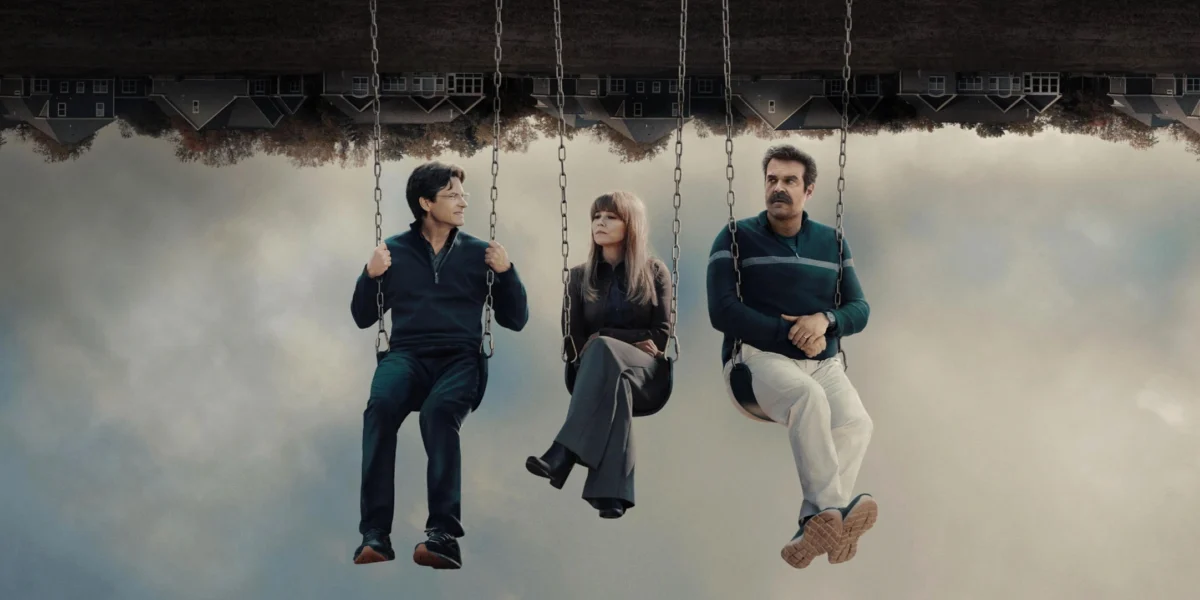
The plot of the series is initiated by the intersection of three lives: Clark Forrest (Bateman), a charismatic local weatherman; Floyd Smernitch (Harbour), an earnest American Sign Language (ASL) translator; and Carol Love-Smernitch (Cardellini), Floyd’s wife. The premise is sparked by the use of a hookup application, leading to an affair and the eventual, untimely death of one of the central figures. However, Conrad avoids the pitfalls of procedural storytelling by treating the murder not as the climax, but as the lens through which the characters’ lives are examined.
The narrative structure utilizes a non-linear approach, often circling back to pivotal moments of vulnerability and connection. This technique emphasizes the show’s primary thesis: that no individual is truly "normal" when viewed from a position of intimacy. As the character Modern Love, portrayed by Peter Sarsgaard, suggests, the appearance of normalcy is merely a function of distance. The series dismantles this distance, forcing the audience to confront the awkward, tragic, and sincere realities of its protagonists.
Character Dynamics and Subverted Archetypes
The success of the production rests heavily on the chemistry and individual performances of the lead actors, each of whom delivers a performance that challenges their established public personas.
Clark Forrest: The Clueless Public Figure
Jason Bateman portrays Clark Forrest, a man whose professional life involves predicting the unpredictable—the weather—yet who remains fundamentally blind to the shifts in his own emotional climate. Unlike the slick-talking, hyper-competent characters Bateman has played in the past, Clark is characterized by a profound lack of self-awareness. He is a local celebrity in St. Louis, a "kind face" to the public, yet he is adrift in his personal desires. Bateman’s performance captures the tragedy of a man who looks to others to define who he is, making his journey toward self-discovery both comedic and poignant.
Floyd Smernitch: The Vulnerable Moral Center
David Harbour’s Floyd Smernitch is the emotional heart of the series. As an ASL translator, Floyd’s life is dedicated to the act of communication and the bridging of gaps between people. Harbour discards his typical "tough guy" exterior to present a soft-spoken, gentle man whose capacity for love is his defining trait. The sincerity Harbour brings to the role is described by critics as "heartbreaking," particularly in scenes where his care for his wife and his unlikely friend, Clark, supersedes his own self-interest. The relationship between Floyd and Clark is one of the show’s most innovative elements, depicting a level of male vulnerability and platonic intimacy rarely seen in contemporary media.
Carol Love-Smernitch: The Multi-Faceted Catalyst
Linda Cardellini provides a complex performance as Carol, a woman navigating the exhaustion of a marriage and the desperation of an affair. Carol is a character who is constantly performing, adapting her personality to meet the needs and expectations of the men in her life. To Floyd, she is the appreciative wife; to Clark, she is a woman in need of rescue; and to the investigators, she is a potential suspect. Cardellini’s ability to weave these different "versions" of Carol into a cohesive, tragic whole is a testament to her range. Her character serves as a critique of the "wife" trope, showing the psychological toll of living a life defined by others’ perceptions.

The Investigative Framework and Supporting Ensemble
While the character drama is the primary focus, the series is framed by an investigation led by Detectives Donogue Homer (Richard Jenkins) and Jodie Plumb (Joy Sunday). This subplot provides much of the show’s dark comedy, as the two detectives represent polar opposite approaches to law enforcement and life.
Richard Jenkins delivers a characteristically nuanced performance as the eccentric Homer, while Joy Sunday provides a grounded, sharp contrast as Plumb. Although critics have noted that the investigative storyline occasionally feels less urgent than the central love triangle, it serves a vital purpose: it provides the "outside" perspective that Sarsgaard’s character references. The detectives represent the "across the street" view of these characters, highlighting the disparity between how the trio is perceived by the law and the reality of their internal lives.
Cinematic Execution and Directorial Vision
Steven Conrad’s direction is marked by a deliberate pace and a focus on visual storytelling. The use of ASL throughout the series is not merely a plot point but a thematic device that emphasizes the difficulty of true communication. Scenes are often framed to highlight the isolation of the characters, even when they are in the same room. The soundtrack and sound design further enhance the "singular" tone of the show, blending melancholy with moments of sudden, offbeat levity.
The production value of the series is evident in its meticulous attention to detail, from the specific "St. Louis" atmosphere to the way the weather serves as a recurring motif for the characters’ internal states. The finale is described as a "masterclass in writing," successfully resolving the central tragedy while maintaining the show’s unique, bizarre emotional frequency.
Thematic Resonance and Socio-Cultural Implications
At its core, the series is a meditation on masculinity in the 21st century. It examines how men like Clark and Floyd navigate a world where traditional roles are shifting, and where vulnerability is often seen as a liability rather than a strength. The "DTF" aspect of the title—a reference to modern hookup culture—serves as a satirical starting point to discuss how technology facilitates physical connection while often deepening emotional isolation.
The show also explores the concept of "Modern Love," personified by Peter Sarsgaard’s character. It suggests that contemporary relationships are messy, non-linear, and often built on a foundation of necessary lies. By focusing on middle-aged characters, the series provides a perspective often ignored in the rom-com or thriller genres, highlighting that the search for identity does not end with youth.
Industry Reception and Award Season Trajectory
With a "Final Score" of 9/10 from prominent critics, the series is positioned as a frontrunner for the upcoming awards season. The "Emmy Prospects" for the production are extensive, with industry insiders predicting nominations across several major categories:
- Outstanding Limited or Anthology Series: For its cohesive vision and high production standards.
- Outstanding Supporting Actor (David Harbour & Richard Jenkins): For their transformative performances.
- Outstanding Supporting Actress (Linda Cardellini): For her complex portrayal of Carol.
- Outstanding Writing and Directing (Steven Conrad): For the show’s unique voice and structural innovation.
The critical consensus emphasizes that the series "stays in its own lane," offering a blend of wit and emotional rumination that is increasingly rare in the era of algorithmic content.
Conclusion: A Lasting Impact
The series succeeds because it refuses to be a conventional thriller. By prioritizing character depth over plot twists, Steven Conrad has created a work that is "emotionally resonant" and likely to remain in the cultural conversation long after its initial airing. The performances of Bateman, Harbour, and Cardellini are being hailed as career highlights, proving that even within the framework of a "murder mystery," there is room for profound explorations of the human condition. As a masterclass in character-driven storytelling, the show stands as a testament to the power of original, auteur-driven television.