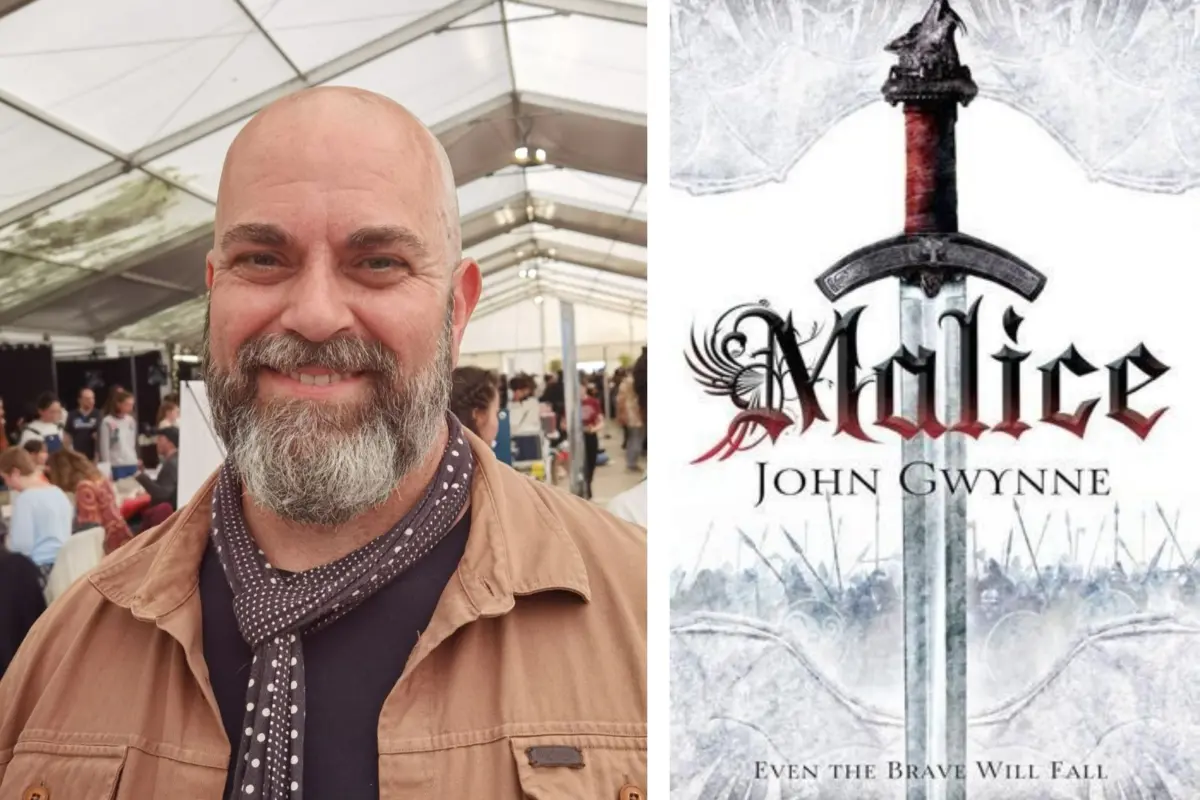
The landscape of epic fantasy television is poised for another monumental addition following the official announcement that John Gwynne’s acclaimed book series, The Faithful and the Fallen, has been optioned for a major television adaptation. The author revealed the milestone development during a live appearance in London, which coincided with the promotional tour for his latest novel, The Wolves of War. While specific details regarding studio affiliation, streaming platforms, network destinations, and production timelines remain closely guarded secrets, the confirmation has instantly galvanized a dedicated global readership that has championed the books for over a decade.
The London Announcement and Initial Revelations
The revelation came directly from Gwynne himself during a crowded literary event in the British capital. Mid-presentation, the author addressed the enthusiastic audience by reading a brief, prepared statement displayed on his mobile phone. The message confirmed unequivocally that negotiations had concluded successfully and that his foundational quartet—comprising Malice, Valor, Ruin, and Wrath—had been acquired for development as a high-budget television series.
True to the traditional protocols of early-stage book-to-screen adaptations, Gwynne exercised caution, declining to elaborate on which production company, studio, or network had secured the intellectual property rights. Furthermore, inquiries regarding potential showrunners, writing staff, budgetary allocations, or impending casting calls were met with silence. Industry observers note that this level of discretion is standard operating procedure for newly minted literary adaptations, as production entities frequently prefer to coordinate synchronized press rollouts alongside major talent acquisitions.
Chronology of The Faithful and the Fallen Universe
To understand the magnitude of this television deal, one must examine the publishing history and trajectory of John Gwynne’s career within the fantasy genre. Gwynne, a former musician and university lecturer who famously worked as a guitar builder and a spoken-word artist, entered the commercial publishing sphere relatively late in life, transforming a lifelong passion for Norse mythology and traditional storytelling into a professional enterprise.
In July 2012, Orbit Books published Malice, the inaugural volume of The Faithful and the Fallen series. Introducing readers to the treacherous expanses of the Banished Lands, the novel established Gwynne as a formidable new voice in grimdark-adjacent traditional fantasy. The narrative momentum steadily increased with the subsequent publication of the remaining core volumes: Valor in 2014, Ruin in 2015, and the dramatic conclusion, Wrath, in 2016.
Following the completion of the original tetralogy, Gwynne did not abandon the world he had meticulously constructed. He expanded the continuity of the Banished Lands through a follow-up sequel series, Of Blood and Bone, which consists of A Time of Dread (2018), A Time of Blood (2019), and A Time of Courage (2021). More recently, Gwynne transitioned to a new Norse-inspired epic fantasy sequence, launching the Bloodsworn Trilogy with The Shadow of the Gods in 2021, The Hunger of the Gods in 2022, and The Faithful and the Fallen spiritual successor trajectory culminating in works like The Wolves of War. The television acquisition, however, centers specifically on the foundational four-book arc that launched his literary career.
Narrative Scope and World-Building of the Banished Lands
The appeal of adapting The Faithful and the Fallen lies in its rich, sprawling lore and traditional yet subverted fantasy tropes. Set within the Banished Lands—a continent scarred by a brutal historical conflict between humanity and a race of giants—the narrative operates on a grand, operatic scale.
The political equilibrium of the realm is fragile. An uneasy peace is threatened as long-dormant giants stir, portents of doom manifest in the natural world—such as bleeding stones and sightings of colossal subterranean worms—and ancient prophecies begin to unfold. At the heart of the mythology is an existential struggle between cosmic forces, where angels and demons turn the mortal world into a bloody chessboard.
The human element anchors this high-stakes cosmic conflict. The story introduces readers to Corban, a young boy initially fixated on the mundane ambitions of youth, such as watching local warriors train and hoping to earn his family’s respect. As the geopolitical landscape collapses and violence engulfs his home, Corban is forced onto a harrowing path of maturation and survival. Simultaneously, monarchs fortify their borders, priesthoods desperately petition silent deities for guidance, and an elite faction recognizes that the ultimate fate of the world rests upon a decisive clash between two prophesied champions: the Black Sun and the Bright Star.
Reviewers and critics have frequently noted the narrative pacing of Gwynne’s work. Literary analysis from outlets like Reactor (formerly Tor.com) has characterized the series as a deliberate "slow-burn." Unlike contemporary fast-paced fantasy that prioritizes immediate spectacle, The Faithful and the Fallen takes calculated time to establish the historical weight, intricate lore, and socio-political dynamics of its world. Once the foundational elements take root, however, the narrative accelerates into relentless, high-stakes military fantasy.
Market Context and Industry Implications
The announcement of a television adaptation for The Faithful and the Fallen arrives at a fascinating juncture for the entertainment industry and the fantasy genre at large. Over the past decade, premium cable networks and subscription video-on-demand (SVOD) platforms have aggressively sought out multi-book fantasy intellectual properties capable of capturing the cultural cachet once held by franchises like Game of Thrones.
With major studios continually scouting for proven book series with built-in, passionate fandoms, Gwynne’s work represents a prime asset. Traditional epic fantasy, characterized by detailed world-building, sprawling ensemble casts, moral complexity, and visceral combat choreography, commands significant global viewership. Gwynne’s background in historical combat reenactment has always infused his battle scenes with a distinct tactile realism and visceral intensity—elements that, if translated effectively to the screen, could provide a distinct competitive advantage in the crowded fantasy television market.
Furthermore, the commercial success of Gwynne’s subsequent output, including the Bloodsworn Trilogy, indicates that his readership has grown exponentially since Malice was published in 2012. An adaptation of The Faithful and the Fallen has the potential to introduce millions of mainstream television viewers to his broader literary bibliography, mirroring the synergistic marketing phenomena observed with other modern fantasy franchises.
Next Steps and Future Outlook
As the literary and television communities await official press releases detailing network partnerships, creative team selections, and production timelines, the immediate impact of Gwynne’s announcement has been a resurgence in book sales and heightened engagement across online fantasy reading communities.
Media outlets, including Reactor, have reached out to John Gwynne’s literary agents and publishing representatives for formal comments regarding the scope of the television deal. While additional disclosures are expected in due course, the confirmation alone marks a monumental step forward for a series that began as a single man’s vision of an ancient, war-torn continent. For longtime fans of Corban, the Banished Lands, and the impending war between the Black Sun and the Bright Star, the journey from the printed page to the screen is officially underway.