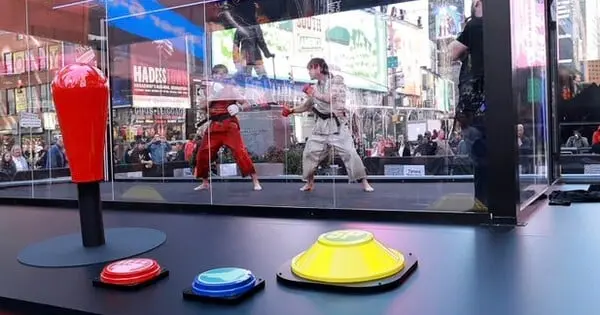
The intersection of global cinema and interactive marketing reached a new milestone this week as the promotional campaign for the upcoming Street Fighter feature film transformed New York City’s Times Square into a living, breathing arcade arena. On Thursday, October 8, 2026, actor Noah Centineo, who portrays the iconic fighter Ken Masters in the highly anticipated live-action adaptation, captivated crowds by executing a choreographed, real-life rendition of the character’s signature "Hell Wheel" move. The performance served as the centerpiece for an immersive marketing activation that has dominated social media discourse in the days leading up to the film’s October 13 theatrical release.
The Spectacle in Times Square
The centerpiece of the activation was a colossal, fully functional Street Fighter arcade cabinet installation positioned in the heart of the bustling tourist hub. Designed to replicate the aesthetic of classic 1990s arcade hardware—complete with oversized, responsive command buttons and a towering joystick—the installation functioned as both a promotional billboard and a stage for live-action stunt performers.
Throughout the day, professional martial artists and stunt doubles dressed as series protagonists Ryu and Ken Masters engaged in stylized combat atop a platform integrated into the cabinet’s base. The kinetic energy of these displays drew thousands of onlookers, effectively blurring the lines between the game’s digital roots and the high-budget physicality of the upcoming film. The climax of the event arrived when Centineo himself took to the makeshift stage, performing a high-fidelity version of the "Hell Wheel" to the roar of the crowd. The studio’s official social media channels quickly capitalized on the viral moment, sharing a clip of the stunt with the caption, "You just witnessed Ken’s Hell Wheel IN REAL LIFE!"
A Marketing Strategy Rooted in Nostalgia
The decision to utilize Times Square for a retro-gaming-themed installation is a strategic move by the studio to tap into the deep-seated nostalgia surrounding the Street Fighter franchise. Since its inception by Capcom in 1987, the series has become a cultural touchstone for multiple generations of gamers. By scaling the arcade experience to a monumental size, the promotional team has successfully bridged the gap between the franchise’s origins and its modern, blockbuster-budget incarnation.
Industry analysts note that this approach is becoming increasingly common for major intellectual property (IP) adaptations. In an era of fragmented media consumption, physical, "experiential" marketing creates "shareable moments" that translate into organic reach on platforms like X (formerly Twitter) and Instagram. Reports from DiscussingFilm, which captured early footage of the stunt performers, highlighted the viral potential of the campaign, noting that the sheer absurdity of a giant arcade console in a high-traffic urban center creates an immediate demand for user-generated content.
Production and Creative Pedigree
The film, directed by Kitao Sakura, represents one of the most ambitious live-action adaptations in recent years, characterized by a sprawling ensemble cast that blends veteran action stars, established dramatic actors, and professional athletes. The cast list features Andrew Koji as Ryu, alongside a supporting roster that includes Rayna Vallandingham as Juli, Orville Peck as Vega, Mel Jarnson as Cammy, Jason Momoa as the formidable Blanka, and Eric André as Don Sauvage.
The diversity of the cast—ranging from martial arts experts like Vidyut Jammwal (Dhalsim) and Olivier Richters (Zangief) to crossover stars like Cody Rhodes (Guile) and Alex Volkanovski (Joe)—suggests a production that prioritizes authentic physicality and combat choreography. The inclusion of figures like Roman Reigns (Akuma) and 50 Cent (Balrog) further signals a deliberate attempt to capture a broad demographic, leveraging the existing fanbases of professional wrestling and hip-hop culture to bolster the film’s reach.
Chronology of the Promotion
The rollout of the Street Fighter promotional campaign followed a tightly controlled schedule designed to maximize anticipation in the final week before the film’s premiere:
- October 5–6, 2026: Teaser images of the oversized arcade hardware begin appearing on local New York news feeds, generating speculation among the gaming community.
- October 7, 2026: The cabinet is fully unveiled in Times Square. DiscussingFilm posts the first high-quality video of stunt performers engaged in choreographed combat, causing the hashtag #StreetFighterMovie to trend regionally.
- October 8, 2026: Noah Centineo makes an unannounced appearance at the installation. His performance of the Hell Wheel serves as the primary press event, with the studio’s official channels releasing the footage shortly after midnight.
- October 13, 2026: Official wide theatrical release of Street Fighter.
Analytical Context: The Challenges of Adaptation
Translating a fighting game to the big screen has historically been a perilous endeavor. Previous attempts have struggled to balance the abstract, heightened reality of a 2D fighter with the narrative demands of a feature film. However, the current production appears to be leaning into the "hyper-reality" of its source material.
By employing actors with legitimate athletic backgrounds, the production team is signaling a commitment to practical stunts rather than an over-reliance on computer-generated imagery (CGI). This shift in philosophy is likely a response to contemporary audience fatigue regarding "CGI-heavy" action sequences. The success of the Times Square event—which relied on the raw, physical performance of the actors—serves as a proof-of-concept for the film’s aesthetic goals.
Official Response and Public Impact
While the studio has remained relatively quiet regarding the specifics of the film’s budget or box office projections, the sheer scale of the Times Square activation implies a significant marketing investment. Industry insiders estimate that such an installation, combined with the logistical requirements of hosting talent like Centineo in a high-profile location, suggests a multi-million-dollar promotional budget aimed at securing a dominant opening weekend.
Public response has been largely enthusiastic. Gaming forums and social media threads have praised the attention to detail in the arcade cabinet’s design, particularly the inclusion of functional, tactile controls. For many fans, the presence of these performers in the city center serves as a validation that the adaptation respects the "spirit" of the game, even if the narrative takes creative liberties.
Looking Ahead: The October 13 Premiere
As the October 13 release date approaches, all eyes are on the potential box office performance. The film enters a competitive landscape, but its unique selling point—the fusion of high-stakes action, a massive ensemble cast, and a globally recognized brand—places it in a strong position.
The success of the Times Square campaign serves as a barometer for the film’s broader cultural resonance. If the "real-life" arcade experience can successfully convert casual observers into ticket buyers, the studio may have found a blueprint for future adaptations of similar video game franchises. For now, the image of Noah Centineo performing the Hell Wheel in the middle of New York City stands as a definitive moment in the 2026 film season—a testament to the enduring power of Street Fighter and the evolving nature of blockbuster marketing in the digital age.
The final days leading up to the release will likely see further social media engagement as the cast continues their promotional tour. However, the Times Square event has already set a high bar for the film’s public-facing presence, cementing the idea that for this adaptation, the game is no longer just on the screen—it is on the streets.