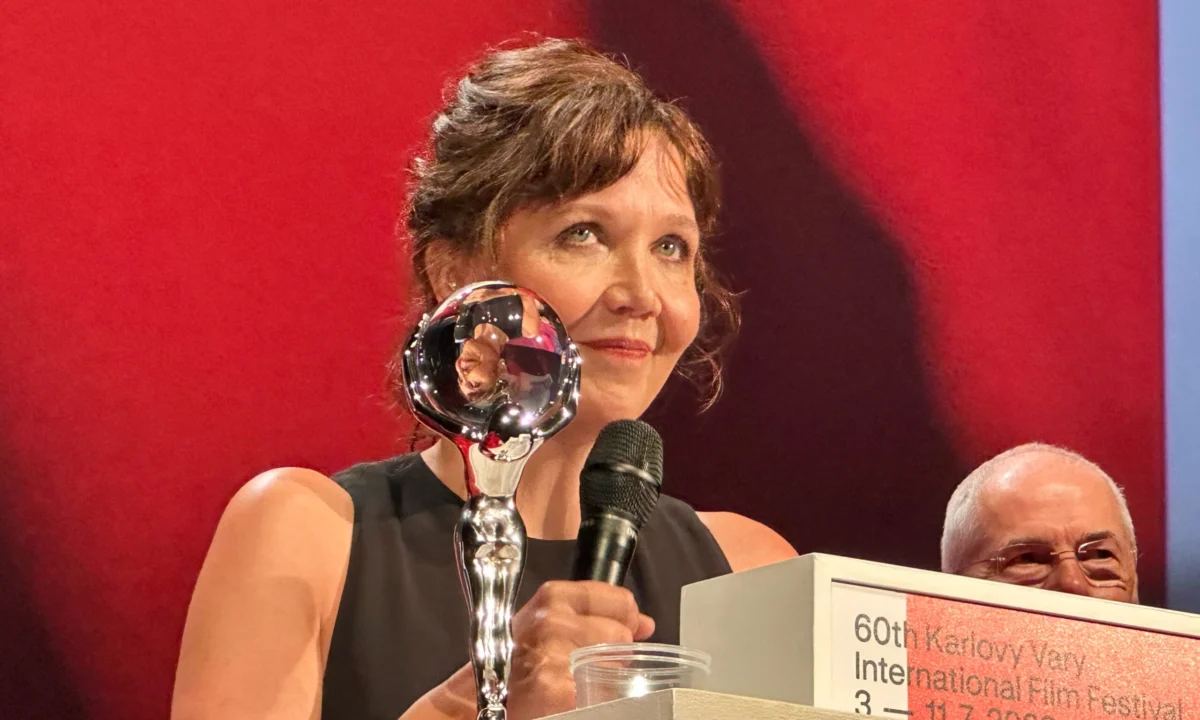
Karlovy Vary, Czech Republic – Acclaimed filmmaker Maggie Gyllenhaal, celebrated for her nuanced performances and increasingly recognized for her distinctive directorial vision, offered profound insights into her evolving career, the responsibilities of filmmaking, and her observations on the broader industry landscape during a press gathering at the Karlovy Vary International Film Festival (KVIFF) on Saturday. Gyllenhaal, who was in the historic Czech spa town to receive the festival’s prestigious President’s Award, engaged journalists in a wide-ranging discussion that touched upon the intricacies of directing, the unique position of women in the field, and her perspectives on contemporary societal issues. Her presence at KVIFF, coinciding with its 60th festival edition in its 80th year, underscored a significant juncture in her artistic journey, marking a return to a festival where she once secured a major acting accolade.
The Director’s Chair: A Parallel to Motherhood and a Newfound Joy
Central to Gyllenhaal’s discourse was her articulation of the directorial role, a responsibility she likened with striking immediacy to the profound experience of motherhood. "I feel it is very similar to being a mother," Gyllenhaal remarked, drawing a compelling analogy. "You become a mother – all of a sudden you are actually responsible for the life of another person. That is both incredibly exciting, powerful, and absolutely terrifying." This comparison highlights the immense weight of creative and logistical stewardship inherent in directing, extending beyond mere artistic expression to encompass the well-being and collaborative efforts of an entire production. She further emphasized the magnitude of this responsibility, stating, "In terms of responsibility, it is really major. That’s a really interesting thing about directing, way more so than producing, and also way more so than acting." This distinction illuminates a hierarchy of accountability she perceives within film production, placing the director at the apex of creative and operational oversight.
Gyllenhaal’s transition from a highly successful acting career to directing, exemplified by her critically acclaimed debut The Lost Daughter and her recent genre-bending endeavor The Bride!, has clearly opened new avenues of creative fulfillment. She expressed particular joy in the collaborative "prep process" with her cinematographer, describing it as "thinking through the movie in a joined imaginary world." This period of conceptualization and shared vision building is, for Gyllenhaal, a source of intense pleasure and intellectual stimulation. "It’s so cool, it’s so intense, and there is the pleasure for me in being on set with a plan with a shared language that we’ve built together," she elaborated. The development of this "shared language" underscores the deep artistic partnership required between a director and their cinematographer, forming the visual grammar of a film. This newfound passion is so profound that it has, in her own words, begun to eclipse her desire to act. "That was new to me, and I didn’t know how much I would love it," Gyllenhaal confessed. "So sometimes when people ask me if I want to act, I think no, I want to prep with my cinematographer, and I want to keep learning this language that I have gotten so much pleasure out of learning." This statement reflects a significant artistic pivot, indicating a sustained commitment to her directorial craft.
Navigating a Male-Dominated Field: Respect and Evolving Dynamics
Gyllenhaal also addressed the historically entrenched gender dynamics within the film industry, particularly concerning the directorial role. "Directing is, historically and still, predominantly a male job," she acknowledged, echoing a widely recognized reality within Hollywood and global cinema. Despite increasing calls for diversity and inclusion, statistics consistently show an imbalance in directorial opportunities for women. For instance, recent reports from institutions like the USC Annenberg Inclusion Initiative and the Celluloid Ceiling study by the Center for the Study of Women in Television and Film at San Diego State University have consistently highlighted that women direct only a small fraction of top-grossing films, though their presence in independent cinema and television has seen modest growth.
Her personal experience, however, offered a nuanced perspective on how her new role has altered interactions within the professional sphere. "I found that when I went to do it, I was treated with a kind of respect that I had never encountered before, just because that’s how one treats the director," Gyllenhaal shared. This observation speaks volumes about the inherent authority and deference traditionally afforded to the director, regardless of gender, once they assume the mantle of leadership. While the path to the director’s chair may be more arduous for women, Gyllenhaal’s comments suggest that once there, the professional respect commanded by the role itself transcends gender biases in certain contexts. This insight offers a glimmer of hope regarding the professional recognition that awaits female directors, even as the industry continues its slow march towards equitable representation.
KVIFF’s Enduring Legacy and Gyllenhaal’s Two Decades of Connection
Maggie Gyllenhaal’s appearance at KVIFF was not merely a celebration of her recent achievements but also a full-circle moment, connecting her current status as an esteemed director with her earlier career as an actress. She traveled to the Czech Republic, accompanied by her husband, actor Peter Sarsgaard, to receive the festival’s President’s Award at the opening ceremony on Friday night. This honor, bestowed upon individuals who have significantly contributed to world cinema, places her among a distinguished cohort of past recipients, including luminaries like Julianne Moore, Casey Affleck, and John Travolta. KVIFF, established in 1946, stands as one of the oldest and most prestigious film festivals in Central and Eastern Europe, recognized as a Category A festival by the International Federation of Film Producers Associations (FIAPF). Its 60th edition, celebrated in the 80th year since its inception, underscores its enduring legacy and its vital role in fostering cinematic dialogue and showcasing diverse storytelling.
Notably, Gyllenhaal’s history with KVIFF dates back two decades. In 2006, she clinched the Best Actress award for her compelling performance in Laurie Collyer’s drama Sherrybaby. In the film, Gyllenhaal portrayed a young woman grappling with recovery from heroin addiction after being released from prison, a role that garnered significant critical acclaim and contributed to Sherrybaby also winning Karlovy Vary’s coveted Crystal Globe award that year. However, due to unforeseen circumstances, she was unable to attend the festival to accept her award in person back then. Her return this year to accept the President’s Award thus served as a poignant culmination of her journey, acknowledging both her artistic evolution and her lasting connection to the festival.
During her acceptance speech for the 2024 honor, Gyllenhaal fondly recalled a study abroad semester in the Czech Republic, which included a visit to Karlovy Vary, as a formative experience. She shared that this period was "part of what pushed me to be a director to express my view of the world, however strange and challenging, and however different." This revelation provides a deeper understanding of the origins of her directorial ambition, linking it to an early, perhaps subconscious, desire to articulate a unique perspective through the cinematic lens, a desire that has now fully blossomed.
Beyond Cinema: Personal Stances and Public Discourse
The discussion at KVIFF also ventured into Gyllenhaal’s personal views on contemporary societal and political matters, reflecting the increasing expectation for public figures to engage with broader issues. On the occasion of America’s 250th birthday, which coincided with the festival, Gyllenhaal initially acknowledged the date by saying, "It is the Fourth of July today, so we’re celebrating it here." However, she quickly pivoted to a more introspective stance: "I’m abstaining from celebration this year. I’m not celebrating the Fourth of July." This statement, while brief, suggests a nuanced perspective on national celebration, potentially aligning with a growing segment of the population that views the historical and contemporary complexities of American identity with critical reflection rather than unbridled festivity. Such sentiments are often rooted in ongoing debates about social justice, civil rights, and the nation’s role on the global stage, indicating a thoughtful engagement with the current socio-political climate.
Gyllenhaal was also directly questioned about her daughter Ramona’s involvement in last year’s Columbia University protests, where students demonstrated against Israel’s war in Gaza, leading to arrests. Her response was both concise and definitive, emphasizing her daughter’s autonomy: "My daughter is her own woman. I’m sure you’re not surprised to hear that." This statement underscores a parent’s respect for their child’s independent political and social conscience, particularly in an era where student activism on university campuses has become a significant focal point of national and international discussion. The Columbia University protests, part of a larger wave of student demonstrations across the United States and globally, brought intense scrutiny to issues of free speech, academic freedom, and geopolitical conflict, placing students and their families at the center of a complex and often polarizing debate.
Future Horizons: From "The Bride!" to "Creation Lake"
Gyllenhaal’s recent directorial work has been characterized by both ambition and the inherent risks of creative exploration. Her latest film, The Bride!, a genre-bending reimagining of the Frankenstein narrative, which she was also introducing at a late Saturday screening, garnered significant attention but faced challenges at the box office. While specific figures can be impacted by various factors including release strategy, market saturation, and audience reception for non-franchise films, the commercial performance of The Bride! serves as a reminder of the competitive and often unpredictable nature of the contemporary film market, especially for original, art-house leaning genre pictures.
Despite the commercial reception of The Bride!, Gyllenhaal’s directorial journey continues with robust industry backing. She recently reteamed with Warner Bros., with the studio optioning Rachel Kushner’s acclaimed novel Creation Lake for her to write and develop as a directing vehicle. Gyllenhaal is also attached to produce the project, indicating a comprehensive creative involvement. Rachel Kushner, a highly regarded contemporary American author, is known for her distinctive literary voice, intricate narratives, and sharp social commentary, often exploring themes of rebellion, identity, and the fringes of society in novels like The Flamethrowers and The Mars Room.
Asked about Creation Lake at the festival, Gyllenhaal offered a glimpse into its nascent stage of development. "It’s in the very, very beginning of the process," she stated, emphasizing the delicate nature of early creative work. "I feel like it’s in the part of the creative [process] that is so personal and private and secret. I’m very excited about it. I love the author, Rachel Kushner. I love the book. I have my own unusual take on it, but it’s just beginning to simmer." This description highlights the intimate and often solitary initial phase of adapting a literary work for the screen, where the director’s unique vision begins to coalesce. The project’s early phase suggests a careful, deliberate approach to bringing Kushner’s work to life, with Gyllenhaal’s "unusual take" promising a fresh and distinctive cinematic interpretation.
As Maggie Gyllenhaal continues to carve out her path as a director, her observations at KVIFF provide valuable insights into the artistic, professional, and personal dimensions of filmmaking. From the profound responsibility she feels at the helm, akin to motherhood, to the evolving dynamics for women in a historically male-dominated industry, her perspective underscores a thoughtful engagement with her craft and the world around her. Her journey, marked by critical acclaim as both an actor and director, solidifies her position as a significant voice in contemporary cinema, dedicated to exploring complex narratives and pushing artistic boundaries.