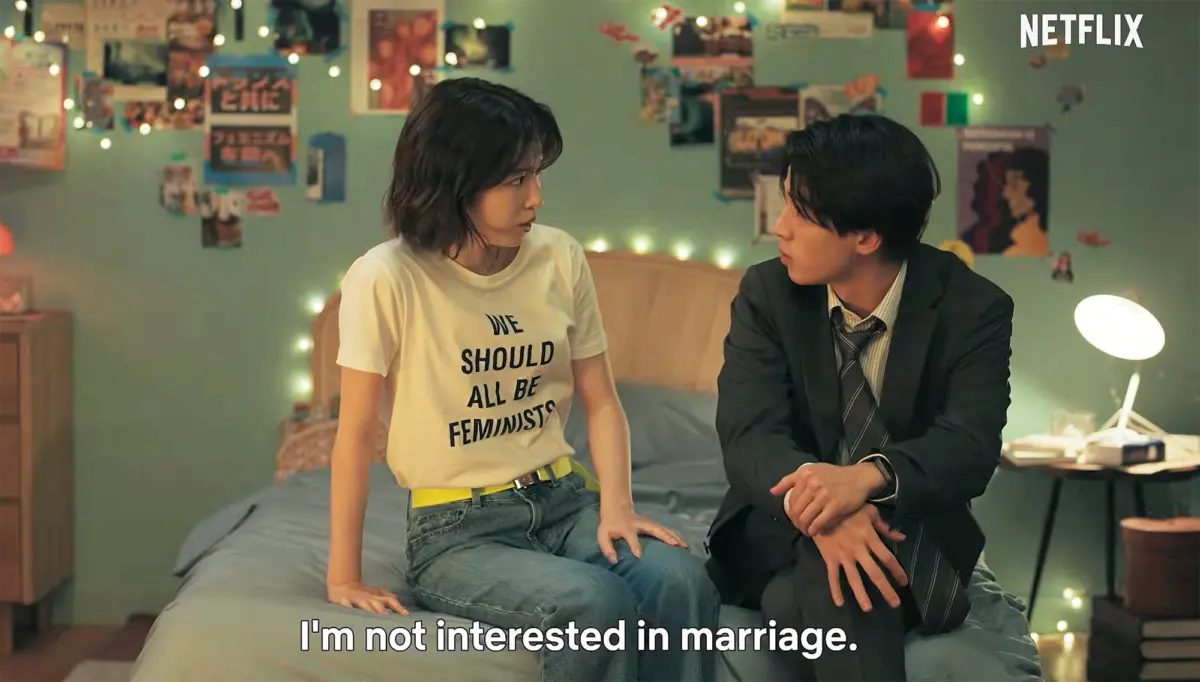
Netflix has officially released the high-anticipated trailer, key art poster, and promotional imagery for its upcoming Japanese feature film adaptation, My Crazy Feminist Girlfriend. Directed by acclaimed Japanese filmmaker Keiichi Kobayashi and adapted from Min Ji-Hyoung’s hit Korean novel of the same name, the romantic comedy stars Mei Nagano and Taisei Kido. Scheduled for a worldwide streaming release on Netflix on December 3, 2026, the film aims to spark cultural discourse around shifting gender roles, modern relationships, and societal expectations in contemporary Japan.
The narrative centers on Haruki, played by Taisei Kido, a self-proclaimed nice guy who remains infatuated with his first love, who abruptly ended their relationship years prior due to an unspecified incident. Seven years later, while commuting home from work, Haruki crosses paths with a group of female demonstrators and is shocked to discover that one of the passionate activists is his unrecognizable ex-girlfriend, portrayed by Mei Nagano. What begins as an earnest plea from Haruki for a second chance quickly devolves into ideological warfare as the former couple clashes over societal norms, personal autonomy, and the modern definitions of love and rights.
The Supporting Cast and Production Team
Directed by Keiichi Kobayashi—whose previous directorial credits include About the Pink Sky, Bon Lin, Lights of Kyoto, He Won’t Kill She Won’t Die, Love is Light, the television series Eternal Yesterday, and A Girl & Her Guard Dog—the project brings together a notable ensemble cast from the Japanese entertainment industry. Alongside leads Mei Nagano and Taisei Kido, the film features performances by Junki Tozuka, Maho Nonami, Sotaro Tanaka, Hiroki Konno, Manami Higa, and Yumi Aso. The film is produced by industry veterans Kei Haruna and Mio Morita.

The cinematic adaptation is based on the widely read Korean novel My Crazy Feminist Girlfriend by author Min Ji-Hyoung, originally published by Louder Books. The transition from a Korean literary source to a Japanese cinematic landscape represents a deliberate effort by the production team to address regional nuances in gender politics, maintaining the source material’s satirical edge while tailoring the social commentary to modern Japanese audiences.
Chronology and Development Timeline
The path to the film’s December 2026 release reflects a steady trajectory of international literary adaptation and strategic streaming distribution.
- Literary Origins: Min Ji-Hyoung’s novel My Crazy Feminist Girlfriend gained widespread traction in South Korea for its sharp, humorous examination of modern romance intersecting with contemporary feminist discourse.
- Adaptation Announcement: Japanese studios acquired the rights to adapt the novel into a feature-length romantic comedy, enlisting Keiichi Kobayashi to helm the project due to his experience directing character-driven narratives with distinct social commentary.
- Casting and Principal Photography: Production commenced with Mei Nagano and Taisei Kido cast in the lead roles, capturing the chemistry required for characters locked in both romantic tension and ideological debate.
- Trailer and Poster Reveal (October 30, 2026): Netflix released the official promotional trailer and theatrical posters via YouTube and media outlets, setting a global release date of December 3, 2026.
Background Context: Evolving Media and Gender Dynamics in Japan
The release of My Crazy Feminist Girlfriend arrives at a critical juncture in Japanese media regarding the representation of gender roles, feminism, and interpersonal relationships. Historically, mainstream Japanese romantic comedies have leaned heavily into traditional tropes, often portraying female characters through domestic or submissive lenses. However, in recent years, streaming platforms such as Netflix, Amazon Prime Video, and Disney+ have accelerated the demand for content that challenges conservative frameworks and reflects shifting societal realities.

Japan continues to grapple with systemic gender inequality, reflected in international metrics such as the World Economic Forum’s Global Gender Gap Report, where Japan routinely ranks lower among developed nations regarding political empowerment and economic participation. By framing these complex socio-political discussions within the accessible, lighthearted genre of a romantic comedy, filmmakers have a unique vehicle to reach demographics that might otherwise avoid overtly political documentaries or academic texts.
Industry Analysis and Market Implications
Media analysts and cultural commentators have noted several broader implications regarding the strategic release of My Crazy Feminist Girlfriend:
- Cross-Cultural Adaptation Trends: The project highlights the ongoing success of adapting contemporary South Korean literature for Japanese media markets. While South Korea and Japan share certain cultural and societal proximity regarding Confucian values and rapid modernization, the distinct cultural adjustments made during the adaptation process allow the narrative to resonate specifically with Japanese viewers.
- Streaming Platforms as Catalysts for Social Discourse: Traditional box offices in Japan can occasionally shy away from controversial or politically sensitive subjects due to risk aversion among major studio financiers. Global streaming services like Netflix, however, possess the financial flexibility and international reach to back content designed specifically to provoke conversation and debate among younger, digital-native audiences.
- Genre Subversion: By utilizing the romantic comedy framework—traditionally built on predictable narrative resolutions—Kobayashi subverts audience expectations. The conflict does not solely revolve around external plot barriers, but rather internal philosophical differences that challenge the male protagonist’s preconceived notions of entitlement, romance, and societal complicity.
Official Responses and Public Reception
Following the October 30, 2026 release of the official trailer and key art, initial public response on social media platforms and film discussion boards has been robust. Fans of Mei Nagano and Taisei Kido have expressed enthusiasm for the sharp comedic timing displayed in the footage, while literary fans of Min Ji-Hyoung’s novel have scrutinized the visual choices and tonal balance of the adaptation.

Commentators have pointed out that the provocative title alone has successfully captured public attention, functioning as an intentional hook to draw viewers into a nuanced narrative that ultimately explores mutual understanding rather than outright polarization. While some conservative viewers have questioned the film’s satirical approach to contemporary activism, progressive audiences have welcomed mainstream media’s willingness to engage with feminist principles in a commercial feature film.
Next Steps Leading to the Premiere
With the promotional campaign officially underway, Netflix will roll out additional promotional interviews, featurettes, and press events featuring director Keiichi Kobayashi and leads Mei Nagano and Taisei Kido throughout November 2026. The film is slated to premiere globally on Netflix on December 3, 2026, where it will be available with multi-language subtitles and dubbing options, positioning it as one of the major international streaming releases to close out the year.