The intersection of generative artificial intelligence and traditional cinematic production has become the central flashpoint of modern media, yet the current technological landscape suggests that a complete replacement of live-action filmmaking remains a distant prospect. During a featured session at the Access Canada Summit—an industry-leading forum powered by The Hollywood Reporter—Coco Mao, co-founder and CEO of the AI startup OpenArt, provided a nuanced perspective on the trajectory of digital creation. Speaking with Steven Zeitchik, the magazine’s senior editor for technology and politics, Mao articulated a vision for the entertainment industry that favors a collaborative synthesis of human performance and synthetic enhancement rather than an automated revolution.
The Rise of Generative Video and the "Vibe Directing" Paradigm
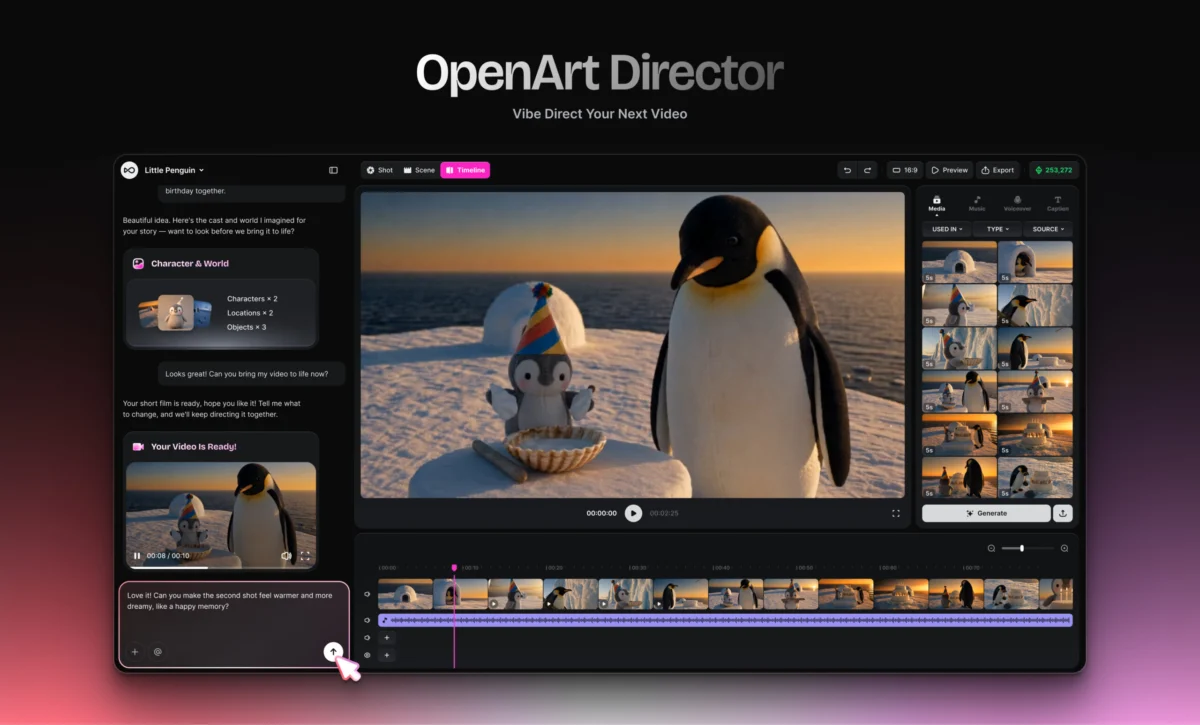
At the core of the discussion was OpenArt’s latest innovation, a tool dubbed "Director." Designed to bridge the gap between creative conceptualization and visual output, the software allows users to translate natural language prompts and detailed scripts directly into video content. Currently, the platform boasts a monthly user base of approximately seven million, a significant portion of whom hail from the marketing and advertising sectors.
Mao noted that the adoption rate in digital marketing is markedly higher than in traditional film and television. This disparity is largely driven by the economic imperatives of social media content creation, where speed and cost-efficiency are paramount. Marketing agencies, according to Mao, represent a unique segment of the creative economy because they are highly motivated to invest in tools that facilitate the rapid production of revenue-generating assets.
The platform’s "vibe directing" approach allows creators to maintain stylistic consistency over video segments lasting up to five minutes. By focusing on tonal cues and visual style transfers, the tool enables creators to iterate on concepts with unprecedented velocity. However, Mao is careful to distinguish between this rapid-fire content creation and the rigorous demands of professional cinematic production.
Chronology of AI Integration in Media
To understand the current tension between AI developers and the film industry, one must examine the timeline of technological disruption in Hollywood. The early 2010s saw the democratization of high-quality digital cameras, which lowered the barrier to entry for independent filmmakers. By the late 2010s, deepfake technology and initial iterations of neural style transfer began to surface in experimental film circles.
The year 2023 served as a watershed moment for generative AI, with the release of sophisticated text-to-video models such as Runway Gen-2, Pika Labs, and OpenAI’s Sora. This rapid maturation forced a reckoning within the industry, culminating in the 2023 WGA and SAG-AFTRA strikes. These labor disputes underscored a profound anxiety regarding the potential displacement of human labor.
In this context, Mao’s cautious approach to "Director" reflects a strategic decision to align with, rather than disrupt, existing professional workflows. By positioning her tool as a utility for previz (pre-visualization) and post-production, Mao aims to navigate the delicate political climate of the film industry, acknowledging that trust must be built before these tools can be integrated into high-budget productions.
Comparative Analysis of Industry Adoption Rates
The film and television industry is historically one of the most conservative sectors regarding the adoption of disruptive technology, and Mao argues that this caution is well-founded. While digital creators and influencers have embraced generative AI to replace physical sets and traditional logistics, professional filmmakers prioritize reliability, legal security, and creative control.
Data from the current market suggests that while the use of AI in pre-production—specifically for storyboarding and concept art—is accelerating, its role in principal photography remains minimal. A recent industry survey indicated that while 65% of post-production houses have experimented with AI-driven color grading or upscaling, fewer than 15% of feature-length productions have utilized AI for primary scene generation.
Mao emphasized that the difficulty of replicating human performance is the primary barrier to total AI adoption. "I don’t see moving strictly online as the right direction, because people’s acting is still very, very hard to imitate in AI," she stated. This sentiment echoes the broader consensus among casting directors and performance coaches, who argue that the nuance of human emotion—the micro-expressions, timing, and interpersonal chemistry—remains beyond the current scope of generative models.
Historical Precedent: The VFX Parallel
During the Access Canada Summit, Mao drew a direct comparison between the current resistance to generative AI and the historical reception of Visual Effects (VFX) in the 1980s and 90s. When digital compositing and CGI were first introduced, a significant faction of the creative community viewed the technology as an existential threat to the "purity" of the film medium.
"It’s almost like when VFX came out and a lot of people were against it," Mao observed. "And now, there are so many VFX artists." The evolution of VFX demonstrates a cyclical pattern: initial fear, followed by integration, and finally, the emergence of a new professional class dedicated to the technology.
This historical lens suggests that the tension surrounding tools like OpenArt’s Director may eventually dissipate as the technology becomes a standardized part of the filmmaking curriculum. However, the transition will likely be characterized by a hybrid model. Rather than replacing physical sets or actors, future production workflows will likely utilize AI to enhance, extend, or augment footage captured on location, reducing the need for expensive reshoots or CGI-heavy traditional workflows.
Broader Implications for the Creative Economy
The implications of this shift are twofold. First, there is the immediate impact on cost structures. By enabling smaller production teams to achieve higher visual fidelity, generative AI is lowering the "floor" of entry for high-end production values. Second, there is the long-term impact on the division of labor. If an editor can use an AI tool to generate a background, or a cinematographer can use it to test lighting setups in real-time, the roles of these professionals will evolve to become more curatorial and directorial in nature.
However, the industry faces significant hurdles, including copyright litigation regarding training data and the ethical implications of deepfake technology. Legal experts monitoring these developments suggest that until a clearer regulatory framework is established, major studios will remain hesitant to adopt generative AI in a way that risks their intellectual property rights.
Official Responses and Future Outlook
The industry’s response to Mao’s presentation was largely reflective of the broader "wait and see" attitude prevalent in Hollywood. Producers, directors, and union representatives have expressed a keen interest in the productivity gains offered by AI, provided that the tools respect the sanctity of performance and the intellectual property of the creators.
As the Access Canada Summit concluded, the prevailing consensus was that the industry is in a period of transition. The technology is no longer a distant abstraction; it is a tangible, albeit nascent, part of the creative ecosystem. Mao’s vision for a hybrid future—where the camera captures the soul of the performance and AI elevates the environment around it—offers a roadmap for how the industry might survive the transition without losing its human core.
Looking ahead, the next 24 to 36 months will be critical. As models improve in coherence, temporal consistency, and fidelity, the "vibe directing" tools currently favored by social media creators will likely find their way into the high-end boutique production houses, eventually trickling into the major studio pipeline. Whether this results in a renaissance of independent filmmaking or a consolidation of power among those who own the most advanced tools remains a subject of intense debate. For now, however, the focus remains on incremental integration, ensuring that the technology serves the story, rather than the story serving the technology.