The second-season premiere of Starz’s highly anticipated Outlander prequel, Outlander: Blood of My Blood, picks up immediately following the intense narrative threads established in the season one finale. The episode, titled "Remembrance Day," thrusts its central couples—Brian Fraser and Ellen MacKenzie, as well as Henry and Julia Beauchamp—into harrowing circumstances defined by geopolitical upheaval, familial duty, and the insurmountable barriers of time. As the historical romantic drama leans heavily into its dramatic elements, both storylines fracture existing alliances, forcing the female protagonists to navigate hostile environments while their male counterparts confront unprecedented physical and psychological trials.
Main Facts and Chronological Setup
The narrative architecture of Outlander: Blood of My Blood relies heavily on the juxtaposition of historical reality and speculative fiction, a thematic signature inherited from its parent series, Outlander. In the premiere, the consequences of the turbulent Grant-MacKenzie wedding reverberate across the Scottish Highlands and 20th-century Britain alike.

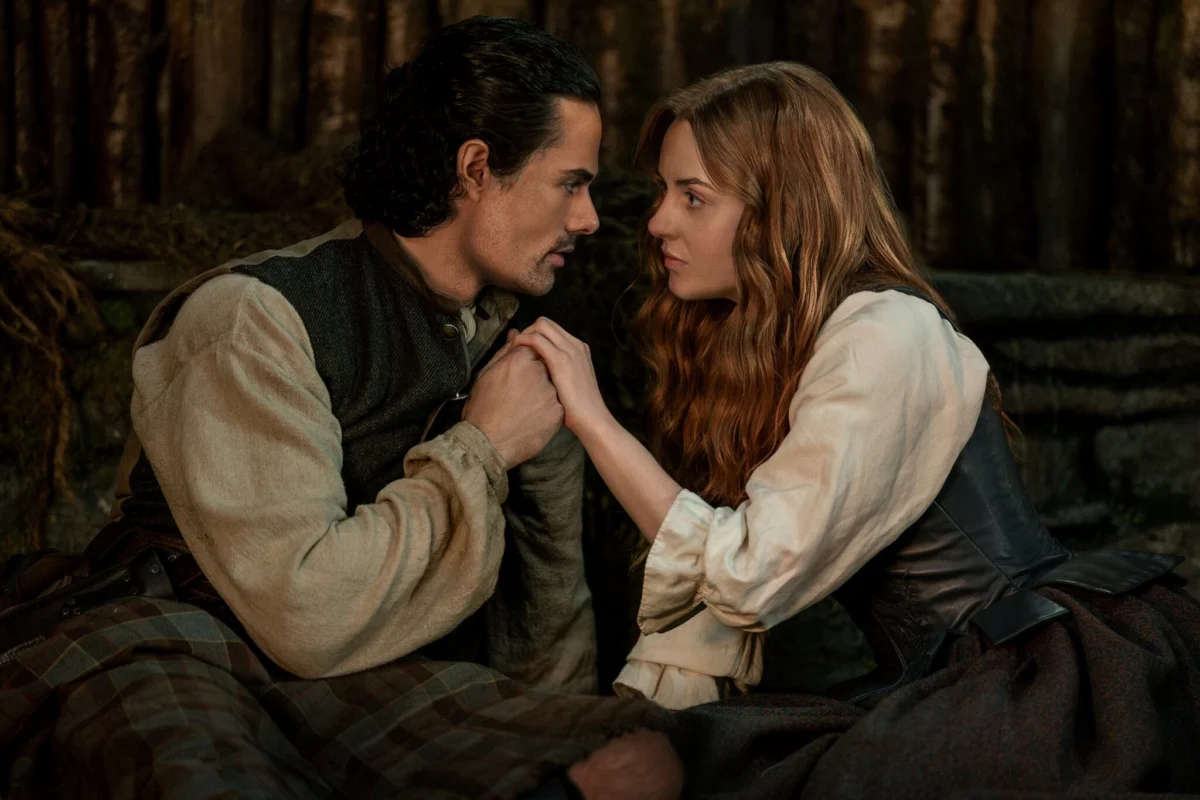
According to the established chronology of the episode, Brian Fraser (portrayed by Jamie Roy) is summoned by the fiery crosses to take up arms in the impending Jacobite uprising. This mandatory departure shatters any immediate hopes of a domestic life with Ellen MacKenzie (Harriet Slater), who is compelled to return to Castle Leathers under a veil of secrecy, concealing the truth of their union from her formidable clan.
Simultaneously, the fate of the Beauchamp family is resolved with tragic velocity. Henry Beauchamp (Jeremy Irvine) attempts to transport his wife, Julia (Hermione Corfield), and their infant son, William, through the mystical stone circle. However, the temporal passage fails initially, leaving them vulnerable to an ambush by Arch Bug. The ensuing chaos results in Henry successfully passing through the stones to 1924, while Julia is left stranded in the past alongside her infant child.
Character Arcs and Psychological Fallout
The emotional core of the premiere rests on the performances of the principal cast as they grapple with separation and survival. Within the first five minutes of the episode, Julia Beauchamp’s reaction to Henry’s disappearance sets a tone of visceral grief. Forced to mask her devastation instantly, Julia adopts a survival narrative, claiming she was abducted by a "Grant bladier" to appease the hostile inhabitants of Castle Leathers and deflect suspicion from Lord Lovat’s calculated advances.

To maintain her agency, Julia confides her true origins as a time traveler to Davina. While Davina’s initial skepticism leaves her attributing Julia’s claims to folklore or witchcraft, the shared secret provides Julia with a vital confidante as she plots a future escape.
Conversely, Henry’s journey takes a profoundly psychological turn. Stranded in Inverness in 1924—having departed from 1923—Henry suffers from a severe stab wound and subsequent fever, leading to his institutionalization in a psychiatric asylum. Seeking to treat his condition, medical practitioners administer early electroconvulsive therapy (ECT). Rather than clarifying his state of mind, the treatment induces jarring hallucinations that merge his memories of the 18th-century Highlands with 20th-century realities.
Production stills and narrative analysis indicate that these hallucination sequences are visually striking and crucial to illustrating Henry’s declining mental stability. In a moment of acute tragedy within a warped memory, Henry recalls hearing the laughter of a young Claire, yet he remains trapped in a timeline where he cannot remember his own surname, identifying only as Henry Grant. Consequently, his connection to Uncle Lamb remains severed, leaving him isolated from potential familial rescue in the 20th century.

Historical Context and Institutional Responses
The broader historical backdrop of Outlander: Blood of My Blood incorporates the simmering tensions of the Jacobite risings, which serve as a catalyst for the separation of Brian and Ellen. Both characters experience the stifling weight of clan politics. Ellen faces reprimand from Colum MacKenzie upon her return, while Brian encounters open disdain from Lord Lovat. These interactions alienate both characters from their traditional allegiances, mirroring the broader historical friction that characterized mid-18th-century Scotland.
In the 20th-century narrative thread, the introduction of Reverend Wakefield provides a critical link to established Outlander lore. Historically recognized as a pivotal figure in facilitating Claire Fraser’s return through the stones and acting as the adoptive father of Roger MacKenzie, the Reverend’s appearance in the 1924 timeline establishes a pre-existing connection to the unfolding temporal anomalies. Although initially skeptical of Henry’s erratic claims and inclined toward spiritual counsel, the Reverend—alongside Mrs. Graham, a known participant in the sun-feast rituals at Craigh na Dun—offers a glimmer of hope. Mrs. Graham’s willingness to listen provides Henry with a crucial lifeline, bridging the gap between clinical misunderstanding and esoteric reality.
Broader Impact and Industry Analysis
As Outlander: Blood of My Blood progresses into its second season, the structural reliance on parallel timelines continues to distinguish the series within the historical drama genre. By anchoring the narrative in dual eras—the pre-Jacobite Scottish Highlands and post-World War I Britain—the production expands the mythological scope of the Outlander universe while exploring themes of institutional control, familial duty, and temporal displacement.

Industry analysts note that prequels often struggle to maintain audience engagement when the ultimate fates of their primary characters are pre-determined by an established parent series. However, by focusing on the lesser-known parental lineage of Jamie Fraser and Claire’s parents, the writers have carved out a distinct narrative space that avoids predictable plotting. The introduction of high-stakes medical trauma, such as early psychiatric treatments, combined with supernatural elements, broadens the genre appeal beyond traditional romance.
As "Remembrance Day" concludes, the overarching narrative sets a rigorous pace for the remainder of the season. With Brian marching toward war, Julia strategizing her escape within Castle Leathers, and Henry fighting to reclaim his identity in a 1924 asylum, the foundational conflicts of Outlander: Blood of My Blood are firmly established, promising a complex exploration of love, sacrifice, and survival across the centuries.