Last autumn, during the height of the awards season promotional circuit for his feature film One Battle After Another, acclaimed director Paul Thomas Anderson was spotted alongside frequent collaborator Benny Safdie inside the historic walls of Carnegie Hall. Armed with film cameras, the duo captured a sold-out, minimalist performance by Brooklyn-based musician Cameron Winter. Initially circulating as unverified smartphone clips and social media rumors, the project sparked widespread speculation throughout the entertainment industry. Observers questioned whether the footage was intended for a standard music video, a promotional teaser, or an episodic documentary. Months later, those questions were answered with the official announcement of a 75-minute, feature-length concert film directed entirely by Anderson. The project made its high-profile world premiere on October 1 at the New York Film Festival, followed by a targeted, highly exclusive theatrical rollout utilizing pristine 35mm prints in late November.
Chronology and Production Background
The genesis of the project dates back to a single evening in December of the previous year, during Winter’s critically lauded solo engagement at Carnegie Hall. Unlike conventional concert documentaries that rely on multiple dates, cross-cutting between venues, and extensive post-performance pick-up shots, Anderson and his production team chose a purist approach. The entirety of the visual material utilized in the final cut was recorded live during that single performance.
Production logistics reflected the spontaneous nature of the collaboration. Reports from the venue indicated a lean, mobile crew operating under tight constraints to capture the atmosphere without disrupting the intimate nature of Winter’s performance. By relying exclusively on the single-night recording, the filmmakers preserved an unfiltered sense of urgency. The chronology of the production shifted rapidly from a quiet, unannounced shoot in late autumn to a finalized theatrical cut slated for festival submission by early October, bypassing traditional multi-month editorial cycles typical of high-profile music documentaries.
Aesthetic Design and Cinematography
Running at a brisk seventy-five minutes, the film bypasses standard documentary tropes such as talking-head interviews, archival background packages, and introductory voiceovers. Instead, the runtime plunges the audience directly into the venue. The opening sequences establish a distinct sense of place, featuring exterior shots of the winter evening, patrons presenting tickets at the turnstiles, and audiences settling into their seats.
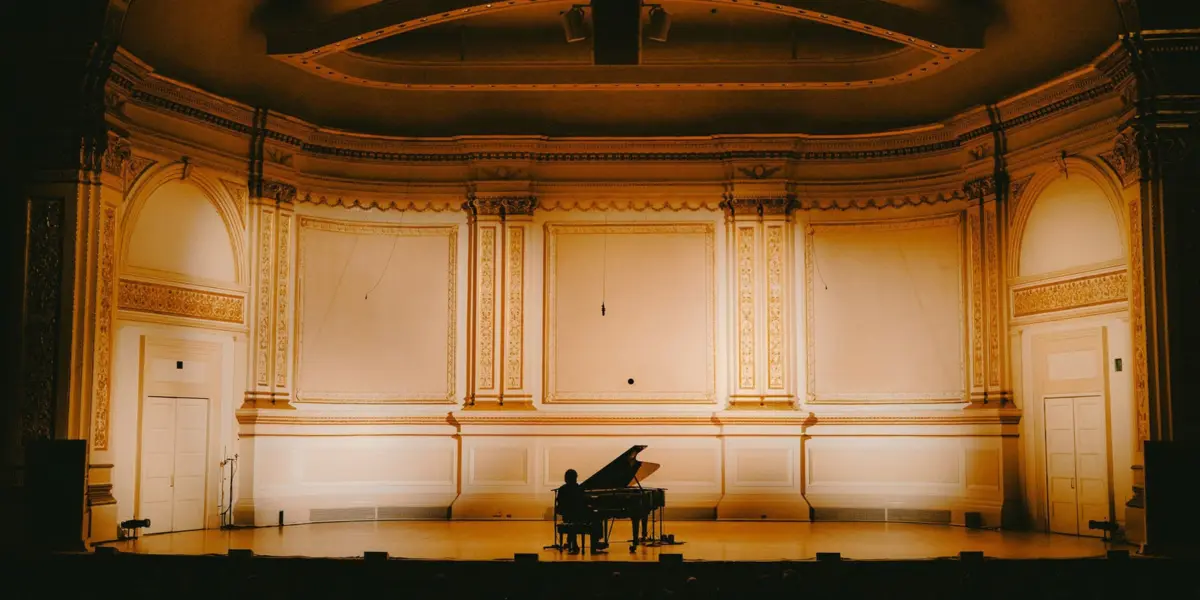
Aesthetically, the film is defined by a warm, cozy palette dominated by rich orange and brown hues. This color grading enhances the intimacy of the space, contrasting sharply with the often cold, overly digital look of contemporary concert recordings. Camera placement fluctuates intentionally between stark intimacy and distant observation. Striking visual compositions capture Winter’s silhouette cast against the stage backdrop or complex reflections rippling across the polished surface of his piano.
Technical execution, however, reveals the constraints of the rapid, live-action production style. The camerawork features moments of visible instability, with certain tracking shots exhibiting noticeable hand-held shake and steady frames occasionally drifting as camera operators dynamically search for optimal framing in real time. Rather than utilizing stabilization algorithms or secondary takes to smooth out these imperfections, the final edit embraces the raw, unvarnished mechanics of the live recording process.
Audio Engineering and Musical Performance
The auditory component of the project serves as its primary anchor. Recorded with acoustic precision, the sound design faithfully replicates the natural reverberation and acoustic profile of performing within the famed main auditorium of Carnegie Hall. Winter’s vocals and piano arrangements are rendered with pristine clarity, offering viewers an authentic auditory experience that closely mirrors being physically present in the room.
Interspersed between musical numbers are brief moments of stage theatrics and transitional audience interaction. By retaining these interludes, the film maintains a theatrical rhythm that breaks up the musical chronology and underscores the personality of the performer. Industry analysts note that the success of the audio-visual pairing relies heavily on the viewer’s pre-existing affinity for Winter’s musical catalog. Because the film offers little contextual introduction to the artist, audiences unfamiliar with his solo work may find the experience challenging, whereas devoted fans receive a high-fidelity artifact of his live touring persona.
Industry Implications and Critical Reception
The surprise release of the collaboration between a master filmmaker and an independent indie-rock musician highlights a growing trend of high-profile directors exploring spontaneous, low-footprint digital and celluloid hybrid projects. By utilizing 35mm projection for a limited theatrical run, Anderson reinforced his well-documented advocacy for analog film exhibition in an increasingly digital distribution landscape.
Critical reception of the film has been characterized by a division between appreciation for its raw, unpretentious vitality and technical critiques of its rougher editorial choices. Reviewers have debated whether the visible operator adjustments and occasional shaky tracking shots represent a deliberate stylistic choice emulating cinema vérité or simply the unavoidable byproduct of a frantic, single-night live shoot. Regardless of these technical debates, media analysts suggest that the project functions as a successful trial run for Anderson, demonstrating his capacity to pivot toward rapid, independent documentary filmmaking outside the traditional studio apparatus. For fans of both artists, the resulting feature stands as a unique archival document of a singular performance space captured through a distinctive cinematic lens.