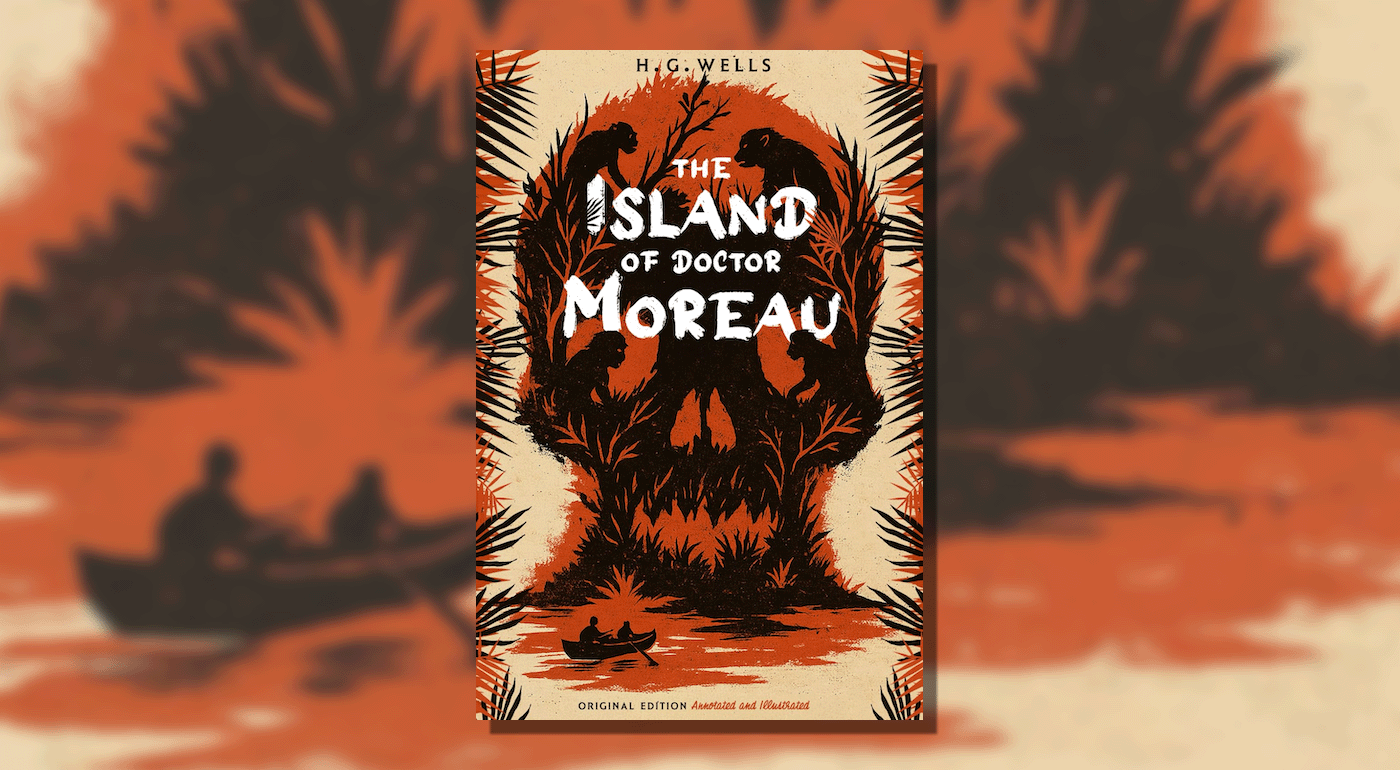
The literary and cultural analysis series Reading the Weird has returned to examine the intricate intersections of cosmic horror, historical science fiction, and early speculative literature, dedicating its latest installment to chapters 13 through 15 of H.G. Wells’s seminal 1896 novel, The Island of Doctor Moreau. Originally serialized and published during a period of intense public and scientific debate regarding evolutionary theory, medical ethics, and vivisection, Wells’s novel continues to provoke critical discussion concerning the philosophical boundaries of human intervention in the natural world. This week’s analytical deep dive, led by commentators Ruthanna and Anne, unpacks the moral arguments of the titular mad scientist, the psychological erosion of the protagonist Edward Prendick, and the historical controversies surrounding animal experimentation in Victorian Britain.
Confrontation and Parley Along the Shoreline
The narrative sequence under review begins with Chapter 13, titled A Parley, in which the protagonist Edward Prendick attempts to escape the relentless terror of the compound by fleeing to the island’s coastline. Hoping to break into the enclosure to secure a weapon, Prendick is instead intercepted by Dr. Moreau, Montgomery, a staghound, and a contingent of Beast Men who systematically cut off his inland retreat. Driven to utter desperation by the prospect of being captured and subjected to surgical mutilation—transforming from a human into an engineered beast—Prendick wades into the ocean, resolving to drown rather than face Moreau’s scalpel.
As additional engineered entities, including M’Ling and the Ape-Man, close in, Prendick engages in a frantic verbal confrontation. He directly addresses the Beast Men, urging them to recognize that Moreau and Montgomery have infected them with an artificial bestial taint and pointing out that their supposed masters actually harbor a deep, collective fear of them due to sheer numerical superiority.
In a pivotal moment of psychological paralysis, the Beast Men pause, appearing to struggle with dormant fragments of a forgotten human past. This brief lapse in their conditioning allows Moreau to interject in school-boy Latin, rationalizing that his subjects are merely animals subjected to a humanizing surgical and psychological process rather than true humans. When Moreau and Montgomery strategically relinquish their firearms and retreat to the treeline to demonstrate good faith, Prendick seizes the weapons as insurance and agrees to hear the doctor’s comprehensive explanation, observing with profound unease that while the creatures may have originated as beasts, they are exhibiting unprecedented capacities for abstract thought.
The Physiological Philosophy of Doctor Moreau
Chapter 14, Doctor Moreau Explains, shifts the narrative into a chilling physiological lecture within Prendick’s designated guest room. Initially gripped by terror and pointing the captured revolvers, Prendick finds himself increasingly disarmed by the intellectual clarity and calm authority of Moreau’s discourse, ultimately experiencing a profound sense of shame regarding their adversarial positions.
Moreau outlines the vast, untapped potential of advanced vivisection and physiological manipulation. He details how skilled practitioners can execute complex operations—including amputations, tissue grafting, biochemical modifications, blood transfusions, and the surgical rearticulation of limbs—to reshape living organisms. Furthermore, Moreau reveals that higher cognitive functions and vocal apparatuses can be altered through hypnotism, the systematic suppression of inherent instincts, and rigorous indoctrination.
Central to Moreau’s philosophy is a radical departure from conventional understandings of physical pain. Operating under the premise that he is differently constituted from ordinary men, Moreau asserts that not all living tissue is equally innervated and that pain is merely a primitive biological warning mechanism. In his view, highly evolved and intelligent creatures eventually transcend the necessity of pain as a deterrent.
Moreover, Moreau articulates a rigid, ascetic worldview, declaring himself to be a religious man in the truest sense. He posits that humanity’s obsession with pleasure and pain represents the fundamental mark of the beast, binding mortals to the dust. On his isolated island, free from societal oversight, Moreau pursues what he defines as true research—the dispassionate exploration of the absolute plasticity of living flesh. Despite previous setbacks, including a limbless creation that went on a murderous rampage and eliminated his original Kanaka servants, Moreau remains undeterred in his quest to engineer a genuinely rational creature from raw animal stock.
Anatomy and Sociology of the Beast Folk
In Chapter 15, Concerning the Beast Folk, Prendick gains deeper insight into the daily existence and societal structure of the island’s inhabitants through extended dialogue with Montgomery. Having resided among the creations for an extended period, Montgomery regards them as nearly normal, exhibiting a distinct preference for their company over the ordinary humans he encounters during his infrequent travels off the island.
The stability of the settlement relies heavily on the Beast Folk’s limited mental scope, the enduring psychological anchors implanted by Moreau, and a strict moral code known as "The Law," which appears to be heavily influenced by the teachings of an early missionary-minded Kanaka servant. Adherence to the Law fluctuates between day and night, reinforced continuously by the looming, omnipresent dread of the House of Pain.
Demographic and physiological data provided in the text indicate that Moreau’s experiments have yielded approximately 120 creations over time, with roughly 60 surviving specimens currently inhabiting the island, excluding smaller, unhumanized monstrosities. While some creatures successfully reproduce, their offspring do not inherit acquired physiological modifications; surviving offspring must undergo Moreau’s humanization process. The population exhibits a pronounced gender imbalance, skewed heavily toward males, which frequently generates social instability within the community.
Physically, the Beast Folk display characteristic deformities, including disproportionately long torsos, shortened limbs, forward-leaning postures, and spinal curvatures, alongside facial and manual malformations. Notable entities include the Leopard-Man, a Hyena-Swine creature, the Sayer of the Law, the Ape-Man, M’Ling—a complex composite of bear, ox, and dog—an ape-goat satyr, multiple bull-creatures, Swine-people, a mare-rhinoceros, wolf-variants, a bear-bull, a Saint-Bernard-Man, dappled youths, a sloth-creature, and an odiferous fox-bear hybrid colloquially designated as the old woman. Over time, Prendick’s initial visceral horror mellows into a desensitized acceptance, though occasional behavioral flashes remind him of their underlying animality.
Historical Context and the Vivisection Debate in Victorian England
The publication of The Island of Doctor Moreau in 1896 occurred at the height of a ferocious cultural and political war in Great Britain regarding the ethics of vivisection. The Victorian era witnessed the rapid professionalization of the biological sciences, accompanied by a sharp public backlash led by prominent anti-vivisection societies that condemned the infliction of pain on conscious animals for scientific advancement.
H.G. Wells himself occupied a complex and evolving position on the subject. As a young author of twenty-nine, Wells demonstrated deep ambivalence, utilizing Moreau not merely as a crude, villainous caricature from an anti-vivisection pamphlet, but as a compelling figure of chilling rationalism. Critics of the era, such as zoologist P. Chalmers Mitchell, fiercely attacked the novel for propagating scientific inaccuracies and sensationalizing medical research, arguing that it unfairly demonized experimental physiology.
Decades later, in his mature writings—such as a notable 1927 article in The New York Times—Wells clarified his stance, expressing strong support for regulated animal experimentation while dismissing anti-vivisectionists. He argued that the core animus of the anti-vivisection movement was directed not against physical pain itself, given that many opponents remained meat-eaters, but rather against the quiet, methodical deliberation of the clean-handed scientist operating with a scalpel.
Analytical Implications and Legacy
From a contemporary critical perspective, Moreau’s character embodies the ultimate realization of unchecked scientific hubris combined with absolute emotional detachment. Commentators like Ruthanna note that Moreau’s philosophical framework mirrors the dangerous allure of pure, goal-oriented rationality—the pursuit of an objective from motive to execution without ethical hindrance. By viewing pain not as an empathetic trigger but as an obsolete evolutionary hurdle, Moreau isolates himself entirely from the human community he ostensibly attempts to replicate.
Concurrently, Anne’s commentary highlights the haunting parallels between Moreau’s unapologetic torment of his subjects and modern societal indifference to institutionalized animal suffering, drawing connections from Victorian laboratory debates to contemporary digital media. Ultimately, The Island of Doctor Moreau endures as a masterclass in cosmic horror and speculative fiction, forcing readers to confront the unsettling porousness of the boundary between humanity and bestiality, and the perilous costs of intellectual ambition divorced from moral empathy.