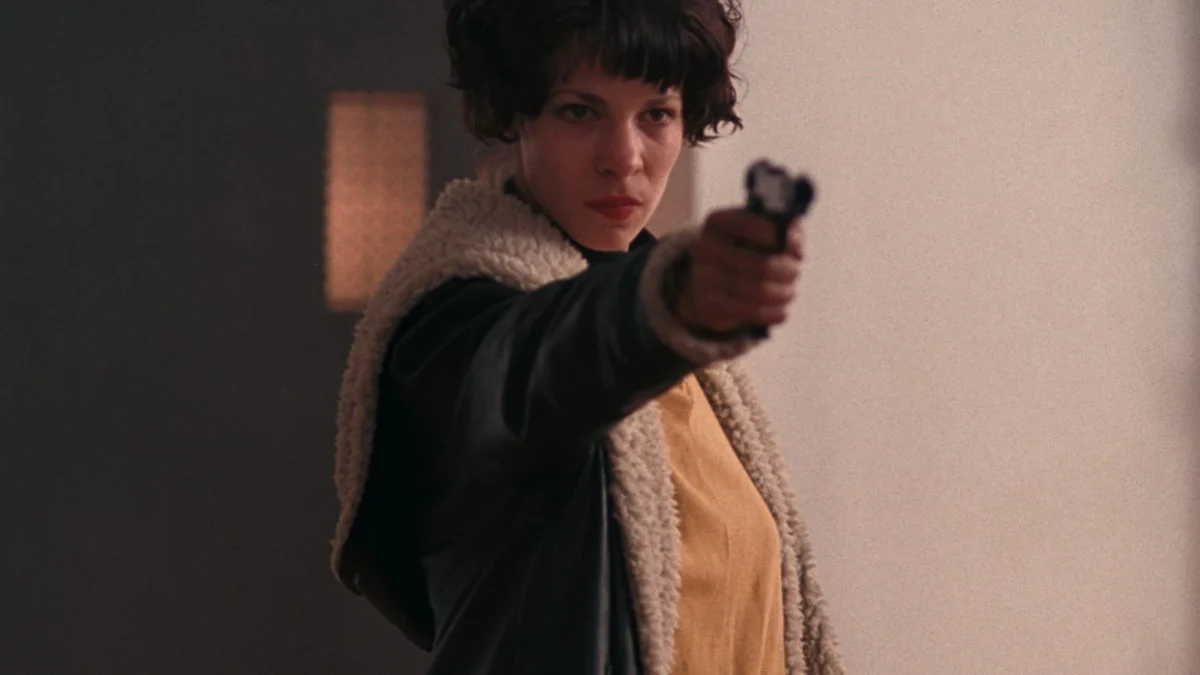
Decades before she captured the chilling, calculated pathology of the yuppie serial killer Patrick Bateman in 2000s American Psycho, director Mary Harron dissected a vastly different manifestation of New York countercultural darkness. Her 1996 debut feature, I Shot Andy Warhol, chronicled the volatile trajectory of Valerie Solanas, the radical feminist writer who infamously shot the iconic pop artist in his studio on June 3, 1968. As the film returns to contemporary theatrical screens in a pristine new 4K restoration supervised by cinematographer Ellen Kuras, critics and audiences alike are offered a timely opportunity to reexamine a cinematic portrait that refuses easy categorization.
The feature film, which originally helped anchor the burgeoning New York independent cinema scene of the mid-1990s, stars Lili Taylor as Solanas. Taylor’s blistering performance captures the paradox of an intellectual outsider wandering the fringes of Manhattan’s downtown arts ecosystem—hawking copies of her seminal, incendiary text, the SCUM Manifesto, and desperately trying to mount her avant-garde play, Up Your Ass. With a supporting cast that includes Martha Plimpton, Michael Imperioli, and Stephen Dorff as Candy Darling, alongside a seminal score composed by John Cale after Lou Reed denied permission to use Velvet Underground tracks, the film operates not merely as a period piece, but as a living, breathing artifact of a bygone era.
Chronology and Historical Context
The events central to the narrative trace back to the volatile ecosystem of New York City during the late 1960s, a period marked by shifting cultural paradigms, the rise of radical social movements, and the commercialization of the downtown art world. By 1967, Valerie Solanas had self-published the SCUM Manifesto—an uncompromising, highly polemical critique of patriarchal society that advocated for the elimination of the male sex. Operating largely in total isolation and forming a supposed organization of which she was the sole member, Solanas existed on the absolute periphery of society.
Her trajectory eventually intersected with Andy Warhol’s legendary studio, The Factory, a creative epicenter that regularly embraced society’s castaways, drag queens, and trans women, offering them fleeting moments of avant-garde stardom before discarding them. The escalating friction between Solanas’s uncompromising radicalism, her financial grievances with publisher Maurice Girodias, and her profound alienation within Warhol’s orbit culminated on June 3, 1968. Solanas entered The Factory at 33 Union Square West and shot Warhol multiple times, nearly ending his life. The attack fundamentally altered the trajectory of the pop art movement, traumatized the downtown scene, and consigned Solanas to decades of psychiatric confinement, prison, and eventual obscurity until her death in a welfare hotel in 1988.
The 4K Restoration Process and Visual Aesthetics
The technical undertaking to bring I Shot Andy Warhol back to modern theatrical standards involved meticulous color grading and digital restoration supervised closely by original cinematographer Ellen Kuras. In a recent retrospective interview discussing the project’s long journey to the screen, Harron reflected on watching the newly struck 4K transfer.
"You’re just able to see Ellen’s beautiful lighting and the colors," Harron noted, emphasizing the film’s naturalistic approach. While cinematic depictions of The Factory often lean into stylized fantasy, Kuras and Harron deliberately grounded the environment in a gritty, tactile realism. "It’s very naturalistic. The Factory is this kind of dream world, but it’s all realistic… It looks both gritty and beautiful—but not too beautiful, which is important."
To achieve this distinct aesthetic, the production deliberately bypassed conventional dramatic cinematic models of the era. Instead, Harron and Kuras drew inspiration from period documentary photography, Magnum agency archives, and the raw visual texture of neighborhood-level New York street life, utilizing available light to mirror the poetic realism found in contemporaneous independent cinema like Larry Clark’s 1995 feature, Kids.
Evolving Interpretations of the SCUM Manifesto
In the decades since its initial publication and cinematic adaptation, the SCUM Manifesto has experienced a complex cultural afterlife. Long dismissed by mainstream critics as the unhinged rantings of a fringe extremist, the text has progressively undergone reevaluation by successive generations of academics, political theorists, and cultural critics.
During the late 1980s and early 1990s, when Harron first encountered the document while working as a researcher on a documentary about Warhol, the text was largely unknown outside small circles of radical feminists.
"I first learned about it as a kind of joke, amid my obsession with Warhol, the Factory, and the Velvet Underground," Harron recalled. "This crazy woman had this manifesto. It felt darkly comic… When I found a copy in a left-wing bookstore while working as a researcher, I was completely stunned by how brilliant it was."
Harron points to Solanas’s sophisticated literary style—characterized by precise irony and a tone evocative of satirists like Evelyn Waugh—as evidence of the manifesto’s enduring intellectual weight. However, the text’s inherent contradictions continue to spark fierce debate. Built upon a rigid, biological essentialist framework that asserted men were genetically inferior due to chromosomal deficiencies, Solanas’s ideology presents distinct challenges for contemporary readerships.
When questioned about how modern audiences interpret these essentialist views, particularly regarding gender identity and trans inclusivity, Harron acknowledged the anachronism of applying twenty-first-century frameworks to a 1968 text. While some contemporary scholars have attempted to read the manifesto as retroactively trans-affirming, Harron maintains that such interpretations require significant analytical stretching.
"If you’re going to understand somebody in 1968, you have to go back and think about how people then thought and talked," Harron stated. "She had a very essentialist philosophy… But because of that essentialist framework, she held that men cannot be women—whereas now, almost 60 years later, we understand gender and identity very differently. I don’t think we can simply impose our current thinking onto her."
Societal Implications and the Modern Resonance
The theatrical rerelease of I Shot Andy Warhol arrives amid a contemporary sociopolitical landscape defined by intense polarization, institutional distrust, and fierce debates concerning the permissible boundaries of feminist expression. Observers note that the film’s thematic exploration of institutional gatekeeping, male dominance, and the societal marginalization of non-conformist voices resonates profoundly with current cultural discourse.
Furthermore, the film’s depiction of Andy Warhol—played with nuanced vulnerability by Jared Harris—challenges simplistic heroic or villainous narratives. Harron deliberately avoided assigning absolute moral clarity, preferring to position Solanas and Warhol in a mutual, complex dance of attraction and repulsion. This refusal to offer clean narrative resolutions drew criticism from contemporary reviewers in 1996 who sought a definitive verdict on right and wrong, but it has ultimately allowed the film to age with remarkable resilience.
In an era where digital culture enables radical voices to bypass traditional institutional gatekeepers entirely, Harron suggests that a figure like Solanas might have navigated her ambitions differently today.
"You can make your own fame now in a way you couldn’t in the ’60s," Harron observed. "Valerie could have found a voice, found an audience, in a way she really couldn’t then. When I first read the manifesto, I was deeply frustrated. I hadn’t yet started directing… I totally related to her longing to make something."
Broader Impact and Critical Legacy
As I Shot Andy Warhol circulates through art-house cinemas in its new 4K format, its place within the canon of American independent cinema appears firmly secured. By refusing to sanitize its central subject or reduce a profoundly troubled historical figure into a two-dimensional villain, Harron’s film established a blueprint for biographical filmmaking that prioritizes psychological complexity over hagiography.
The film’s final moments—which pivot from the bleak reality of Solanas’s impoverished final years to acknowledge the enduring status of the SCUM Manifesto as a recognized, if controversial, radical text—reflect a deliberate artistic choice. Decades after its premiere, the film stands not only as a testament to Mary Harron’s pioneering vision as a female filmmaker navigating a male-dominated industry, but as a vital cinematic inquiry into the costs of artistic ambition, systemic alienation, and the enduring power of unyielding dissent.