The television landscape of modern science fiction has frequently relied on backdoor pilots and temporal narrative devices to expand established universes, and the fourth-season finale of Paramount+’s acclaimed series Star Trek: Strange New Worlds executes this strategy with unprecedented ambition. Directed toward establishing a foundation for a potential spin-off titled Star Trek: Year One, the season finale bridges the narrative gap between Christopher Pike’s tenure aboard the USS Enterprise and James T. Kirk’s formative first year in the captain’s chair. While the official greenlight for Year One and the broader long-term trajectory of the Star Trek franchise remain under administrative review by studio executives, the narrative structure of the Strange New Worlds season-four conclusion leaves little doubt about creative intentions. Showrunners Henry Alonso Myers and Robbie Thompson have constructed a complex, multi-layered episode that functions simultaneously as a series finale setup, a character study, and a structural bridge to the iconic 1966 aesthetic of Gene Roddenberry’s original television continuity.
Chronology and Narrative Mechanics of the Temporal Anomaly
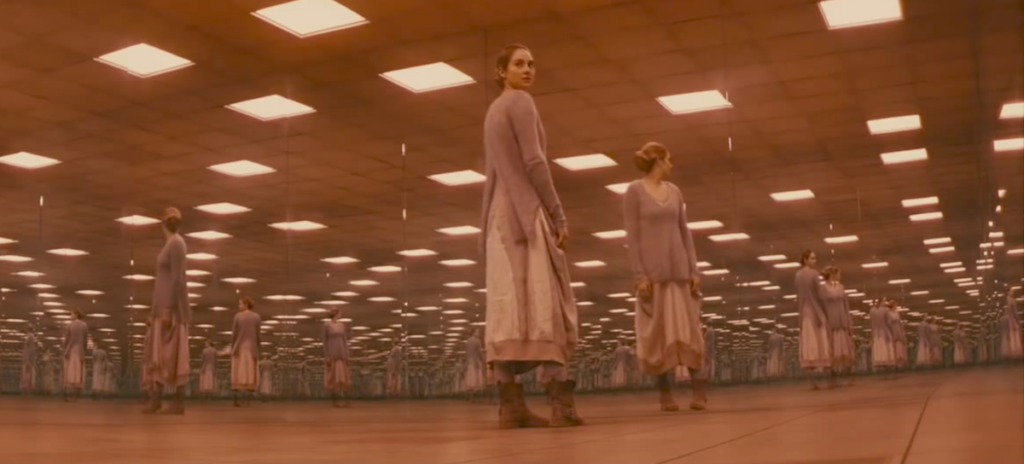
The narrative engine of the finale is set in motion when the USS Enterprise encounters an extraordinarily rare cosmic phenomenon: a white hole. During the initial scientific investigation, Communications Officer Nyota Uhura intercepts anomalous audio signals across ship frequencies just moments before the vessel is ensnared in an unexpected tractor beam. An explosion ensues, resulting in a minor head wound for Uhura and a sensory hallucination in which she perceives Chief Engineer Montgomery Scott shouting warnings before a catastrophic blast—an event that did not physically occur. Following standard medical evaluation in sickbay and a mandatory rest period in her quarters, Uhura experiences a quantum-level displacement, establishing contact with an alternate version of herself from a future timeline.

The narrative immediately executes a one-year time jump. In this evolved timeline, James T. Kirk has assumed full command of the USS Enterprise, following Christopher Pike’s elevation to the rank of admiral. This bureaucratic detail successfully reconciles decades of minor continuity discrepancies originating from the classic Star Trek episode The Menagerie, aligning the specific fleet hierarchy with modern franchise lore. The chronological shift brings notable visual updates: characters including Uhura, Montgomery Scott, and Christine Chapel adopt distinct hairstyles mirroring the visual presentation of actors Nichelle Nichols, James Doohan, and Majel Barrett from the 1966 series pilot.
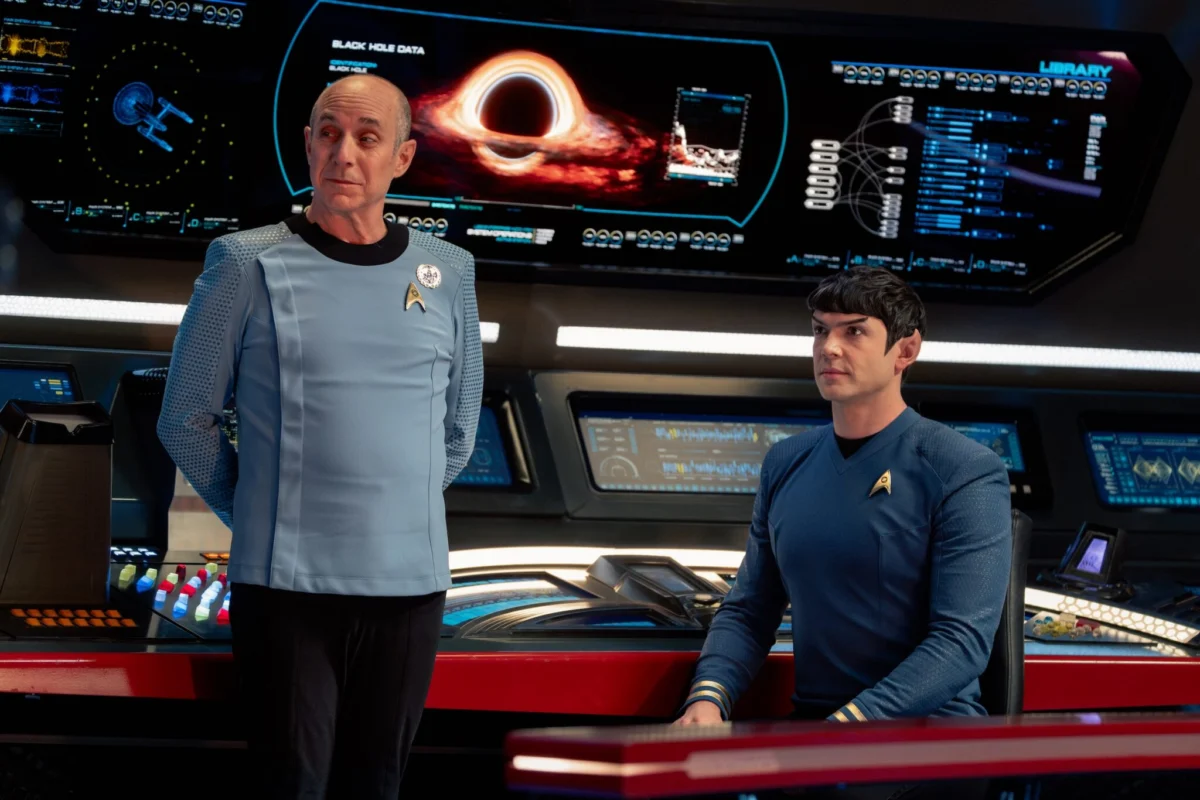
In this alternate deployment, the Enterprise is stationed near a black hole. Facing atmospheric and gravitational hazards requiring specialized shuttlecraft maneuvers, Kirk selects Erica Ortegas—pulled temporarily from her academic responsibilities at Starfleet Academy—to pilot the mission due to her superior navigation profile. However, a catastrophic shuttle failure mirrors the initial danger experienced during the white hole incident. When Uhura is rematerialized aboard the enterprise, she discovers a divergent reality: Scotty was reportedly killed in action one year prior, and Ortegas has permanently returned to Starfleet Academy.
Background Context and Franchise Continuity
The integration of long-standing franchise lore represents a significant achievement for the writing staff. The episode systematically addresses several historic continuity hurdles and fan-debated plot points from previous iterations of the franchise. Most notably, the developing, casual romantic dynamic between Uhura and Scotty provides a long-awaited canonical foundation for their surprisingly domestic pairing depicted in the 1989 feature film Star Trek V: The Final Frontier. By establishing the early stages of their interpersonal relationship decades ahead of the cinematic timeline, the writers retroactively resolve a long-standing narrative disconnect.

Furthermore, the script weaves intricate connections to established Star Trek mythology by introducing references to Gary Mitchell, canonically established as Kirk’s closest friend from his Academy days. By explicitly defining Rong Fu’s character, Mitchell, as the half-brother of Gary Mitchell, the creative team transforms a background surname into a meaningful narrative thread. This approach demonstrates a commitment to deep continuity while maintaining accessibility for viewers less versed in the granular details of the 1960s television canon.
Performance and Character Dynamics
The core of the episode relies heavily on the dramatic interplay between dual iterations of Nyota Uhura, portrayed through masterclass performances by Celia Rose Gooding. The future iteration of Uhura, serving under Captain Kirk, exhibits the heightened maturity, poise, and strategic assurance that characterized Nichelle Nichols’ legendary portrayal in the original series. The psychological weight of the narrative requires both versions of Uhura to utilize quantum entanglement to communicate across temporal divides, synchronizing their efforts to formulate solutions for their respective trapped vessels.
Supporting performances further anchor the temporal narrative. Ethan Peck’s portrayal of Spock under Kirk’s command shifts subtly toward the definitive, emotionally controlled cadence popularized by Leonard Nimoy, contrasting sharply with the more hesitant, developing Vulcan persona seen earlier in the run of Strange New Worlds. Additionally, the return of guest stars such as Brian Markinson as Dr. Boyce and the seamless integration of medical personnel transitions—hinting at the eventual arrival of Dr. Leonard "Bones" McCoy—demonstrate a meticulous attention to the chronological stepping stones leading directly into Where No Man Has Gone Before.

The Resolution of the Cosmic Anomaly and Broader Implications
The scientific mystery driving both ships into peril ultimately resolves around a biological entity existing outside linear time—colloquially termed a "space baby" by the crew—which is attempting to breach the spatial barrier between the white and black holes. The cryptographic musical signals intercepted by Uhura earlier in the timeline serve as a localized warning transmitted backward through temporal dimensions by Uhura herself. Through collaborative problem-solving across timelines, the dual Uhuras successfully facilitate the birth of the creature, restore historical continuity, and preserve the life of Chief Engineer Scott.
The extradimensional entities, existing beyond standard chronological constraints, offer a gesture of gratitude before returning both versions of Uhura to their respective points of origin, leaving only residual memories of the temporal crossover. For Kirk’s Uhura, the harrowing ordeal restores Scotty to active duty, while Pike’s Uhura absorbs the emotional lessons of the encounter, resolving to embrace her found family and live deliberately within the present moment.
Industry Implications and Future Outlook

The strategic positioning of the fourth-season finale of Star Trek: Strange New Worlds carries substantial weight regarding the administrative and creative future of the broader franchise. Paramount+ has maintained a cautious approach to expanding its live-action television slate amid shifting corporate strategies and budgetary recalibrations across the streaming sector. However, the overwhelmingly positive critical response to the character-driven storytelling, combined with the clear narrative setup for Paul Wesley’s James T. Kirk to helm a potential Year One series, positions the production team advantageously should leadership authorize the greenlight.
From an analytical perspective, the episode exemplifies the contemporary television strategy of utilizing legacy IP to construct self-contained event programming that satisfies long-term fandom while testing the waters for potential commercial spin-offs. By blending high-concept science fiction tropes—such as white holes, quantum entanglement, and temporal mechanics—with grounded emotional character arcs, Strange New Worlds continues to set a high benchmark for modern franchise expansion. As production eyes the fifth and potentially final season of Strange New Worlds, the creative foundation established in this finale ensures that the transition toward the classic era of Star Trek will remain one of the most closely monitored developments in contemporary media.