The literary landscape of speculative fiction during October 2026 was heavily shaped by a pervasive undercurrent of geopolitical anxiety, institutional distrust, and societal introspection. As democratic nations worldwide braced for pivotal midterm legislative cycles and escalating socio-economic pressures, contemporary authors of science fiction, fantasy, and horror gravitated toward narratives examining systemic exploitation, human resilience, and the ethical implications of technological advancement. Within this thematic ecosystem, critics and enthusiasts tracking short-form speculative publications identified ten distinct works across prominent literary venues that successfully encapsulated the anxieties of the era while offering profound emotional resonance.
Thematic Currents and Socio-Political Context
The intersection of speculative literature and real-world geopolitical tension has long served as a diagnostic tool for societal unease. Throughout the autumn publishing window of 2026, editorial selections in magazines such as Kaleidotrope, Clarkesworld, and Radon Journal demonstrated a marked preoccupation with themes of displacement, technological alienation, and the moral compromises demanded by oppressive systems. Literary analysts observing the period noted that protagonists frequently faced binary choices: pursue localized, fleeting compassion amidst systemic catastrophe, or accelerate institutional descent through compliance. This thematic dichotomy closely mirrored public sentiment during the final quarter of 2026, characterized by high-stakes electoral build-ups in the United States and enduring supply-chain and resource extraction crises across the Global South.
Family, Folklore, and Moral Reckoning
Fairy tale retellings underwent a rigorous deconstruction in October 2026, moving beyond surface-level subversion to examine the systemic fallout of magical bargains and institutionalized cruelty.
In Kaleidotrope’s Autumn 2026 issue, Mari Ness examined the long-term domestic consequences of classical folklore tropes in “The Bargain.” While traditional narratives traditionally focus on the transactional trade of a child to a magical entity, Ness explores the psychological aftermath for the guardian tasked with raising a stubborn five-year-old boy. The narrative deepens when the child discovers that his mortal father willingly bartered him away. Reviewers praised the story for treating this revelation with emotional gravity rather than easy cynicism, highlighting the complexities of inherited trauma within familial structures.
Similarly, Imogen Crowe’s “Nine Truths About the Yrsul,” published in Diabolical Plots on October 2, 2026, interrogates the mechanics of institutionalized fear. Set in a village menaced by a predatory feathery beast known as the Yrsul—which reportedly enters homes to consume food and inhabitants alike—the protagonist Saskia is forced to reevaluate state-sanctioned doctrine when the creature bonds directly with her child. Crowe’s narrative serves as a sharp commentary on propaganda, scapegoating, and the difficulty of recognizing humanity within designated monsters.
Labor, Mortality, and Grief
The burden of specialized labor, particularly work interfacing with mortality and cultural preservation, emerged as a dominant motif in Autumn 2026 speculative fiction.
In Perseid Prophecies (Issue 11), Obongodu Paul Unanam introduced readers to Uduak, a tailor who inherits her grandmother’s shop with a specialized clientele: the deceased. Beyond standard tailoring, Uduak crafts the garments in which bodies are buried, a vocation where a single structural error can reportedly prevent a corpse from remaining interred. Despite familial pressure to pursue conventional employment, Uduak persists. Literary critics noted that Unanam successfully avoided tropes of victimization, rendering the protagonist as a resilient figure navigating high-stakes cultural responsibilities.
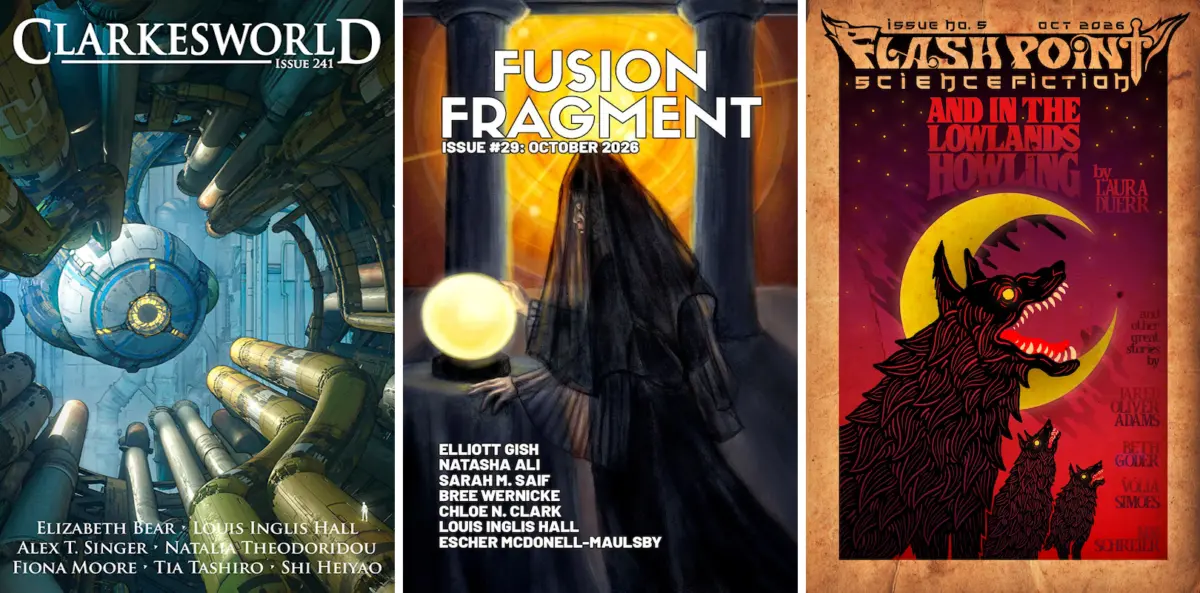
Concurrently, Natalia Theodoridou’s “Roams the Planet of Our Grief,” published in Clarkesworld (Issue 241), explored the societal architecture of mourning following a catastrophic colonial disaster on a newly settled moon. Tasked with delivering the final recorded messages of the deceased to estranged surviving relatives, Johny—a transgender courier—navigates polarized reactions ranging from gratitude to hostility. The story examines the psychological dangers of converting grief into performative activism, offering a measured critique of martyrdom at the expense of personal well-being.
Technological Alienation and Resource Extraction
Hard science fiction and near-future dystopias in October 2026 frequently interrogated the human cost of technological progress, juxtaposing cosmic ambition against terrestrial exploitation.
Sarah M. Saif’s “Graftage,” featured in the October 2026 edition of Fusion Fragment, transports readers to a submersible at the ocean floor of Jupiter’s moon, Europa. Protagonist Noor collects ice-core samples while processing personal grief over her father’s loss of his Palestinian homeland and ancestral orange groves. The narrative draws a direct parallel between the allocation of astronomical budgets for interstellar exploration and the chronic underfunding of earthly populations facing displacement—a structural critique frequently likened to historical protests against space-race expenditures.
In Saros SF (Issue 7), Becks Simpson delivered a visceral narrative titled “Haunting Rocks.” Eschewing plot synopsis to preserve the narrative’s immediate emotional impact, literary reviewers emphasized its direct thematic connection to modern telecommunications hardware manufacturing. Critics recommended pairing the story with Siddharth Kara’s investigative non-fiction work, Cobalt Red: How the Blood of the Congo Powers Our Lives, underscoring the fiction’s grounding in contemporary human rights abuses related to mineral extraction for consumer electronics.
Artificial intelligence and automated warfare also received nuanced treatment in Tomias Keno’s “Jackie Hates That War,” published in Radon Journal (Issue 14). Set in a near-future corporate apparatus, the protagonist Marek analyzes historical military data alongside an AI war-simulation module colloquially named “Jackie.” Eschewing simplistic tropes of rogue superintelligence, Keno presents an AI that demonstrates unexpected behavioral complexity. The narrative concludes on a cautiously optimistic note, suggesting that technological tools can potentially be reclaimed from military-industrial apparatuses rather than viewed exclusively as instruments of doom.
Resistance, Identity, and Freedom
Narratives focusing on structural resistance, state control, and bodily autonomy provided some of the most striking speculative fiction of the month.
Rina Song’s “Into the Gentle Night,” published in Penumbric (Vol. X, Issue 3), presents a bleak fantasy landscape where human souls are bound to gossamer spirits known as daena. When a conquering warlord subjugates her village and transforms free citizens into state vassals, protagonist Naniluk loses her family and community. Her subsequent campaign against the regime functions as an exploration of the personal costs associated with dismantling entrenched authoritarian power structures.
Identity and transformation were further explored through lenses of magical realism and speculative anatomy. In Baffling Magazine (Issue 25), Malcolm MacDougall’s “Ticket to a New Body” follows a protagonist who undertakes hazardous fairy rituals to achieve bodily autonomy. Eschewing conventional tropes associated with physical metamorphosis, MacDougall delivers a triumphant portrayal of queer liberation.
Humor also found a place amidst the heavier speculative offerings. MM Schreier’s flash fiction piece “Class Action,” published in Flash Point SF (Issue 5), utilized a satirical journalistic format to report on a surreal event in Divinolândia, São Paulo, where a citizen scales a building rooftop to consume the moon, prompting municipal concern over a suddenly missing satellite.
Chronology and Publishing Overview of Featured Works
| Title | Author | Publication | Release Date | Primary Themes |
|---|---|---|---|---|
| "The Bargain" | Mari Ness | Kaleidotrope | Autumn 2026 | Folklore, childcare, familial abandonment |
| "Class Action" | MM Schreier | Flash Point SF | October 31, 2026 | Satire, surrealism, municipal journalism |
| "The Going Cloth" | Obongodu Paul Unanam | Perseid Prophecies | Autumn 2026 | Mortality, traditional labor, resilience |
| "Graftage" | Sarah M. Saif | Fusion Fragment | October 2026 | Space exploration, displacement, techno-critique |
| "Haunting Rocks" | Becks Simpson | Saros SF | October 2026 | Mineral extraction, consumer electronics ethics |
| "Into the Gentle Night" | Rina Song | Penumbric | October 2026 | Authoritarianism, soul lore, resistance |
| "Jackie Hates That War" | Tomias Keno | Radon Journal | October 2026 | AI simulation, corporate dystopia, ethics |
| "Nine Truths About the Yrsul" | Imogen Crowe | Diabolical Plots | October 2, 2026 | Propaganda, parental instinct, myth-busting |
| "Roams Planet of Our Grief" | Natalia Theodoridou | Clarkesworld | October 2026 | Trauma transmission, grief delivery, trans identity |
| "Ticket to a New Body" | Malcolm MacDougall | Baffling Magazine | October 2026 | Bodily autonomy, fairy magic, queer liberation |
Broader Impact and Industry Implications
The critical reception of these ten works highlights a maturation in contemporary speculative short fiction, where editors and writers increasingly reject escapism in favor of direct engagement with systemic realities. By anchoring fantastical elements—such as soul-binding spirits, oceanic submersibles on Europa, and celestial consumption—to grounded themes of labor exploitation, political oppression, and personal identity, the literature of October 2026 established a benchmark for socially relevant storytelling.
Publishing analysts note that independent and digital-first literary magazines continue to drive this vital discourse, offering agile platforms for authors to respond rapidly to global shifts. As the literary community evaluates the legacy of the late 2026 publishing cycle, these short stories stand as a permanent archive of an era striving to locate compassion and resistance within structural uncertainty.