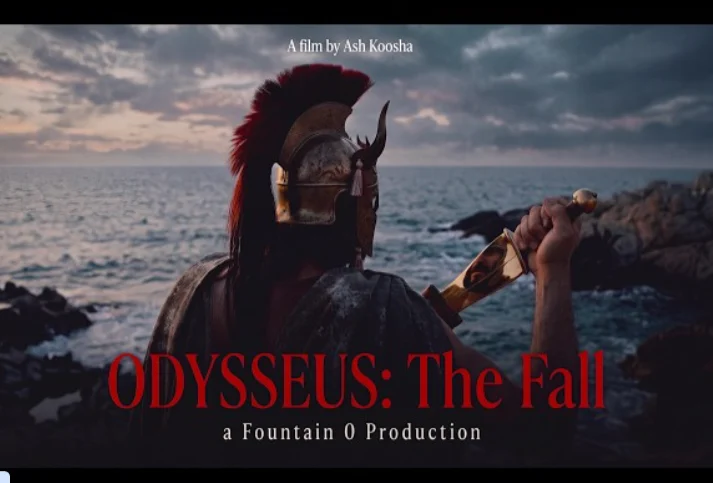
The global film industry is currently witnessing a paradigm shift as the traditional boundaries of cinematic production are challenged by the emergence of generative artificial intelligence. At the center of this burgeoning conflict is Ash Koosha, an Iran-born, England-raised engineer and filmmaker, who recently announced the completion of a 135-minute feature film titled Odysseus: The Fall. The project, created almost entirely through AI tools for a fraction of a traditional Hollywood budget, is inspired by Homer’s The Odyssey—the same public-domain epic currently being adapted by Christopher Nolan for a $250 million blockbuster slated for release in the summer of 2026. This convergence of high-budget analogue craftsmanship and low-cost digital innovation has ignited a fierce debate regarding the future of the moving image, the role of human actors, and the democratization of storytelling.
The Provocateur and the Epic
Ash Koosha’s announcement of Odysseus: The Fall caught the industry off guard, not merely because of its technical ambition, but because of its timing. While Christopher Nolan, a staunch advocate for practical effects and celluloid film, prepares a massive production featuring A-list stars like Matt Damon, Koosha has produced a feature-length alternative with no actors and a budget of only a few thousand dollars.
Koosha, working alongside his brother Pooya and producer Tom Rogers—the founder of CNBC and former CEO of TiVo—operates under the banner of Fountain 0, an AI-centric production house. The filmmaker has clarified that his intention is not to sabotage Nolan’s work but to explore what he terms "tangential filmmaking." This concept suggests that AI can allow creators to produce "companion" pieces or alternative interpretations of famous stories at the speed of the modern news cycle.
The backlash to the project was immediate. Critics and industry traditionalists questioned the ethics of "trading off" a major studio’s marketing momentum. However, Koosha defends the project as a personal exploration of a story he has loved since childhood. By utilizing AI, he claims to have translated his specific perspectives on the character of Odysseus—informed by his own experience as an immigrant moving from Iran to the West—into a visual medium that would otherwise have been financially inaccessible to him.
A Timeline of the AI Cinematic Evolution
To understand the weight of this moment, one must look at the rapid progression of AI in the creative arts over the last twenty-four months:
- Early 2023: Generative AI video tools like Runway and Pika Labs begin producing short, often distorted, five-second clips. The "uncanny valley" effect is prominent.
- Late 2023: The Hollywood actors’ (SAG-AFTRA) and writers’ (WGA) strikes bring the industry to a standstill, with AI protections being a primary point of negotiation.
- May 2024: Ash Koosha debuts Dreams of Violet at the Tribeca Film Festival. The film, which uses AI to depict the Iranian democracy protests, receives a sympathetic reception due to the impossibility of filming safely on the ground in Tehran.
- Early 2025: High-fidelity video models such as Sora and Kling demonstrate the ability to create photorealistic environments and consistent characters.
- Summer 2025: Koosha announces Odysseus: The Fall, marking the first time a feature-length AI film directly parallels a major studio tentpole production.
- Summer 2026 (Projected): Christopher Nolan’s The Odyssey is scheduled for theatrical release, setting the stage for a direct comparison between analogue and digital philosophies.
The Philosophy of Tangential Filmmaking
The core of the debate lies in Koosha’s definition of his work. Rather than viewing his AI feature as a replacement for traditional cinema, he views it as a "discourse vehicle." In his interview with The Hollywood Reporter, Koosha compared the current state of film to the early days of the internet. Just as blogging and social media allowed individuals to bypass traditional media gatekeepers to share their opinions, AI tools are now allowing individuals to bypass the financial gatekeepers of Hollywood.
"Before these AI tools, if I had a theory about Odysseus, I could write a Substack about him," Koosha noted. "Now I can put my take into a film. I can paint my opinion with images and sound and light."
This shift suggests a future where cinema is not just a high-stakes commercial product but a form of public conversation. Tom Rogers, Koosha’s producer, echoed this sentiment, stating that Fountain 0 aims to show that AI-generated content does not have to be "slop"—a derogatory term used for low-quality, AI-generated filler—but can instead be a "gorgeous" and "cogent" vision of a director’s intent.
The Economic Disruption: $250 Million vs. $5,000
The financial implications of Koosha’s project are staggering. Christopher Nolan’s The Odyssey is reported to have a production budget exceeding $250 million, excluding marketing costs. This figure includes the salaries of hundreds of crew members, location scouting, set construction, visual effects houses, and the significant fees of stars like Matt Damon.
In contrast, Odysseus: The Fall was produced for a sum described as "a few thousand dollars." The primary costs in AI filmmaking currently involve subscription fees for high-end generative models, computing power (GPU usage), and the time of the engineers and artists directing the software.
Comparative Cost Analysis (Estimated)
| Feature | Traditional Epic (Nolan) | AI Feature (Koosha) |
|---|---|---|
| Budget | $250,000,000+ | ~$5,000 |
| Production Time | 2–3 Years | 6–12 Months |
| Cast | 50+ Actors, 1000+ Extras | Zero (AI Generated) |
| Crew | 500+ Specialists | 2–5 Engineers/Artists |
| Distribution | Global Theatrical | Digital/Streaming |
This 50,000-fold difference in budget highlights the "low risk, high reward" nature of AI cinema that Koosha advocates. While a studio must guarantee a massive box office return to break even, an AI filmmaker can afford to be experimental, niche, or even controversial without facing financial ruin.
The Internal Conflict: Nolan vs. Damon
The tension surrounding Koosha’s project is further amplified by a public disagreement between Christopher Nolan and his frequent collaborator, Matt Damon. During the promotion of their upcoming projects, Damon expressed a somber view of the industry’s future, suggesting that the era of large-scale, analogue filmmaking might be coming to an end. "I knew that this was the last chance I was going to have to do something like this," Damon remarked, referring to the traditional scale of their collaboration.
Nolan, however, rejected this "defeatist" attitude. He remains a vocal defender of the theatrical experience and the physical reality of filmmaking. This internal rift within the "old world" of cinema provides a dramatic backdrop for Koosha’s entry. If one of the world’s most successful actors believes the end of cinema is near, Koosha’s 135-minute AI feature serves as a potential harbinger of what comes next.
Industry Implications and the Role of Actors
One of the most contentious aspects of AI filmmaking is the absence of human actors. The 2023 SAG-AFTRA strike was largely driven by fears that studios would use AI to replicate performers’ likenesses without consent or compensation.
Tom Rogers argues that the rise of AI filmmaking might actually have a counter-intuitive effect on the value of human actors. "I think this will make actors more valuable," Rogers suggested. He posits that as the market becomes saturated with synthetic imagery, the public’s desire for genuine human performance—whether in traditional film or live theater—will increase. In this vision of the future, "analogue" human performance becomes a luxury good, while AI content provides the bulk of everyday entertainment and "tangential" storytelling.
Analysis of Broader Impact
The emergence of Fountain 0 and Odysseus: The Fall suggests several long-term trends for the entertainment industry:
- Democratization of Scale: Historically, only major studios could afford to tell stories of epic proportions (e.g., ancient battles, space travel). AI levels the playing field, allowing independent creators to visualize grand-scale narratives.
- The Rise of "Cinematic Blogging": If films can be made quickly and cheaply, they may become more like essays or editorial pieces, responding to current events or existing media in real-time.
- The Metadata and Copyright Challenge: Since Koosha’s film is based on a public-domain work, he is on safe legal ground. However, the use of AI to generate these images relies on models trained on copyrighted data, a legal battle that remains unresolved in international courts.
- A Bifurcated Market: The industry may split into two distinct tiers: "Prestige Analogue," where high budgets and human craft are marketed as premium experiences, and "Generative Digital," a high-volume, highly accessible tier of content.
Conclusion
The release of Odysseus: The Fall is being intentionally delayed by Koosha and his team until late summer to avoid "overloading" the audience and to allow for a clearer comparison with traditional filmmaking. While Christopher Nolan continues to push the boundaries of what is possible with physical sets and IMAX cameras, Ash Koosha is exploring the boundaries of the human imagination when uncoupled from financial constraints.
Whether Koosha’s work is viewed as a provocative stunt or a visionary breakthrough, it marks a point of no return for the film industry. The "new world" of cinema, as Koosha calls it, does not seek to destroy the old, but it undeniably seeks to occupy the same space. As 2026 approaches, the dual releases of two very different versions of The Odyssey will serve as a definitive litmus test for the future of the Seventh Art.