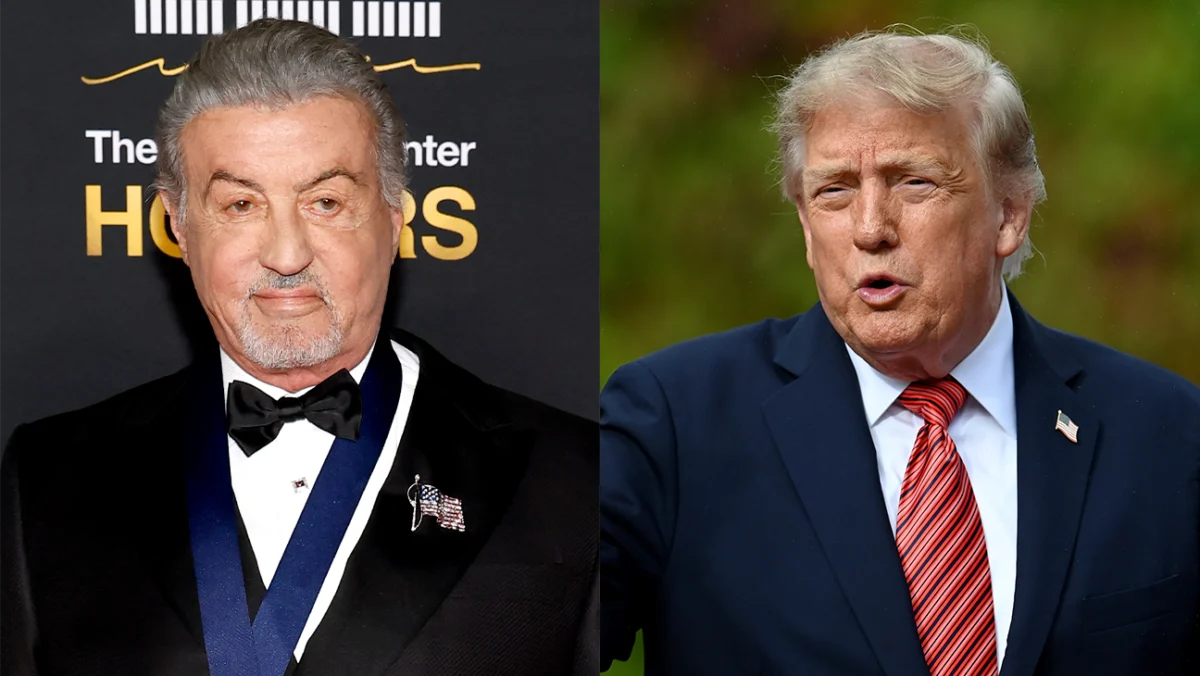
The intersection of American politics and the entertainment industry has long been a complex landscape, but recent developments involving President-elect Donald Trump and high-profile Hollywood figures have added a new layer of ambiguity to the relationship. Last year, in an unexpected announcement, President Trump designated iconic actors Sylvester Stallone, Mel Gibson, and Jon Voight as his "Special Envoys" to the entertainment industry. The stated mission, according to the president, was to revitalize a sector that he claimed had suffered significantly due to the exodus of business to foreign jurisdictions over the previous four years. Trump expressed an intent for these figures to act as his "eyes and ears" within the studio system, promising to act upon their recommendations to make Hollywood "bigger, better, and stronger."
However, the reality of this appointment appears to be far less structured than the presidential announcement suggested. In a candid interview with The Sunday Times, Sylvester Stallone, the star behind the Rocky and Rambo franchises, revealed that he was blindsided by the news of his appointment, learning of his supposed role through television broadcasts rather than any direct consultation from the Trump administration.
The Chronology of an Unsolicited Appointment
The origin of this political narrative can be traced back to the public declaration made by Donald Trump, which framed the appointment as a strategic move to address the economic climate of the film industry. The selection of Stallone, Gibson, and Voight was framed as a direct line of communication between the White House and the creative heart of the United States.
Stallone’s recollection of the event highlights a notable disconnect between political messaging and professional reality. "I was watching TV one night and they go, ‘So Stallone and Mel Gibson and Jon Voight will be…’ And I went, ‘What? Excuse me? Really?’" Stallone stated. He clarified that had he been consulted, he would have dismissed the idea as impractical from the outset. This lack of prior notification underscores the often-performative nature of political naming conventions, where public figures are occasionally conscripted into policy narratives without their formal consent or participation.
The Structural Reality of Hollywood Economics
Beyond the personal confusion, Stallone’s rejection of the role is rooted in a pragmatic understanding of how the motion picture industry operates. In his comments, he likened the studio system to "feudal states," characterized by competing kingdoms and entrenched corporate structures. From his perspective, the notion that three actors—regardless of their stature—could simply walk into major studio boardrooms and influence corporate financial strategy is fundamentally flawed.
"You don’t go in and tell six studios how to do things," Stallone noted, adding that the collaborative nature of film production is inherently decentralized. He expressed that he explicitly communicated this impossibility to the president, citing the corporate nature of the industry as a barrier to the kind of top-down influence the administration sought to exert. Stallone, who describes himself as a "political atheist" and "not a political animal," has maintained a career defined by diverse political interactions, often navigating the divide between his personal support for certain figures and the realities of his craft.
Comparative Approaches: The Role of Jon Voight
While Stallone has distanced himself from the administrative duties of the "Special Envoy" title, other appointees have taken a more proactive approach. Jon Voight, a consistent and vocal supporter of the Trump administration, has utilized his association with the White House to advocate for specific legislative changes. Unlike Stallone, who viewed the role as an abstract and unworkable concept, Voight has focused his efforts on lobbying for federal film and television tax credits.
In recent discussions with industry analysts, Voight emphasized the economic necessity of such credits, arguing that the United States is currently at a competitive disadvantage compared to other nations that offer aggressive tax incentives to attract major productions. Voight’s argument is that a federal tax credit could trigger an immediate "explosion of energy" within the sector, effectively reversing the trend of runaway production that has seen American film shoots migrate to Canada, the United Kingdom, and Australia.
This divergence in approach between Stallone and Voight highlights the tension between two different types of political involvement: the celebrity who is reluctant to merge his professional reputation with political policy, and the advocate who views their platform as a tool for legislative lobbying.
Economic Context: The State of Runaway Production
The impetus for the Trump administration’s focus on Hollywood is the economic phenomenon known as "runaway production." Over the past two decades, the global film industry has become increasingly competitive, with various states and nations offering generous subsidies to capture the high-value jobs associated with film and television production.
According to data from the Motion Picture Association and various regional film commissions, the competition for production dollars has led to a significant shift in where content is created. While the United States remains the global leader in creative output, the physical production of major studio films is increasingly distributed globally. The argument for federal tax credits—a key component of the platform Voight has been championing—is that the U.S. currently lacks a unified national strategy to compete with the localized incentives offered by foreign entities.
However, critics of federal film subsidies argue that such programs can lead to a "race to the bottom," where states and the federal government effectively subsidize multi-billion-dollar corporations at the expense of taxpayers, with questionable long-term economic gains. The complexity of these financial instruments makes the prospect of a simple "fix" via presidential envoy difficult to realize, regardless of the star power involved.
Implications and Political Positioning
The episode involving Stallone serves as a case study in the risks of political branding. By naming high-profile individuals to advisory roles without securing their active participation, administrations risk creating a narrative that does not align with the actual intentions of the individuals involved. Stallone’s public clarification serves to protect his own brand, ensuring he is not perceived as an architect of policy initiatives he does not support or understand.
Furthermore, Stallone’s self-identification as a "political atheist" underscores the nuance often missed in contemporary political discourse. His support for certain figures does not necessarily translate into a desire to engage in the day-to-day mechanisms of governance. By explicitly stating that he told the president "thank you and ciao," Stallone has effectively insulated himself from the potential political blowback of the initiative’s failure.
As the administration moves forward, the role of "Hollywood ambassadors" remains an open question. While figures like Voight continue to engage with the White House on substantive issues like tax policy, the broader initiative appears to have stalled in the face of industry complexity. The episode highlights a fundamental truth about the relationship between Washington and Hollywood: while both are industries built on the power of narrative, their mechanisms of operation—one based on legislative compromise and the other on corporate risk-taking—are rarely compatible.
Ultimately, the divergence between the presidential decree and the reality on the ground illustrates the limitations of using celebrity influence as a proxy for economic policy. For the industry at large, the focus remains on the tangible metrics of production costs, labor availability, and infrastructure, rather than the symbolic gestures of political appointments. Whether or not the lobbying efforts of those who remained involved, such as Voight, will result in actual federal legislation remains to be seen, but the distance created by Stallone serves as a reminder that even the most famous names in Hollywood have little interest in being the public face of complex and controversial political agendas.