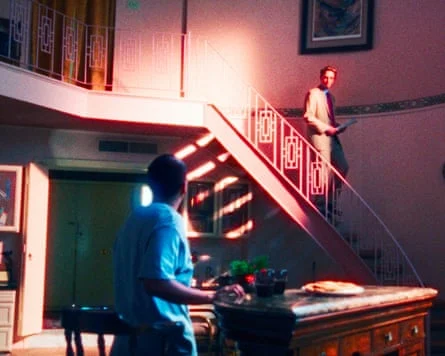
The premiere of the documentary You Can See Everything at the New York Film Festival has generated unprecedented critical and public discussion, uniting the worlds of investigative journalism, absurdist comedy, and high-profile corporate fraud. The three-hour feature film, co-directed by reality-television auteur Nathan Fielder and distinctive documentarian Lance Oppenheim, chronicles an unexpected collaboration between the filmmakers and disgraced Theranos founder Elizabeth Holmes alongside her husband, Billy Evans. Filmed primarily across 2023 following Holmes’s federal conviction for wire fraud and conspiracy, the project explores the friction between constructed public personas and reality through an unorthodox lens.
Main Facts of the Production
You Can See Everything captures a period in 2023 when Elizabeth Holmes was awaiting the commencement of her 11-year prison sentence at Federal Prison Camp, Bryan, in Texas. Accompanied by Evans, Holmes permitted a documentary crew entry into their household rental to record their daily domestic routines, care for their two young children, and present what Evans described as unrestricted access to their lives.
The choice of directors immediately drew scrutiny from industry analysts and legal observers alike. Lance Oppenheim, known for his work on projects such as Some Kind of Heaven, utilizes a hyper-saturated visual style characterized by tight framing and creeping camera movements to expose the eerie elements within ordinary environments. Nathan Fielder, celebrated for his boundary-pushing HBO docu-series Nathan for You and The Rehearsal, is recognized for staging elaborate social experiments and confronting subjects with direct, unsettling inquiries. The intersection of Oppenheim’s atmospheric aesthetic and Fielder’s commitment to social discomfort resulted in a documentary that defies traditional categorization, shifting fluidly between psychological study, thriller pacing, and satirical commentary.
Chronology and Background Context
The genesis of You Can See Everything dates back to interactions initiated in 2023, shortly after the conclusion of Holmes’s high-profile federal trial. Holmes had been convicted on four counts of wire fraud and conspiracy related to her management of Theranos, the blood-testing startup that once claimed a valuation of $9 billion before its foundational technology was exposed as fraudulent by investigative reporting in 2015.
During the interlude between her sentencing and her surrender to federal authorities, Holmes and Evans sought out documentary representation. According to production notes and on-camera discussions within the film, the subjects initially intended to utilize the medium to project transparency, challenge the narrative established by federal prosecutors, and potentially lay the groundwork for public rehabilitation.
Instead, the inclusion of Fielder shifted the dynamic of the production. Rather than functioning as passive subjects of a sympathetic profile, Holmes and Evans found themselves subjected to continuous, meticulously calibrated interrogations regarding their motivations, past business practices, and interpersonal dynamics. The documentary charts a gradual erosion of narrative control, as Fielder persistently questions the logic of employing a comedian famous for executing elaborate business parodies to document a rehabilitation effort intended to address a multi-billion-dollar corporate scandal.
Supporting Data and Production Metrics

Running at an unusual and demanding three-hour duration, You Can See Everything represents a significant departure from standard true-crime documentaries or traditional investigative profiles. The project was developed under tight security, with A24 managing distribution and limiting early press access to preserve narrative twists that become apparent as the runtime progresses.
The premiere screening at the New York Film Festival drew record ticket demand, outpacing major narrative feature debuts showcased at the same event, including Lance Oppenheim’s narrative feature debut Primetime, which starred Robert Pattinson. The commercial anticipation surrounding You Can See Everything underscores a growing public appetite for hybrid media formats that blur the boundaries between documentary filmmaking, performance art, and reality television.
Official Responses and Related Parties
Representatives for Elizabeth Holmes and Billy Evans have not issued official statements regarding the final cut of the documentary following its festival premiere. However, archival and contemporaneous legal filings indicate that Holmes’s legal team consistently opposed attempts to sensationalize her personal life during the post-trial phase.
Legal analysts have noted that participating in an unscripted, prolonged documentary project while pursuing appeals and awaiting incarceration presented considerable legal risks. Criminologists and legal scholars observe that the decision to grant access to filmmakers known for interrogative and satirical techniques highlights a fundamental miscalculation regarding public relations management by individuals convicted of white-collar offenses.
Industry unions and documentary guilds have similarly debated the ethical boundaries highlighted by the film. Questions regarding informed consent, the responsibilities of filmmakers when engaging with convicted felons, and the potential manipulation of documentary formats for personal image rehabilitation remain central topics of discussion among media ethicists following the film’s public debut.
Broader Impact and Implications
The release of You Can See Everything carries significant implications for the genres of documentary filmmaking and investigative journalism. By integrating the comedic deconstruction techniques pioneered by Fielder into a serious examination of corporate malfeasance, the film challenges audiences to reevaluate the reliability of first-person testimony and the mechanics of documentary framing.
Furthermore, the project reflects a broader cultural shift in how society interacts with figures of corporate corruption. Rather than relying solely on traditional journalistic retrospectives or dramatized streaming series—such as the Hulu miniseries The Dropout—contemporary audiences are increasingly exposed to direct, confrontational engagements that test the limits of truth and performance.
As You Can See Everything prepares for a wider theatrical and streaming rollout through A24, the discourse surrounding its production is expected to influence upcoming projects involving public figures attempting to renegotiate their public narratives. The film ultimately demonstrates that while access can be granted, control over the final interpretation of character remains firmly outside the grasp of those who seek to author their own redemption.