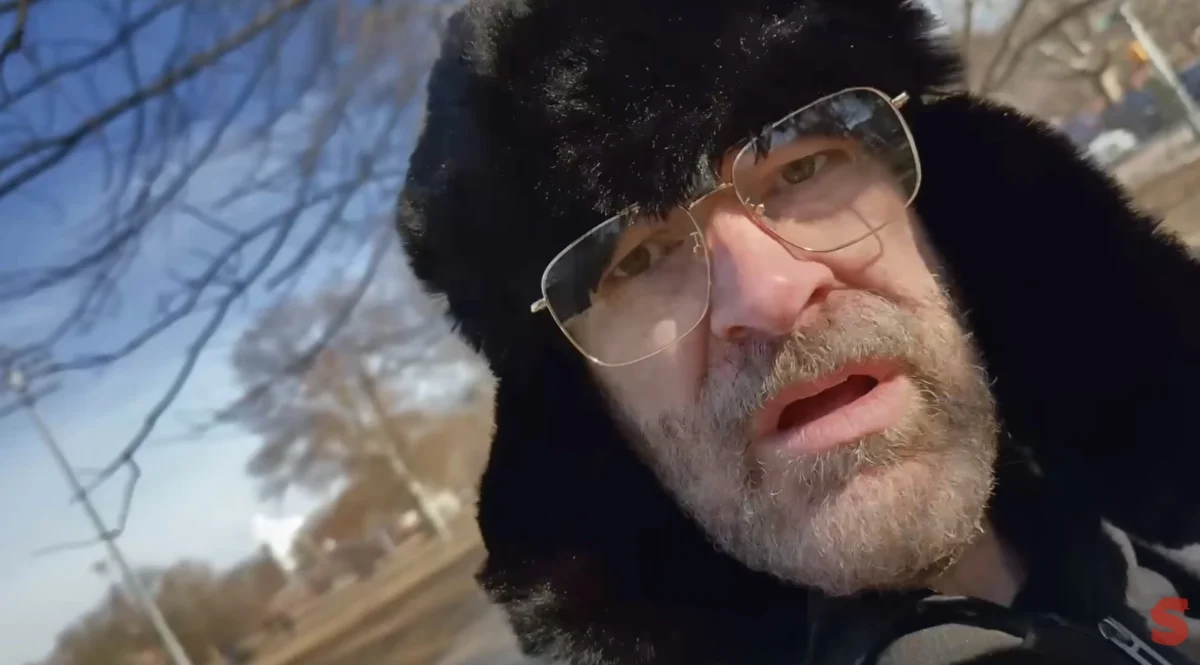
The second episode of the third season of the Shudder series The Creep Tapes marks a significant escalation in the narrative trajectory of its central antagonist, the character known as Randy—or, as he often refers to himself, Mr. Peachfuzz. As the series shifts its setting to the bustling, anonymous environment of New York City, the show explores the intersection of urban isolation and the volatile psychological state of a serial offender whose primary motivation appears to be a pathological, albeit twisted, desire for human connection.
The New York Encounter: A Chronology of Escalation
The episode follows a structured descent into violence, beginning in a public park where Randy identifies Mo, played by James Earl, as a potential subject. Randy’s approach is characteristic of his established modus operandi: he attempts to leverage financial incentives to bypass social boundaries. By offering Mo $1,000—and subsequently increasing the bounty to $2,000—to be followed and filmed for a single day, Randy attempts to commodify a human interaction.
The chronology of the encounter is defined by a series of failed refusals. After Mo initially rejects the financial overture, Randy initiates a persistent pursuit through the city’s public transit infrastructure. This pursuit establishes the central tension of the episode: the conflict between a victim’s right to personal space and an antagonist’s total disregard for social rejection. The dynamic shifts when the two individuals interact with a security guard, Steve, portrayed by Chris Gethard. In this sequence, Randy utilizes sophisticated gaslighting techniques to manipulate the authority figure into perceiving the victim, Mo, as the primary source of aggression. This manipulation leads to the intervention of security personnel and the subsequent use of non-lethal force—pepper spray—against Mo.
The climax of the episode takes place in Central Park, where the two characters undergo a brief, unstable period of reconciliation. This psychological "yo-yoing"—alternating between intense hostility and performative camaraderie—serves as the hallmark of the episode’s narrative structure. Ultimately, the relationship terminates when Mo asserts his autonomy by attempting to end the acquaintance, triggering a fatal response from Randy. The episode concludes with a violent confrontation that mirrors the physical trauma Mo had earlier described in a moment of vulnerability, followed by an expression of emotional instability from the perpetrator.

Psychological Profiling and The Peachfuzz Persona
The character of Randy represents a departure from traditional horror tropes. Unlike antagonists who operate out of malice or greed, Randy is driven by an obsessive need for external validation and intimacy. The introduction of the "Peachfuzz" persona serves as a psychological compartmentalization tool. By externalizing his internal volatility as a "wild animal" that must be managed, Randy attempts to rationalize his actions to his victims.
This behavior aligns with psychological theories regarding predatory social behavior. By frame-shifting his intent as a search for a "deep, fast human connection," Randy seeks to lower the defenses of his targets. The efficacy of this tactic is evidenced by the brief moments of rapport he successfully builds with Mo. When the two discuss the concept of human cruelty, they find a temporary, albeit horrifying, common ground. This suggests that the danger posed by the character lies not in his strength, but in his ability to identify and exploit the shared human capacity for aggression.
The Evolution of the Horror Genre and Audience Reception
The decision by series creator Mark Duplass to lean into the "sensitive" aspects of the antagonist is a calculated shift in the show’s development. Horror, as a genre, has historically relied on the "otherness" of the monster. The Creep Tapes, however, bridges this gap by making the monster inherently relatable.
Data regarding the series’ audience reception indicates a strong viewer preference for this psychological depth. Feedback collected by the production team suggests that the horror community is increasingly interested in the "why" behind the violence, rather than merely the mechanics of the violence itself. This trend is reflective of a broader shift in prestige television, where audiences have demonstrated a willingness to engage with complex, morally reprehensible characters if the writing allows for an exploration of their internal logic.
Production Context and Creative Intent
The production of the third season of The Creep Tapes has been marked by a deliberate effort to expand the scope of the "found footage" subgenre. By moving the action to New York City, the producers have utilized the inherent chaos of the urban environment to heighten the stakes. The use of multiple camera angles—including the victim’s own device—creates a multi-perspective narrative that forces the audience to question the reliability of the footage they are viewing.

Mark Duplass has noted that the creative team felt an inherent pressure during the show’s inception to satisfy traditional genre expectations. However, as the series has progressed, the confidence of the writers has grown, allowing for a more experimental approach to the character’s "hunting methods." This evolution is not merely a change in tone but a fundamental reimagining of the horror antagonist as a figure of tragic, albeit lethal, human failing.
Broader Implications of the Narrative
The interaction between Mo and Randy serves as a case study in modern social anxiety. In an era where digital surveillance and public interactions are increasingly documented, the fear of being followed or recorded is a pervasive cultural anxiety. The episode taps into this by transforming a simple, mundane interaction into a fatal confrontation.
Furthermore, the involvement of a third party—the security guard—highlights the fragility of social order when an antagonist is skilled at manipulating perceptions. The fact that the security guard is convinced to use force against the victim underscores the power of a confident, albeit deceptive, narrative. This mirrors real-world concerns regarding how individuals in positions of authority can be misled by convincing, yet factually incorrect, accounts of events.
The ending of the episode, which features an emotional, sobbing outburst from the killer, serves to cement the character’s status as one of the most complex antagonists in modern streaming media. It forces the audience to grapple with the discomfort of empathy. By humanizing the perpetrator at the moment of the victim’s death, the show achieves a level of psychological dissonance that is difficult to sustain.
Conclusion
The Creep Tapes continues to challenge the boundaries of the found-footage horror genre. By focusing on the intersection of human connection and predatory behavior, the series offers a unique critique of loneliness and the ways in which it can manifest as violence. The second episode of the third season is particularly notable for its effective use of setting, its exploration of psychological manipulation, and its refusal to provide the audience with a simple resolution. As the series moves forward, it remains to be seen how the "Peachfuzz" persona will continue to evolve, but the foundation laid in this New York-based arc suggests that the show will continue to prioritize deep psychological exploration over conventional genre tropes. Through the lens of the camera, the series forces a confrontation with the "wild animals" that reside not only in the fictional characters but perhaps in the societal structures that allow such encounters to unfold in the shadows of major cities.