Filmmaker Marcus Batto embarks on an ambitious and poignant journey into the digital past with his first feature film, There’ll Likely Be Michael Jackson Vigils Throughout the Night, a meticulous reconstruction of June 25, 2009—the day the world learned of Michael Jackson’s death—pieced together exclusively from found footage available online. The film serves not merely as a documentary but as a profound act of digital archaeology, challenging the fleeting nature of online content and highlighting the collective human experience through the lens of early 21st-century internet culture.
The Ephemeral Internet: A Challenge to Reconstruction
Reconstructing a single day in the life of the internet, particularly one over a decade in the past, presents an almost insurmountable challenge. The inherent transience of digital information, coupled with the rapid evolution of platforms and the slow obsolescence of traditional search engines—first diluted by advertisements, then optimized into algorithmic silos, and now increasingly influenced by artificial intelligence—means our digital past is perpetually blurring. What escapes immediate notice often evades long-term preservation, creating a vast, unindexed graveyard of cultural moments. Batto, a 31-year-old artist, archivist, and programmer, confronts this challenge head-on, leveraging his expertise as a "YouTube ethnographer" to breathe life back into a pivotal moment in recent history. His work underscores a critical question: how do we preserve and interpret shared human experiences when the very mediums that capture them are designed for constant flux and impermanence?
Marcus Batto: An Archivist of Digital Subcultures
Batto’s journey into found-footage artistry began during his formative years, growing up alongside the nascent YouTube platform. He was just twelve when "Charlie Bit My Finger," one one of YouTube’s earliest viral sensations, was uploaded, sparking an interest that has continued to focus on the platform’s foundational decade. His artistic practice, which he admits blurs the lines between film, music video, and art piece, is deeply rooted in this early digital landscape, observing how individuals interacted with new technologies and formed nascent online communities.
This fascination with overlooked digital phenomena is evident in his ongoing Certain Moments To Remember series (2020–). A standout entry, RANDOM WEBCAM DANCE @ DA IMAC STORE (2023), compiles footage of individuals spontaneously dancing in Apple Stores in 2011, using the then-novel front-facing cameras on Mac products. Set to Johnny Duncan and Jane Fricke’s 1978 rendition of "Stranger," the film creates a layered nostalgia. The juxtaposition of a 1970s country ballad with a V-necked teenager doing the robot in front of an iPad 2 advertisement in 2011 evokes a sense of technological determinism, placing the utopian vision of the Apple Store against the backdrop of an ever-expanding, overpopulated graveyard of lost media. Other installations in this series, described on Batto’s website as "bearing witness to subculture, shared experience, and social phenomena," include Flashmob Compilation (2023) and Maid of the Mist VII (2023). These works highlight Batto’s consistent focus on collective, often spontaneous, digital-IRL (in real life) experiences.
Batto’s short documentary Honeycomb (2024) further exemplifies his distinctive approach. Also composed entirely of found footage—from vlogs, television broadcasts, and security cameras—it chronicles the surge in catalytic converter thefts across the United States between 2020 and 2022. The "honeycomb" refers to the core component of the converter, which filters toxic exhaust and contains precious rare metals like platinum, rhodium, and palladium. At one point, rhodium alone commanded prices of $21,000 per ounce. The film draws a compelling parallel between the thieves, who meticulously extracted these valuable components from parked vehicles, and Batto himself, who acts as an "archivist" or "programmer" unearthing hidden value from the vast digital commons. Both endeavors are driven by a frantic realization that something meaningful, often overlooked, sits ripe for the taking, whether at the bottom of a car or buried deep within the results of a YouTube search. This shared ethos of unearthing latent value, whether material or cultural, underpins Batto’s entire body of work.
June 25, 2009: A Day of Global Synchronicity
The choice of June 25, 2009, as the subject for Batto’s feature is not driven by personal devotion to Michael Jackson but by its unique status as a moment when a significant portion of the world’s diffuse energy converged into a single, overwhelming emotional current. Michael Jackson, the "King of Pop," was a global icon whose influence transcended music, impacting fashion, dance, and cultural discourse for decades. His sudden death at age 50 from acute propofol and benzodiazepine intoxication sent shockwaves across the globe. News broke rapidly, disseminating through traditional media and, crucially, through the burgeoning digital networks that were just beginning to assert their dominance.
The date is etched into collective memory as a "where were you when…?" moment. Batto recounts his own experience: "I was at a friend’s house, one of the first times that we had smoked weed. Someone said that Michael Jackson died, and we all huddled around his desktop computer." This vivid anecdote encapsulates the immediate, shared digital experience that characterized the day for many. The internet, particularly platforms like YouTube, Twitter, and early social media, became a central gathering place for grief, shock, and collective processing. It was a digital vigil, unfolding in real-time across time zones.
Adding to the day’s intensity, actress Farrah Fawcett, another beloved cultural figure, also passed away on June 25, 2009. While her death garnered significant media attention, it was largely overshadowed by the seismic impact of Jackson’s passing. Batto’s film subtly acknowledges this duality, featuring clips of individuals reacting to Fawcett’s death, with one amateur film reviewer solemnly noting, "One of Charlie’s Angels just became an angel herself," in front of a poster for Halloween H20. This layered grief highlights the complex tapestry of global events unfolding simultaneously and how individuals navigated them through their nascent digital expressions.
The Early YouTube Landscape: Innocence and Experimentation
The year 2009 marked a pivotal period for the internet, especially for user-generated content and the rise of the front-facing camera. While smartphones were gaining traction, dedicated webcams and laptop cameras were becoming more common, making vlogging a nascent, experimental genre. Unlike today’s highly polished, algorithm-driven content creation, early YouTube was characterized by a raw, uninhibited authenticity. "With all these videos I found," Batto explains, "there’s this through-line of innocence. People didn’t care about how they looked on their webcam, or how they came off, in the same way they do today. They were just experimenting with this new technology."
This innocence is a primary affective quality of Michael Jackson Vigils. Viewers witness a cascade of unvarnished reactions: an emo teenager performing sarcastic grief, individuals making threats against celebrity blogger Perez Hilton (who had controversially suggested Jackson’s death was a publicity stunt), and countless others sharing their genuine shock, sadness, or bewilderment. These are not curated performances for millions, but immediate, often intimate, expressions intended for a small, perhaps even imagined, audience.
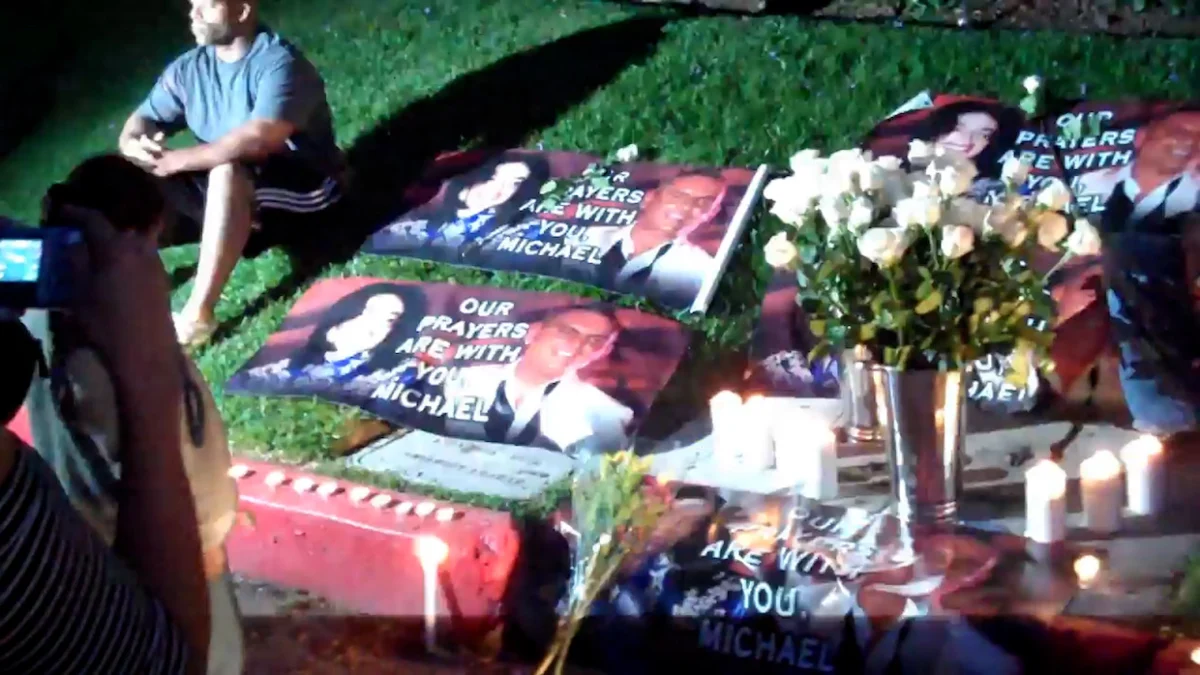
The film follows mourners from their computer screens to the streets of Los Angeles, capturing impromptu gatherings. In one poignant and ironically telling sequence, crowds gather around the Walk of Fame star of the British radio DJ Michael Jackson, mistakenly believing it belonged to the King of Pop (whose star was temporarily obscured by a red carpet for Sacha Baron Cohen’s Brüno premiere). This moment encapsulates the beautiful, sometimes messy, convergence of online information and real-world action, highlighting the collective human impulse to mourn and connect. The image of banners reading "our prayers are with you Michael," alongside white roses and pillar candles, vividly illustrates these spontaneous, heartfelt vigils that sprang up globally, both online and in physical spaces.
Crafting the "Michael Jackson Vigils": An Overwhelming Archive
The sheer scale of Batto’s undertaking is staggering. "I have playlists that I’ve created that have maybe 800 videos," he reveals, illustrating the immense volume of material he sifted through. Like Ian Bell’s WTO/99 (2025), a found-footage documentary on the 1999 anti-globalization protests in Seattle, the challenge lay not just in locating the material but in distilling it into a coherent narrative. "I had a work-in-progress screening last June, but I couldn’t stop finding videos even after that. It was becoming an issue," Batto admits, highlighting the obsessive nature of his archival pursuit.
The film’s opening sets the tone for this overwhelming experience: a rotating prism, each face composed of a five-by-four grid displaying twenty videos simultaneously. This visual device, to which the film frequently returns, immediately immerses the viewer in the digital cacophony of June 25, 2009. Batto then abruptly hones in on specific clips: the Botafumeiro swinging incense in a Spanish cathedral, seconds of ultrasound footage, a group of refugees on a lifeboat. The rapid-fire montage, defying easy categorization, makes the process of cataloguing each scene quickly futile. This deliberate sense of overwhelm is central to the film’s affective quality, mirroring the internet’s chaotic, unfiltered stream of information.
Batto’s global perspective is reinforced by the visual motif of his gridded video arrays often superimposed on a digital rendering of the rotating Earth. This emphasizes the worldwide nature of the shared experience, underscoring how Jackson’s death resonated across continents and cultures, simultaneously fragmented and unified by the nascent global internet.
A Double Memorial: King of Pop and a Bygone Internet Era
There’ll Likely Be Michael Jackson Vigils Throughout the Night functions as a poignant double memorial. It commemorates not only the enduring legacy of the King of Pop but also a specific, irretrievable moment in time when the internet’s cacophony could still coalesce into something resembling a single, shared chorus. Before the hyper-personalization of algorithms, the fragmentation of social media into echo chambers, and the commercialization of online identity, there was a brief period of collective digital experience, characterized by a raw, unselfconscious expression.
Batto’s attraction to "spectacles of joint online-IRL experience"—flash mobs, dance crazes, celebrity deaths—stems from this perceived naiveté. The contrast between the candid, often unpolished webcam recordings of 2009 and the meticulously curated, brand-conscious online personas of today is stark. The film, therefore, acts as a historical document, capturing a pre-social media innocence that has largely vanished.
This historical dimension draws parallels with the work of early cinematographers like Mitchell and Kenyon, whose "Local Films for Local People" in the late 19th century captured the curious faces of British children encountering a movie camera for the first time. The soot-marked faces of children exiting factories in 1897 and the webcam-captured mourners of 2009 share an odd kinship, a profound innocence that compresses the long century between them. Both seem a world away from the internet of 2026, dominated by ASMR sleep aids, AI-generated content, and hyper-edited viral sensations.
Implications and Legacy in a Rapidly Evolving Digital Landscape
The film’s premiere was accompanied by a symbolic giveaway of refurbished third-generation iPod Touches, preloaded with the film and a curated playlist. This tangible artifact, an early symbol of mobile internet connectivity, further reinforces the film’s theme of digital archaeology. The presence of a Michael Jackson impersonator, who reportedly fell asleep during the screening and later offered a lukewarm "okay" as feedback, adds a layer of meta-commentary, highlighting the subjective nature of memory and cultural interpretation.
When asked about the feasibility of creating a similar film for a more recent celebrity death, Batto notes that today’s internet no longer creates discernible, cohesive moments in the same way. "It’s all so fleeting," he observes. "You can’t really hold it anymore." This sentiment speaks to the accelerated pace of audiovisual history and the challenges of archiving in an age of constant content creation and rapid obsolescence. The internet of 2026, saturated with AI-generated narratives and hyper-personalized feeds, disperses collective attention rather than concentrating it.
There’ll Likely Be Michael Jackson Vigils Throughout the Night is more than just a historical compilation; it is a critical commentary on the impermanence of digital culture and the urgent need for digital preservation. Like the catalytic converter thieves, Batto operates at the end of a certain product’s life cycle, extracting value from what others might discard. His work spans the gaps—between artist and archivist, between 2026 and 2009—mourning a lost innocence while keenly aware of what precious parts might still be stripped from the accelerating wreckage of our digital past. In a world where digital memories are increasingly fragile, Batto’s film stands as a vital reminder of what was and what might still be salvaged.