The 2008 release of the biographical drama Milk, directed by Gus Van Sant and written by Dustin Lance Black, arrived at a pivotal juncture in American civil rights history. While the film serves as a chronicle of the life and assassination of Harvey Milk, the first openly gay man elected to a major public office in California, its debut coincided with a modern legislative battle that mirrored the struggles depicted on screen. Released in late 2008, the film became a cultural touchstone during the height of the controversy surrounding California’s Proposition 8, a ballot initiative intended to ban same-sex marriage. This intersection of 1970s history and 21st-century politics elevated the film from a standard biopic to a significant socio-political document.
Historical Foundation and Political Context
To understand the impact of Milk, one must examine the environment of San Francisco in the 1970s. The city was undergoing a radical demographic shift, with the Castro District emerging as a sanctuary for the LGBTQ+ community. Harvey Milk, an insurance salesman from New York, arrived in 1972 with his partner Scott Smith. At the time, gay and lesbian individuals faced systemic discrimination, police harassment, and a lack of legal protections.
The film meticulously recreates the "Castro Camera" shop, which served as the nerve center for Milk’s grassroots organizing. Milk’s political strategy was rooted in the concept of "coalition politics," where he sought to align the interests of the gay community with those of the Teamsters, senior citizens, and other marginalized groups. This approach eventually led to his historic victory in 1977, when he was elected to the San Francisco Board of Supervisors under a new system of district-based representation.
Chronology of Events: 1970–1978
The narrative of the film and the real-life events it portrays follow a distinct timeline of activism and escalating tension:
- 1972: Harvey Milk and Scott Smith move from New York to San Francisco, settling in the Castro District.
- 1973: Milk runs for the Board of Supervisors for the first time, placing 10th out of 32 candidates. This earns him the nickname "The Mayor of Castro Street."
- 1975: Milk runs again for the Board of Supervisors, narrowly losing but solidifying his role as a community leader.
- 1977: In his third attempt, Milk wins a seat on the Board of Supervisors, representing District 5. He is inaugurated on January 9, 1978.
- 1978 (June): Milk successfully leads the campaign against Proposition 6, also known as the Briggs Initiative, which sought to ban gay people and their supporters from teaching in California public schools.
- 1978 (November 27): Former Supervisor Dan White enters City Hall and assassinates both Harvey Milk and Mayor George Moscone.
- 1979: Dan White is convicted of voluntary manslaughter rather than first-degree murder, leading to the "White Night Riots" in San Francisco.
Production Background and Artistic Direction
The journey to bring Harvey Milk’s story to the screen spanned over fifteen years. Gus Van Sant had been attached to a version of the project in the early 1990s, originally intended to star Robin Williams. However, creative differences led to a long hiatus. The eventual 2008 production was marked by a commitment to period authenticity. Filming took place on location in San Francisco, with the production team restoring the original storefront of Castro Camera and filming scenes in the actual City Hall where the assassinations occurred.
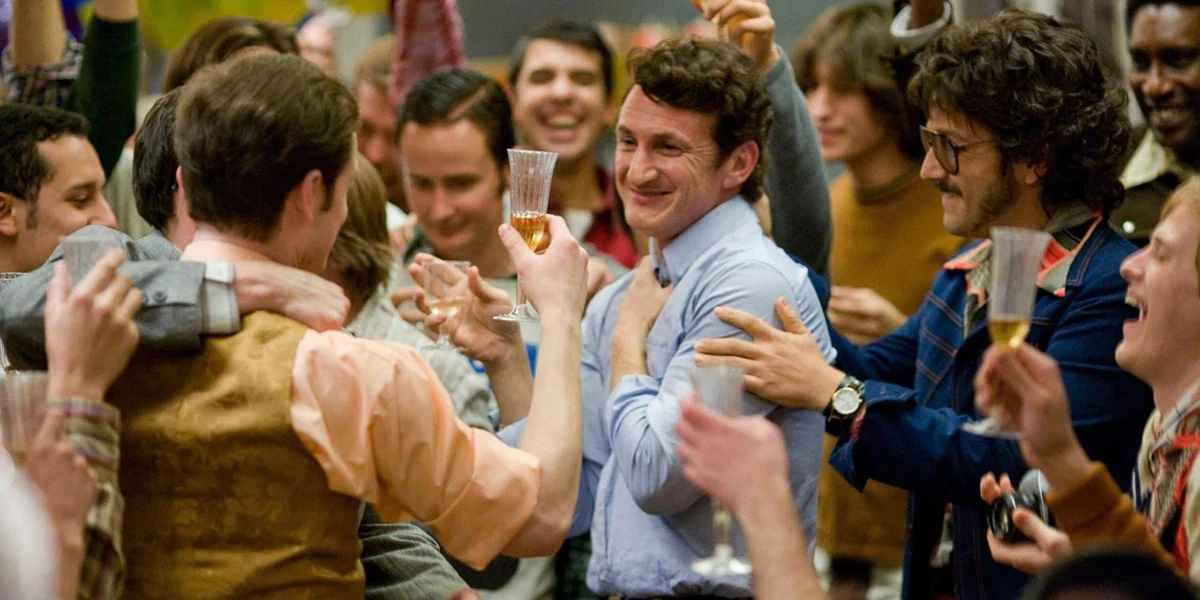
Van Sant utilized a blend of narrative filmmaking and archival footage to create a "living history" effect. Cinematographer Harris Savides employed various film stocks and handheld camera work to mimic the grainy, documentary style of 1970s news broadcasts. This technique allowed the film to transition seamlessly between Sean Penn’s performance and real-life footage of activists and politicians from the era, such as Anita Bryant and John Briggs.
Performance Analysis and Casting Choices
The film’s ensemble cast was widely praised for its depth and realism. Sean Penn’s portrayal of Harvey Milk was noted for its departure from his typically stoic and aggressive roles. Penn captured Milk’s "hope-based" rhetoric, delivering a performance that balanced political ferocity with personal vulnerability. This role earned Penn his second Academy Award for Best Actor.
Josh Brolin’s portrayal of Dan White provided a complex look at the film’s antagonist. Rather than a one-dimensional villain, Brolin depicted White as a man struggling with a shifting social landscape and his own perceived failures. The supporting cast included Emile Hirsch as Cleve Jones, James Franco as Scott Smith, and Diego Luna as Jack Lira. In a notable casting choice for symbolic authenticity, out gay actors Victor Garber and Denis O’Hare were cast as Mayor George Moscone and the homophobic Senator John Briggs, respectively.
The 2008 Socio-Political Intersection
The release of Milk in November 2008 occurred just weeks after California voters passed Proposition 8 by a margin of 52.24% to 47.76%. The parallels between the film’s depiction of the 1978 Briggs Initiative and the contemporary fight for marriage equality were unavoidable. Dustin Lance Black, the film’s screenwriter, used his Oscar acceptance speech to address this directly, stating that the film was written to give "hope to every gay and lesbian kid."
Comparative Data: Proposition 6 vs. Proposition 8
| Feature | Proposition 6 (1978) | Proposition 8 (2008) |
|---|---|---|
| Primary Goal | Ban gay teachers in public schools | Ban same-sex marriage |
| Key Proponent | John Briggs / Anita Bryant | ProtectMarriage.com |
| Key Opponent | Harvey Milk / George Moscone | No on 8 Campaign |
| Outcome | Defeated (58.4% No) | Passed (52.2% Yes) |
| Long-term Result | Protected LGBTQ+ employment rights | Overturned by Supreme Court in 2013 |
The film served as a rallying cry for activists who felt a renewed sense of urgency following the passage of Proposition 8. Focus Features, the film’s distributor, found itself navigating a delicate balance between promoting a commercial film and acknowledging its role as a political catalyst.
Critical Reception and Commercial Performance
Milk was both a critical and a commercial success. It holds a 93% "Certified Fresh" rating on Rotten Tomatoes, with critics highlighting its ability to humanize a political icon without descending into hagiography.
Award Recognition
The film received eight Academy Award nominations, winning two:
- Best Actor: Sean Penn
- Best Original Screenplay: Dustin Lance Black
Other nominations included Best Picture, Best Director for Gus Van Sant, and Best Supporting Actor for Josh Brolin. Commercially, the film grossed approximately $54.7 million worldwide against a production budget of $20 million. While not a blockbuster by traditional standards, its performance was considered strong for an R-rated biographical drama.
Legacy and Broader Implications
The legacy of Milk extends beyond its cinematic achievements. It revitalized interest in the 1984 documentary The Times of Harvey Milk, which provided much of the structural inspiration for Van Sant’s film. More importantly, it introduced Harvey Milk’s philosophy to a new generation of activists. Milk’s core message—"You gotta give ’em hope"—became a recurring theme in the subsequent years of the marriage equality movement.
The film also marked a turning point for Gus Van Sant, reconciling his "New Queer Cinema" roots with mainstream Hollywood success. By utilizing conventional narrative structures to tell a radical story, Van Sant was able to reach a broad audience that might otherwise have been indifferent to LGBTQ+ history.
In the years following the film’s release, the political landscape continued to shift. The federal recognition of same-sex marriage in 2015 via the Obergefell v. Hodges Supreme Court decision fulfilled many of the aspirations voiced by the characters in the film. However, the film remains relevant as a study of grassroots mobilization and the personal sacrifices inherent in the pursuit of civil rights. Milk stands as a definitive record of a man who understood that his life was a secondary concern to the movement he represented, a sentiment captured in the film’s opening recording: "This is to be played only in the event of my death by assassination."