The landscape of modern cinema is frequently defined by its visual grammar, yet the psychological architecture of a film is almost invariably erected by its score. No element wields greater influence over the emotional trajectory of an audience than music, acting as an invisible conductor that transforms tragedy into farce or romance into suspense. It is this fundamental truth of filmmaking that underpins Behemoth!, the ambitious new feature from director and writer Tony Gilroy. Marking Gilroy’s first return to the director’s chair in over a decade—following his 2012 release, The Bourne Legacy—the 124-minute picture offers a sophisticated, if uneven, meditation on artistry, memory, and the mechanics of cinematic storytelling.
Distributed by Searchlight Pictures and bolstered by an ensemble cast that features Pedro Pascal, Olivia Wilde, Will Arnett, and Hank Azaria, Behemoth! utilizes a novel narrative conceit. The film centers on a former child prodigy turned session cellist who uses his musical performances to color and interrogate his own past. While the picture’s screenplay occasionally struggles to ground its protagonist, the film’s innovative structure and staggering auditory landscape have already positioned it as one of the most intellectually stimulating releases of the year.
Main Facts and Plot Overview
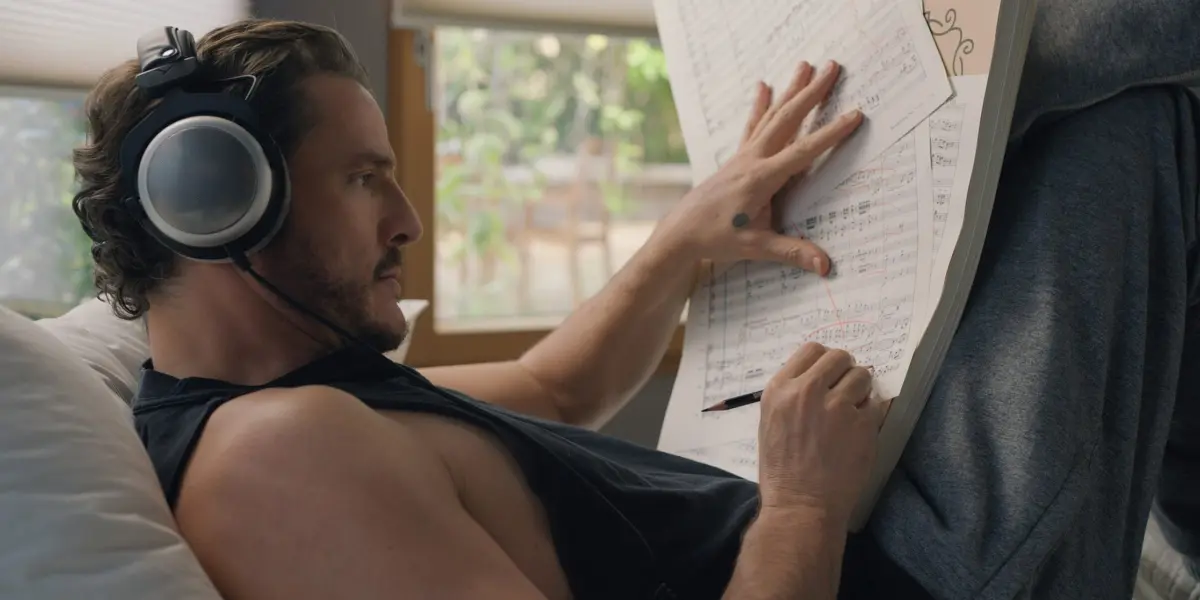
At the narrative core of Behemoth! is Alex Serian, portrayed with characteristic restraint by Pedro Pascal. When audiences first encounter Alex, he is a man adrift, physically and emotionally displaced. A former child prodigy who once appeared on national television at the age of six, Alex now lives in the shadow of a storied musical family. He has recently abandoned his position with a prominent Chicago orchestra, fleeing not only a toxic working environment but also a turbulent, suffocating relationship with a manic former partner.
Seeking refuge, Alex returns to Los Angeles. His ostensible mission is twofold: to secure work recording high-profile Hollywood film scores and to address unfinished family business, chief among them his mother’s accelerating deterioration due to Alzheimer’s disease. However, as Alex navigates a complicated reunion with his less-accomplished brother, Andy (Will Arnett), and mentors a young, aspiring cellist, it becomes increasingly clear that he is running away from his own identity rather than toward a destination.
The film’s primary innovation lies in how its narrative unfolds. As Alex records fictional genre scores in studio settings, the music bleeds into his reality, acting as a diegetic and nondiegetic bridge to his flashbacks. The audience experiences Alex’s memories not as objective historical events, but as they are filtered through the dramatic, manipulative conventions of Hollywood film scores. This metacinematic approach creates a disorienting, fascinating dialogue between lived experience and artistic artifice, suggesting that human memory often adopts the narrative tropes of the cinema we consume.
Chronology and Background Context
To understand the weight of Behemoth! within Tony Gilroy’s career, one must look at the filmmaker’s trajectory over the past decade. Gilroy, celebrated for his tight, muscular screenwriting in projects like the original Bourne trilogy and the critically acclaimed television series Andor, has spent the last ten years largely behind the scenes or operating within established intellectual properties. Behemoth! represents a deliberate return to personal, original storytelling—a cinematic experiment that pushes the boundaries of conventional narrative pacing.
The film’s chronology is deliberately fractured, moving fluidly between the present-day recording studios of Los Angeles and the fraught, memory-laden landscapes of Alex’s past.
Chronological milestones within the film’s narrative framework include:
- Early Childhood: Alex’s introduction to public life as a prodigious young cellist, culminating in a high-profile appearance on the Johnny Carson show that established a lifetime of familial expectations and pressure.
- The Chicago Era: The immediate prelude to the film’s present, detailing Alex’s tenure with a prestigious Chicago orchestra and his entanglement with Carol (Olivia Wilde), the emotionally volatile wife of a major institutional donor.
- The Catalyst: The sudden departure from Chicago, precipitated by Carol’s refusal to accept the end of their affair and the worsening health condition of Alex’s mother in Los Angeles.
- The Los Angeles Return: The contemporary timeline, in which Alex attempts to rebuild his career in Hollywood studio sessions while confronting the ghosts of his familial lineage, including his domineering father (Hank Azaria) and his complicated history with late violinist Nadia (Eva Victor).
Supporting Data and Production Craft
Running at a precise 124 minutes, Behemoth! is a masterclass in technical collaboration. The film’s striking visual palette is the work of cinematographer Damián García, whose lens captures the sterile glare of Los Angeles recording booths and the opulent gloom of Chicago gala halls with equal precision. Complementing García’s visual framing is the seamless editing of John Gilroy, whose work ensures that the abrupt transitions between past and present, memory and reality, maintain a fluid, hypnotic rhythm.
However, the true centerpiece of the production is its unprecedented musical architecture. The film’s score is not merely an accompaniment; it is a principal character. Credited to The Behemoth! Collective—an extraordinary supergroup of contemporary film composers that includes Michael Abels, Emily Bear, Lukas Frank, Michael Giacchino, James Newton Howard, Henry Jackman, Nami Melumad, Brandon Roberts, and Alan Silvestri—the soundtrack covers the absolute full scope of modern movie music.
Every scene introduces a new musical pastiche that references the grand traditions of cinematic composition while remaining entirely distinct. From pulsing, thriller-esque rhythms that underscore Alex’s flight from Chicago to sweeping, romantic motifs that interrogate his tragic past, the score serves as the emotional glue holding the film’s disparate narrative threads together.
Character Analysis and Ensemble Dynamics
While the technical and musical achievements of Behemoth! have earned widespread acclaim, critical evaluation of its character study elements remains mixed. Pedro Pascal carries the film’s narrative burden with a performance defined by profound stillness. Pascal relies on micro-expressions—a subtle tightening of the jaw, a fleeting look of exhaustion—to communicate seismic emotional shifts. Yet, this extreme subtlety occasionally works against the film’s broader ambitions.
Alex Serian is written as a cipher, a man whose internal belief system is largely absent and whose psychological baggage reads as standard-issue trauma for a former child prodigy. Because much of his foundational history—particularly his complex relationship with the late violinist Nadia—occurs off-screen or is communicated through exposition, the audience is forced to take the assertions of supporting characters at face value.
Fortunately, Pascal is buoyed by a powerhouse supporting cast:
- Olivia Wilde brings an electric, brazen energy to Carol, serving as a volatile foil to Alex’s emotional withdrawal.
- Eva Victor infuses Nadia with a sly sensuality that lingers over the narrative long after her character’s untimely death.
- Will Arnett delivers a remarkably grounded, soulful performance as Andy, the brother overshadowed by familial expectations.
- Hank Azaria provides a chilling portrait of parental narcissism as Alex’s overzealous father, illuminating the systemic pressures that forged Alex’s emotional detachment.
Broader Impact and Implications
The release of Behemoth! arrives at a fascinating juncture for Searchlight Pictures and the broader independent film market, serving as a litmus test for audiences’ appetite for mid-budget, original dramas that reject standard narrative conventions. By wedding a traditional character study with high-concept metacinematic structuralism, Gilroy has crafted a film that invites rigorous academic and critical discourse regarding the manipulation of memory through art.
From an industry perspective, the assembly of The Behemoth! Collective represents a watershed moment in film scoring. By pooling the talents of nine distinct, celebrated composers into a unified diegetic framework, the production has established a new benchmark for how music can be integrated into a narrative text. Industry analysts suggest that the film’s innovative approach to sound design and score-as-memory could influence how future filmmakers approach psychological storytelling.
Ultimately, while Behemoth! may falter slightly in its character-building execution—leaving its protagonist somewhat opaque by the time the credits roll—its achievements in atmosphere, technical craftsmanship, and thematic ambition ensure its place as a landmark release of the cinematic year. It is a work that reminds audiences of the profound, sometimes terrifying power of music to rewrite our past, shape our present, and define our understanding of who we are.