Hong Kong screen legend Tony Leung Chiu-wai, a titan of international cinema renowned for his enigmatic gaze and profound character portrayals, has recently captivated audiences with his role in Hungarian filmmaker Ildikó Enyedi’s latest offering, Silent Friend. The film, which premiered on May 8 via 1-2 Special, invites viewers into a unique narrative exploring humanity’s connection to nature across disparate timelines, anchored by the enduring presence of a German ginkgo tree. Leung’s participation in this thought-provoking project, coupled with a rare retrospective of his work at Film at Lincoln Center, underscores his continued artistic curiosity and global influence, nearly 25 years since his last promotional visit to New York.
A Career Forged in Depth and International Acclaim
Tony Leung’s journey in cinema is a testament to an actor’s profound dedication to his craft. Beginning his career in 1982 as a co-host on a children’s television show, Leung meticulously honed his skills, steadily ascending to leading roles in both television and film. His early collaborations with auteur Wong Kar-wai, beginning with Days of Being Wild (1990) and culminating in masterpieces like Chungking Express (1994), Happy Together (1997), and the globally celebrated In the Mood for Love (2000), established him as a master of nuanced, melancholic performances. His portrayal of Chow Mo-wan opposite Maggie Cheung in In the Mood for Love earned him the Best Actor award at the 2000 Cannes Film Festival, solidifying his status as a world-class talent.
Beyond Wong Kar-wai, Leung’s filmography boasts collaborations with an impressive roster of cinema’s most accomplished directors, including John Woo (Hard Boiled, 1992), Hou Hsiao-hsien (A City of Sadness, 1989), Ang Lee (Lust, Caution, 2007), Johnnie To (The Longest Nite, 1998; Infernal Affairs, 2002), and Zhang Yimou (Hero, 2002). These partnerships allowed him to explore virtually every genre imaginable: romance, comedy, horror, sci-fi, crime, thriller, fantasy, and some of the most memorable dramas of the last four decades. His roles in A City of Sadness, In the Mood for Love, and Infernal Affairs are widely considered iconic, showcasing his unparalleled versatility and ability to imbue characters with deep psychological complexity.
Leung’s ability to transition seamlessly between roles—from a reporter to a policeman, smuggler, informer, real-estate tycoon, photographer, gambler, bounty hunter, and now a neuroscientist—is a hallmark of his commitment and empathy. Filmmaker Ildikó Enyedi eloquently noted a distinctive aspect of Leung’s performing style: his penetrating gaze. She shared his personal reflection, “He said it may be due to his childhood, which was painful, difficult. He had to learn to hide his feelings, to isolate himself.” This introspection has undoubtedly contributed to the profound emotional depth he brings to each character, allowing audiences to connect with his internal struggles and triumphs.
Silent Friend: A Philosophical Exploration of Time, Nature, and Consciousness
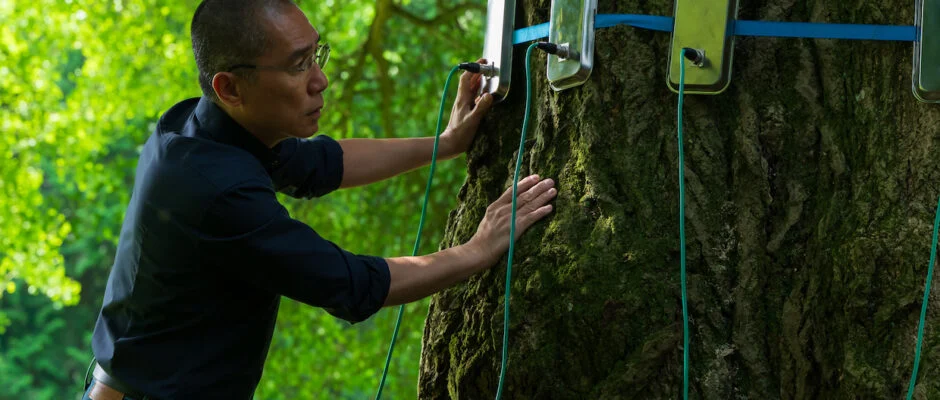
In Silent Friend, Leung takes on the demanding role of a neuroscientist in the year 2020, during the final third of a narrative that spans three distinct periods (1908, 1972, and 2020), all linked by the same ancient German ginkgo tree. The film, directed by the acclaimed Hungarian filmmaker Ildikó Enyedi, known for her Oscar-nominated On Body and Soul, delves into profound philosophical questions. Leung’s character finds his research on newborn brain activity abruptly halted by the global COVID-19 pandemic. During this unexpected professional hiatus, he develops a deep fascination with the nearly 200-year-old ginkgo, embarking on a quest to uncover a potential link between his own neurological activity and that of the tree.
Enyedi’s vision for Silent Friend explores themes of human connection to the natural world, the passage of time, and the elusive concept of consciousness beyond the human realm. The ginkgo tree, a symbol of resilience, longevity, and ancient wisdom, serves as a silent witness and perhaps an active participant in the unfolding human dramas across generations. The film’s unique structure, presenting vignettes from different eras, challenges conventional storytelling and invites viewers to ponder the interconnectedness of all living things. The choice of Leung for such a contemplative role highlights Enyedi’s belief in his unique ability to convey profound internal states with minimal dialogue, allowing his presence and expressions to carry the narrative weight.
The Actor’s Method: Six Months of Scientific Immersion
Leung’s preparation for Silent Friend exemplifies his renowned dedication to his craft, often bordering on method acting. He revealed that he dedicated approximately six months to research before production commenced, primarily because the script offered limited background information about his character. To authentically portray a neuroscientist, Leung immersed himself in the field, studying early cognitive development and engaging with real neuroscientists from various universities. He even attempted to gain practical experience with electroencephalography (EEG) studies on children, though logistical constraints prevented him from accessing a "baby lab."
Simultaneously, Leung delved into the burgeoning field of plant intelligence and the philosophy of consciousness. This interdisciplinary approach was crucial for understanding his character’s unique quest to find evidence of consciousness in the ginkgo tree. His goal was to internalize the character so thoroughly that he could inhabit the role "in an unconscious manner," fostering the confidence necessary for demanding scenes, such as a pivotal lecture. Further demonstrating his meticulousness, Leung assumed his character would have studied at prestigious British institutions like Oxford or Cambridge. To reflect this, he hired a British accent coach, aiming to infuse his dialogue with "the hint of a British accent," adding another layer of authenticity to his portrayal. This extensive preparation underscores Leung’s commitment to not merely acting a part but truly becoming the character, embodying their intellectual and emotional world.
A Dialogue on Sentience: Plants, Buddhism, and the Pandemic’s Echoes
During interviews ahead of the US release of Silent Friend and at the Busan International Film Festival, Leung openly discussed his evolving perspectives on plant consciousness, a central theme of the film. When asked if he believed plants possessed consciousness, he responded affirmatively, stating, “I do, especially after studying books about plant intelligence for this movie. I’ve really changed my entire perspective towards plants. I think they’re just like humans. They are sentient beings. So to some degree they have consciousness.” This transformation reflects a growing global interest in the scientific and philosophical discourse surrounding plant intelligence, moving beyond anthropocentric views to consider the complex communication networks and adaptive behaviors observed in the botanical world.
While acknowledging his Buddhist practice, Leung was cautious about attributing his changed perspective solely to his faith. He clarified, “I’m not sure that Buddhism is what changed my perspective. It’s just that my knowledge about plants changed. Of course, from a Buddhist point of view we all have consciousness.” This statement highlights the convergence of scientific inquiry and ancient spiritual wisdom, both suggesting a broader definition of sentience than traditionally accepted in Western thought.

The film’s narrative, where Leung’s character experiences isolation due to the COVID-19 pandemic, resonated deeply with the actor’s real-life experiences. He recounted, “Very much like what happened in the movie. I was isolated from other people, in a city with no one I really knew. All the hotels and stores closed down. It was in Tokyo.” While his character found solace in nature, Leung’s personal experience involved navigating deserted urban landscapes. “I like to ride my bicycle, but it was strange because there was no one on the streets. So it was very similar to Silent Friend—only in the movie I could be in nature, not in a city.” This parallel between his character’s isolation and his own during a global health crisis adds a layer of poignant authenticity to his performance, reflecting the universal human experience of profound disruption and introspection during the pandemic.
The Art of Collaboration: Directors as Guiding Lights
Tony Leung’s illustrious career is not just defined by his individual performances but also by his deep and enduring collaborations with directors. He articulated a clear philosophy for choosing projects: “I believe my instinct. I love being with someone I think I can work with. I don’t pick a project because of the script, but because of the director, the person. I need to talk with them, have a meeting to feel them out. If it’s good, then I will work with them.” This trust-based approach allows him to immerse himself fully, even under unconventional circumstances.
An example of this trust is his work on Tran Anh Hung’s 1995 film Cyclo, set in Vietnam. The cinematographer, Benoît Delhomme, revealed a challenging production environment where censorship meant they couldn’t review any footage until after leaving the country. Yet, Leung stated this didn’t affect his performance. “No, because I knew the script so well. I stayed very close with the director and the star, Trần Nữ Yên Khê. We stayed at the same hotel. The director lived next door to me, and we spent almost all of our time together. We’d talk about the movie over lunch.” This anecdote underscores the profound level of intimacy and mutual understanding he cultivates with his chosen collaborators, which transcends external production constraints.
Leung also acknowledged the vast differences in directorial approaches, contrasting the flexibility of projects like Cyclo and Silent Friend, which allowed for improvisation, with the rigid demands of Hollywood blockbusters. For his Marvel debut in Shang-Chi and the Legend of the Ten Rings, he noted, “in a Hollywood production, you can’t change a word. You have to do everything just as it was already prepared. So it’s very different.” This adaptability to diverse working styles further showcases his professionalism and ability to deliver exceptional performances regardless of the production environment.
Embracing the Dark Side: Villainous Portrayals and Uncharted Territory
In recent years, Tony Leung has ventured into darker, more morally ambiguous territory, portraying antagonists in films such as Xu Wenwu in Marvel’s Shang-Chi and the Legend of the Ten Rings, the real estate mogul Henry Ching Yat-yin in The Goldfinger, and a corrupt Hong Kong policeman in Where the Wind Blows. When asked about his interest in playing "bad guys," Leung explained, “It’s something I seldom have a chance to do. I just want to explore that mindset, experience how it feels to be that.” These roles offer him an opportunity to delve into the complexities of human nature, exploring motivations and psychologies far removed from his often melancholic or heroic characters.
His performance as Sam, the policeman in Johnnie To’s 1998 crime thriller The Longest Nite, was singled out as one of his darkest. Leung fondly recalled the experience: “I loved that movie. Its box office wasn’t that great, but I loved working with Johnnie To. You know he wasn’t working with a script, right? I asked him, ‘How come you don’t have a script?’ He said, ‘That’s the way I’m working now.’” This improvisational, trust-based environment allowed Leung to explore the character’s depths without predefined constraints. “It was really enjoyable. I thought, why not explore that kind of character? Because I wouldn’t get that chance in real life.” These villainous turns demonstrate his continuous desire to challenge himself and expand his artistic range, adding new dimensions to his already legendary career.
The Goldfinger and Hong Kong’s Financial Underbelly
Leung’s recent role in The Goldfinger saw him portray Henry Ching Yat-yin, a character inspired by the notorious real-life figure George Tan, at the center of the Carrian Group scandal, one of Hong Kong’s largest financial frauds in the early 1980s. The Carrian Group, once a high-flying conglomerate, collapsed spectacularly, leaving a trail of bankruptcies, investigations, and even murders, shaking the city’s financial stability.
Leung admitted his limited knowledge of Tan prior to the project: “I heard of George Tan when I was young, but I had no idea who he was. He’s very mysterious.” Director Felix Chong provided him with the book Carrian: a True Story of Murder, Mystery and Mayhem by Ian Robinson, which detailed the scandal. Leung’s reaction highlighted the shocking nature of the events: “I thought, ‘Wow, how can something like this happen in Hong Kong?’ Someone was even murdered, but there was no follow up.”
Despite the real-life basis, portraying Tan proved challenging due to the figure’s elusive nature. “This guy was so mysterious, he never showed up anywhere unless he had to,” Leung explained. His research involved speaking with bankers who had worked with Tan, but a comprehensive understanding remained elusive. “I still had no idea who he was. I just had to go on what I learned from the book. Even now, no one knows who he really was.” This deep dive into a historical figure shrouded in mystery allowed Leung to craft a performance based on inference and the broader implications of the scandal, rather than direct imitation, showcasing his skill in bringing complexity to even the most enigmatic characters.
Looking Ahead: A Legacy Continues to Unfold
Even after decades in the industry, Tony Leung Chiu-wai shows no signs of slowing down. His recent visit to New York to support both Silent Friend and a comprehensive retrospective of his work at Film at Lincoln Center underscored his enduring relevance and the global appreciation for his contributions to cinema. The retrospective served as a poignant reminder of his extensive filmography and the indelible mark he has left on audiences worldwide.
Looking to the future, Leung confirmed an eagerly anticipated collaboration with director Johnnie To, with whom he has delivered several memorable performances. “Yes, we’re working on the script right now,” he stated, though fans will have to wait a while. “I’ve got two more projects I’m committed to, so the To film will maybe happen in late 2027.” This upcoming project with one of Hong Kong’s most distinctive filmmakers promises another chapter in a career defined by artistic integrity, profound character studies, and an unwavering commitment to the art of acting. Tony Leung Chiu-wai remains a cinematic force, continually seeking new challenges and enriching the global tapestry of film with his unique blend of intensity, vulnerability, and intellectual curiosity.