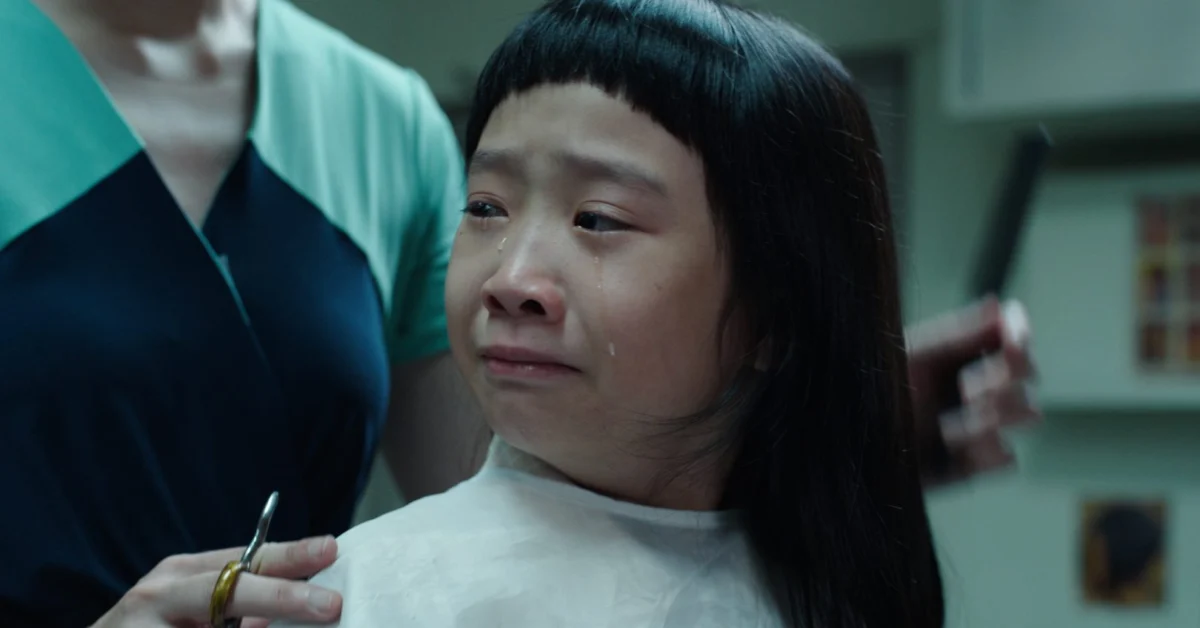
The release of a feature film debut often signals the arrival of a distinct cinematic voice, one eager to interpret personal history through the stylized lens of narrative fiction. In the case of Ang Geck Geck Priscilla’s directorial debut, Ah Girl, that voice is filtered entirely through the perceptive, albeit bewildered, consciousness of a seven-year-old child. Running at 99 minutes, the film transports viewers back to the geopolitical and domestic landscape of 1994 Singapore—a period characterized by rapid economic modernization juxtaposed with enduring traditional social frameworks. At its core, the movie chronicles the unravelling of a standard nuclear family, forcing its youngest members to confront complex adult anxieties long before they have shed their childhood naivety.
The narrative is anchored by a formidable cast led by young actors Ong Xuan Jing, who portrays the titular seven-year-old Ah Girl, and Sydney Wong, who plays her five-year-old sister, Ah Tian. Supporting them are established regional talents Doreen Toh, James Seah, and Carrie Wong, who collectively inhabit the roles of the strained extended family. Yet, despite the emotional weight of its premise, the film navigates a delicate tightrope between evocative childhood remembrance and rough-around-the-edges storytelling, resulting in a family portrait that ultimately feels both compelling in its perspective and fragmented in its execution.
The Premise and Chronology of a Domestic Collapse
The timeline of Ah Girl unfolds across a compressed, highly volatile period within a single suburban household. The inciting incident of the film—and of the sisters’ psychological disruption—occurs when the children are presented with a harrowing ultimatum by their warring parents: a choice of custody. Would they prefer to live with their mother or their father? This single question shatters the illusion of domestic stability, casting the two young girls into an immediate crisis of loyalty and geography.
Set against the backdrop of mid-1990s Singapore, the chronology of the breakdown is charted through subtle shifts in daily routines. Ah Girl’s existence prior to the separation is marked by the eccentricities of ordinary childhood: striving for academic validation, harboring a tentative crush on a classmate, and running a clandestine chewing gum enterprise on school grounds—a humorous nod to Singapore’s strict legislative environment regarding the confectionery at the time. However, this rebellious spirit and vivid imagination are soon conscripted into service as emotional armor.
As the timeline progresses, the domestic routine deteriorates completely. The father, portrayed by James Seah, retreats into a nocturnal schedule of shift work and casual dating, rendering him largely absent and emotionally detached. Meanwhile, the mother, played by Carrie Wong, attempts to salvage her relationship with her daughters through scheduled, often performative weekend interventions. Caught in the silent periphery is the grandmother, brought to life by Doreen Toh, whose quiet suffering underscores the generational toll of the marital rupture. Rather than depicting the slow burn of a dying marriage over years, the film accelerates the collapse, confining the audience to the abrupt, dizzying velocity with which a child’s world can be dismantled.
Cinematic Style and the Aesthetic of Memory
Director Ang Geck Geck Priscilla adopts a deliberate visual strategy to keep the audience tethered strictly to the limited perspective of a seven-year-old. By intentionally withholding the broader legal and interpersonal context of the divorce, the film mimics the psychological reality of children who are routinely kept in the dark by protective—or self-absorbed—adults.
Visually, the production employs a disorienting camera movement, unorthodox framing, and surreal dream sequences designed to externalize Ah Girl’s internal emotional landscape. These moments of magical realism function as a coping mechanism, allowing the protagonist to imagine an idyllic refuge amid domestic hostility. Furthermore, the aesthetic design evokes a vintage home-video quality, intentionally rendering memories in a fragmented, impressionistic manner rather than a rigid historical recounting.
However, this artistic choice introduces a noticeable friction within the film’s production design. While the meticulously crafted costumes and period-accurate props successfully conjure the tactile environment of 1990s Singapore, they occasionally clash with an overly polished cinematography. At times, the high-gloss visual sheen threatens to transform scenes of raw emotional trauma into something resembling a commercial advertisement, undercutting the gritty realism required for a domestic drama of this magnitude.
Narrative Ambitions and Structural Shortcomings
From a structural standpoint, Ah Girl suffers from a stop-and-go narrative momentum that frequently stalls its own dramatic acceleration. While the film excels at recording the minute behaviors of a family in distress, it consistently bypasses the deep-dive character development necessary to sustain a 99-minute feature. The writing often relies on literal action and on-the-nose dialogue, trading complex subtext for overt, sometimes melodramatic storytelling.
This heavy-handed approach occasionally steers the film into emotionally manipulative territory. Sensitive subject matter—such as the psychological displacement of children and the impending threat of sibling separation—deserves a level of introspective nuance that the script occasionally fails to deliver. Consequently, the narrative pacing stutters, leaving viewers with a series of well-observed vignettes rather than a fully cohesive, propulsive arc.
Yet, despite these structural hurdles, the character of Ah Girl remains a fascinating literary and cinematic creation. Her journey tracks a crucial cognitive and emotional evolution from unquestioning obedience to sharp, cynical observation. As she witnesses the petty behaviors and transparent hypocrisies of the adults around her, she reaches a philosophical tipping point encapsulated by her sharp indictment: "Adults are all cheaters and liars." This sentiment marks the definitive death of her childhood innocence and the uncomfortable birth of her independence.
Cultural Identity and Broader Societal Implications
Beyond the immediate domestic drama, Ah Girl touches upon broader themes of cultural identity and linguistic heritage within the Singaporean context. One of the film’s most resonant, albeit underexplored, narrative threads involves the protagonist’s relationship with her name. Initially introduced to external audiences by her English name, Eileen, the character actively reclaims her indigenous roots by asserting her Singaporean name, Swee Swee. This linguistic and cultural assertion mirrors Singapore’s own historical identity struggles during the 1990s—a rapidly globalizing nation attempting to balance Western economic integration with distinct local heritages.
Unfortunately, these profound sociological observations are frequently sidelined in favor of the immediate family conflict. Moments in which Ah Girl and Ah Tian reflect on their shared isolation and the terrifying prospect of being physically divided from one another are glossed over, begging for a more focused and intentional thematic exploration.
Ultimately, Ah Girl stands as an ambitious yet uneven cinematic artifact. It captures the raw vulnerability of children caught in the crossfire of adult dissolution while offering a nostalgic, textured glimpse into 1994 Singapore. While it wrestles with a tonal identity crisis—oscillating uncomfortably between melodramatic indulgence and restrained character study—it nonetheless introduces a distinct directorial voice that demonstrates undeniable promise. Through the uninhibited, rebellious energy of its young protagonist, the film leaves a lingering impression of resilience, proving that even when a world falls apart, a child’s imagination will tirelessly work to piece it back together.