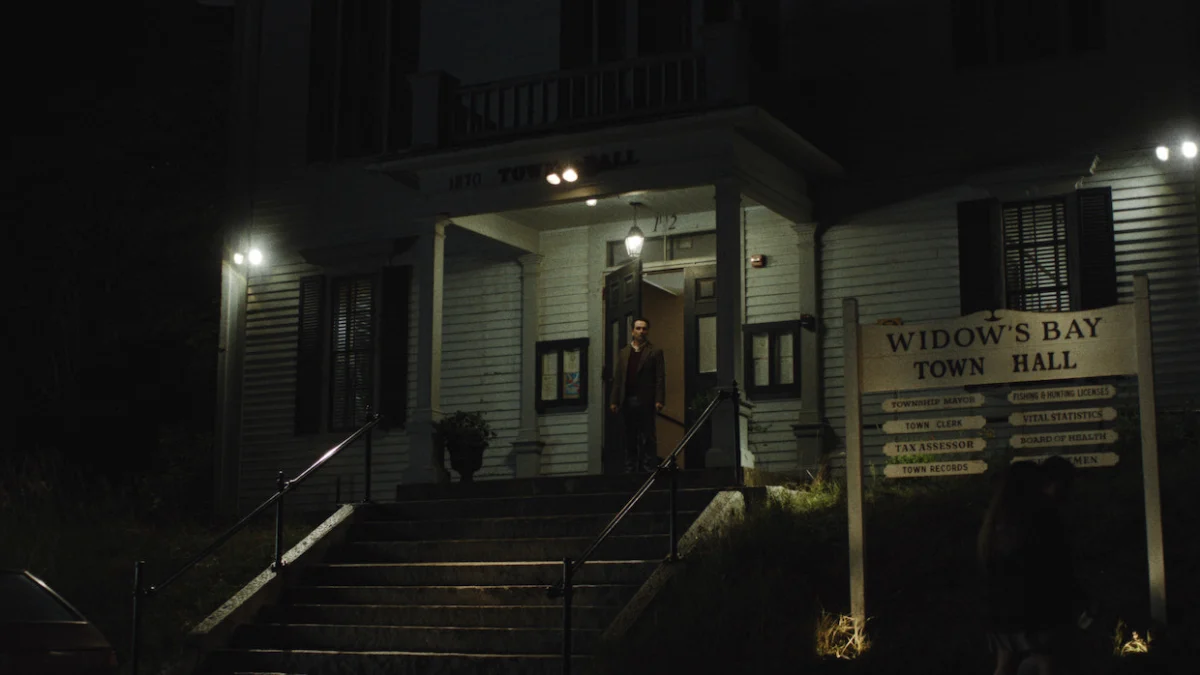
The entertainment landscape has witnessed a fascinating and increasingly prominent trend in recent years: the migration of celebrated comedic auteurs into the realm of horror. This intriguing phenomenon, which sees creators leverage their profound understanding of audience reaction to elicit dread as effectively as laughter, is epitomized by the highly anticipated Apple TV+ series Widow’s Bay. Helmed by Katie Dippold, a veteran writer known for her sharp wit on Mad TV and Parks and Recreation, the show stands as a compelling testament to the permeable boundaries between seemingly disparate genres.
The Shifting Sands of Genre: From Sketch Comedy to Slasher Subtlety
The blueprint for this comedic-to-horror transition was laid emphatically in 2018 when Jordan Peele, formerly half of the acclaimed sketch comedy duo Key & Peele, transcended expectations with his directorial debut, Get Out. The film, a socially incisive psychological horror, earned him an Academy Award for Best Original Screenplay, grossing over $255 million worldwide against a modest $4.5 million budget. Peele cemented his new identity as a horror maestro with subsequent critical and commercial successes like 2019’s Us (which earned $255 million globally) and 2022’s Nope (with a worldwide gross of $172 million), both lauded for their narrative ambition and stylistic reverence. These films consistently achieved high critical ratings, with Get Out holding a near-perfect 98% on Rotten Tomatoes, Us at 93%, and Nope at 85%.
A similar trajectory has been observed with Zach Cregger, a founding member of the irreverent comedy troupe The Whitest Kids U’ Know. Cregger made a significant impact in the horror world with his 2022 feature, Barbarian, which garnered widespread critical acclaim for its inventive scares and earned over $45 million globally from a $4 million budget, achieving an impressive 93% on Rotten Tomatoes. This year, his follow-up, Weapons, continued to push boundaries, earning Amy Madigan a Best Supporting Actress award for her devious performance. These successes underscore a fundamental connection between comedy and horror: both genres thrive on eliciting strong, visceral responses—a laugh or a jump—from their audience through carefully constructed anticipation and release. This shared DNA explains why countless films, from the darkly humorous An American Werewolf in London and The Evil Dead to the meta-commentary of Scream and The Cabin in the Woods, have masterfully straddled both worlds, often with antagonists like Freddy Krueger delivering memorable zingers.
The Architect of Anticipation: Katie Dippold’s Journey from Laughs to Leaps
Katie Dippold’s career path mirrors this evolving trend, making her uniquely suited to helm Widow’s Bay. Her early career was deeply rooted in sketch comedy, where she honed her craft as a writer for the iconic Mad TV, known for its rapid-fire comedic sketches and character development. She further solidified her reputation in television comedy as a writer for the beloved Parks and Recreation, a show celebrated for its ensemble cast, witty dialogue, and optimistic yet grounded humor. This extensive background provided her with an innate understanding of comedic timing, character development, and the precise art of building up to a punchline.
Dippold’s transition into genre filmmaking began with significant contributions to horror-adjacent projects. She co-wrote the screenplay for the 2016 female-led Ghostbusters reboot, a film that, despite its divisive reception, showcased her ability to blend supernatural elements with broad comedy. More recently, she penned the script for Disney’s 2023 Haunted Mansion film, directed by Justin Simien, further demonstrating her comfort in crafting narratives that navigate the spectral and the humorous.
Dippold articulates this connection with clarity: "I really do think there’s something to people who started in sketch comedy understanding how to build something, setting up the anticipation and the payoff," she explains. "What I find fun is that you don’t know if that build is going to lead to something that’s going to make you laugh or scare you." This philosophy is the very bedrock of Widow’s Bay, a project that has been brewing in her mind for nearly two decades. Dippold reveals that she first conceived of the idea as a spec script for Parks and Recreation eighteen years ago, a testament to the enduring nature of her vision and the organic evolution of her creative process. Over the years, the concept matured, transforming from a broad comedy into a sophisticated series that deftly balances humor with genuine horror, a testament to Dippold’s growth as a storyteller and the collaborative nature of television production.
Welcome to Widow’s Bay: A New England Nightmare with a Punchline
Widow’s Bay, which premiered on Apple TV+, invites viewers to a picturesque yet perilously haunted New England island. Matthew Rhys, acclaimed for his dramatic work, stars as Tom Loftis, the island’s perpetually optimistic mayor. Tom embodies a hopeful vision for Widow’s Bay, dreaming of transforming it into a thriving vacation destination, a stark contrast to the ominous realities lurking beneath its charming facade. One might imagine a version of the mayor from Jaws, but infused with Rhys’s lovably rascally charm rather than Murray Hamilton’s skepticism.
Tom’s unwavering belief in his town’s potential constantly clashes with the fervent conviction of the town crankpot, Wyck, portrayed by the inimitable Stephen Root. Wyck is a staunch believer in the island’s ancient curse, serving as a persistent foil to Tom’s progressive aspirations. Despite Tom’s skeptical nature and Wyck’s constant warnings, the malevolent forces inhabiting Widow’s Bay manifest in increasingly bizarre and unsettling ways. The island is plagued by an assortment of evils, ranging from an ominous, soul-chilling fog that blankets the landscape to the terror of a killer clown. Adding to the macabre menagerie are an amorous sea hag with a unique, suffocating method of dispatching her male victims, a notoriously haunted inn, and an ancient spellbook whose accidental invocation nearly turns a cocktail party into a mass drowning.
Crucially, while its supernatural elements are genuinely unsettling and crafted to induce legitimate frights, Widow’s Bay positions itself as a comedy first, a horror show second. Much of the series’ humor is derived from the characters’ remarkably grounded and "reasonable reactions" to the outlandish supernatural occurrences that besiege their island. For instance, Mayor Loftis, ever the pragmatist, attempts to debunk the haunted inn rumors by spending a night there himself—only to be swiftly proven wrong, even as the innkeeper refuses to stay overnight. Another standout comedic moment involves Tom being relentlessly stalked by the aforementioned sea hag. The physicality of the humor peaks during a scene where the hag, known for smothering victims by sitting on their faces, is comically propelled across Tom’s living room by a perfectly timed, malfunctioning reclining armchair. Like the best situational comedies, the true genius of Widow’s Bay lies in watching its well-developed characters navigate increasingly absurd and unhinged scenarios with a blend of disbelief, resignation, and bewildered determination.
Crafting the Creepy and Comical: The Collaborative Vision
The journey of Widow’s Bay from a long-held concept to a vibrant Apple TV+ series underscores Dippold’s deep appreciation for collaboration, a stark contrast to the often more solitary process of feature film writing. "With features, you just write the script and you’re lucky if the director wants you on set," Dippold notes, highlighting the limited influence a writer often has post-submission. "Not being able to have much say once the script is in and [now] being in a position where I have all the say naturally made me someone who wants that collaboration." This philosophy has been instrumental in shaping the show’s distinctive tone and visual aesthetic. Dippold champions the input of her team, stating, "These actors are brilliant, the production design team is tremendous, and the directors who came in had other ideas that I would not have thought of. It’s thrilling to me, and I can’t imagine doing it in a way where it’s all my vision and nothing will ever change."

A pivotal partnership in achieving the series’ unique blend of brooding visuals and comedic timing was with executive producer Hiro Murai. An Emmy-winning director renowned for his distinctive and often surreal work on acclaimed series such as The Bear, Atlanta, and Station Eleven, Murai helmed five of the season’s ten episodes. His influence was crucial in developing the series’ "brooding visual tone," which perfectly complements its comedic undercurrents.
The genesis of this atmospheric quality, and indeed the entire series, harks back to a potent memory from Dippold’s teenage years. The show was inspired by a visit to a haunted house in Long Branch, New Jersey, during the 1980s. Dippold fondly recalls the era’s lack of stringent regulations: "It was the ’80s, and it was lawless. They could chase you around and grab you," she recounts. This visceral experience, a potent cocktail of genuine fear and exhilarating fun, left an indelible mark. "That mix of being scared, but you’re having the time of your life, is a feeling I’ve wanted to capture ever since," she reveals, articulating the core emotional experience she sought to replicate in Widow’s Bay.
Casting for Authenticity: Grounding the Absurd
Another critical element enabling Widow’s Bay to meld its disparate tones effectively is its meticulously curated cast. Alongside Matthew Rhys and Stephen Root, the ensemble includes Kate O’Flynn as Tom’s outwardly mousy but resilient assistant, Patricia; Kevin Carroll as the pragmatic town sheriff, Bechir Clemmons; and Dale Dickey as Rosemary, one of Tom’s no-nonsense employees. With the notable exception of Stephen Root, who possesses a versatile career spanning comedy (NewsRadio, Office Space) and drama (his Emmy-nominated role in Barry, and Emmy-contending voice work in Netflix’s Strip Law), most of the main cast members are more widely recognized for their compelling performances in television dramas.
Dippold’s initial inclination was to populate her fictional town with the wealth of comic performers she had admired since her improv days at the Upright Citizens Brigade Theatre in New York two decades ago. However, she judiciously steered away from this approach, recognizing that it could potentially disrupt the delicate comedy-horror balance she aimed for. "When I imagined an actor that you know from comedy starring in it, it just took me out of it," she explains. "Like, I don’t believe it’s a real place, and I don’t know that I would watch the show. As a horror fan, I want to know that they’re taking it seriously." This insight led to the strategic decision to cast actors known for their dramatic prowess in the central roles, ensuring the horror elements resonated authentically, while reserving recognizable comedic talent (such as Emmy winner Jeff Hiller, Tim Baltz, Toby Huss, Neil Casey, Connor Ratliff, and Chris Fleming) for supporting, often scene-stealing, roles.
Matthew Rhys’s casting, suggested by veteran casting director Allison Jones, was particularly inspired. Dippold, a long-time admirer of Rhys’s Emmy-winning work on The Americans, found his approach perfectly aligned with her vision. "He always just plays the truth of the scene," Dippold praises his performance as Mayor Loftis. "He never goes for the joke. He’s so naturally funny, and he understands what’s funny about [the scene]." This deliberate choice allows the absurdities of Widow’s Bay to land with greater impact, as the characters react with genuine gravity to their fantastical predicaments, inadvertently amplifying the comedic effect.
This nuanced approach to performance resonates deeply with a classic anecdote about the film Tootsie. Director Sydney Pollack once noted how astounded he was by the film’s comedic impact, given that the mood on set during production was overwhelmingly dramatic. Dippold identifies with this sentiment, revealing, "Often when I talk about influences on the show, I talk about Stephen King and John Carpenter, Atlanta and Parks and Rec… but I am secretly also thinking about Tootsie—but I never say it, because I know it’s going to confuse the hell out of everyone." Both Dippold and interviewers agree that it was Dustin Hoffman’s committed, dramatic performance as Michael Dorsey/Dorothy Michaels that imbued Tootsie with its profound humor. "I mean, he’s in a drama," Dippold laughs, reflecting on Hoffman’s approach. "If he was playing it any differently, it would feel terrible. And I think the actors on this show are doing something very similar. They don’t look at it like they’re in a comedy or a horror show; they’re just playing the scenes and they’re not thinking about the genres. And I think that helps a great deal."
The Emmy Gauntlet: Redefining Comedy for a New Era
When it comes to awards season, Widow’s Bay presents a fascinating challenge. The series will be submitted to the Emmys in the comedy category, a strategic decision that, while reflecting its primary comedic intent, positions it as arguably the most gruesome comedy of the year’s slate. This categorization highlights a long-standing tension within the Academy of Television Arts & Sciences: its historical reticence to embrace genre shows fully within the comedy categories.
While recent exceptions like Netflix’s Wednesday and FX’s critically lauded What We Do in the Shadows have managed to break through, these examples, vastly different in tone and comedic style, underscore the inconsistency. For film awards, particularly the Golden Globes, horror films have historically found more success by campaigning in comedy categories; both Jordan Peele’s Get Out and the body-horror film The Substance were notably submitted as comedies, indicating a precedent for genre-bending works to seek recognition outside traditional horror boxes.
Widow’s Bay thus presents a crucial test for Emmy voters: Can the Comedy Series Emmy category evolve to be as inclusive and expansive as its dramatic counterpart? The Drama Series category has, over time, demonstrated a remarkable willingness to embrace genre storytelling, moving beyond traditional dramas to celebrate shows like Game of Thrones (which secured four wins), and later nominating diverse genre entries such as The Boys, The Last of Us, Lovecraft Country, The Mandalorian, and Stranger Things. In these science fiction, fantasy, and horror shows, the drama is intrinsically woven into the fabric of their speculative narratives. Similarly, in Widow’s Bay, the meticulously crafted jokes are as vital and integral to the show’s identity as its genuine chills. The series effectively argues that nailing a perfectly timed jump scare requires a level of artistry and precision comparable to delivering an expertly crafted punchline. By presenting its unique blend, Widow’s Bay challenges voters to reconsider their definitions and appreciate the craft involved in merging these powerful, often contradictory, emotional experiences.
The Broader Implications: A Catalyst for Genre Evolution
The emergence and critical reception of Widow’s Bay, alongside the success of creators like Jordan Peele and Zach Cregger, signal a significant moment in the ongoing evolution of horror-comedy as a respected and potent subgenre. This trend suggests a growing sophistication in audience tastes, a desire for narratives that transcend rigid genre classifications and offer a richer, more complex emotional experience. Streaming platforms like Apple TV+, with their capacity for risk-taking and their pursuit of distinctive original content, are playing a crucial role in championing these innovative, boundary-pushing projects.
The potential success of Widow’s Bay at the Emmys, particularly within the comedy category, could have far-reaching implications for future genre-bending shows and their awards campaigns. It would validate the artistic merit of blending scares with humor and potentially encourage more creators to explore these fertile, hybrid territories. Furthermore, it could reshape how comedic talent is perceived and utilized across the industry, demonstrating that the skills honed in sketch comedy and sitcoms are not limited to laughs but can be powerfully applied to evoke dread, suspense, and poignant social commentary. As television storytelling continues to evolve, shows like Widow’s Bay stand as a testament to the power of genre fusion, proving that the most compelling narratives often emerge from the unexpected intersection of laughter and fear.