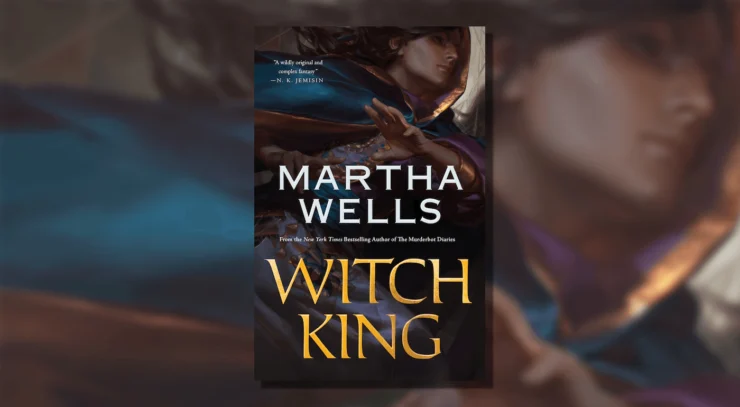
The latest installment of the Martha Wells Book Club, a popular online discussion forum hosted by ReactorMag, has turned its attention to "Witch King," the inaugural novel in Wells’s "The Rising World" fantasy series. This marks a significant departure from the beloved "Murderbot Diaries" for many readers, and for the club’s facilitator, it represents a welcome return to a work that first ignited a passion for exploring the author’s extensive back catalog. Having reread the novel, the facilitator reports an even deeper appreciation for its intricate world-building and complex thematic explorations, solidifying its place as a standout in Wells’s impressive body of work.
"Witch King" plunges readers directly into the tumultuous aftermath of a brutal empire’s collapse and the subsequent revolution that birthed the fledgling nation of the Rising World. The narrative opens with Kaiisteron, a prince from the subterranean Fourth House, awakening in a disoriented state. This is not his first experience with disembodied consciousness or spirit transference; his current predicament stems from a broken stasis curse. After a swift, violent encounter, Kai finds himself inhabiting the body of an expositor, a witch formerly enslaved by the Hierarchs, the mysterious and oppressive conquerors who once ruled the land. This characteristic of Wells’s writing—dropping readers into the thick of the action with minimal upfront exposition—allows the intricate details of the world and its history to unfold organically through the unfolding narrative.
The novel masterfully weaves together the present and past of the Rising World, a land scarred by the Hierarchs’ invasion and the bloody rebellion that finally overthrew them. Kai, now a demon trapped on the surface in a stolen body, is joined by Ziede, a former cloister teacher with the ability to manipulate air spirits. Their immediate goal is to locate Ziede’s wife, Tahren, a former Hierarch Marshall who defected to the rebellion, and to uncover the identities of their captors. This core group is soon augmented by a diverse cast of characters, including Sanja, a child kidnapped by the expositor whose body Kai now inhabits; Tenes, a young witch previously enslaved by the same expositor; and Ramad, a personal vanguarder to a political figure. Their collective quest promises to chart a difficult path forward, not only for the future of the Rising World but for the embattled trio at its heart.
The narrative journey of Kai, Ziede, and Tahren traverses the diverse landscapes of the Rising World, from its eastern coastlands to the flooded ruins of the Summer Halls, the former stronghold of the Hierarchs. In flashbacks, readers witness this fortress in its prime, a testament to the empire’s ostentatious power and ill-gotten wealth. The past also offers glimpses into the western grasslands, the ancestral home of the nomadic peoples Kai once belonged to, and hints at the landmass to the south from which the Hierarchs originated. A detailed map at the beginning of the book aids in orienting readers within this richly imagined world. As they are pursued by an unseen enemy, likely connected to their imprisonment and Tahren’s disappearance, the group unexpectedly encounters Dahin, Tahren’s brother, who provides crucial clues. Kai’s past unfolds through his experiences on the Saredi grasslands and within a demon cage in the Summer Halls, where he, with the aid of Ziede, Tahren, and Bashasa, a hostage prince, resolves to dismantle the Hierarchs’ legacy, even at great personal cost. The interplay between past and present is a cornerstone of the novel, with each informing and illuminating the other.
"Witch King," in line with much of Wells’s oeuvre, serves as a profound meditation on the enduring impacts of trauma, imperialism, colonization, forced assimilation, genocide, and the systematic exploitation of labor and resources by those in positions of power. The narrative centers on characters who, despite their initial blunders, forge a found family as they confront and dismantle their oppressors. While tinged with sadness, the novel is ultimately imbued with a resilient thread of hope, posing the vital question of what comes after the rebels achieve victory. The thematic resonance of "Witch King" draws parallels with popular media such as "Andor" and the recent Star Wars trilogy, where the fervor of rebellion (“fuck the empire”) clashes with the complex moral calculus required to build a lasting peace. The novel illustrates that while hope may fuel a rebellion, a stable society requires progressive ideals and an unwavering commitment to preventing the resurgence of fascism. The precarious position of Kai, Ziede, and Tahren underscores the consequences of the Rising World’s failure to fully address those who sided with their oppressors, a decision now jeopardizing the future they fought so hard to secure.
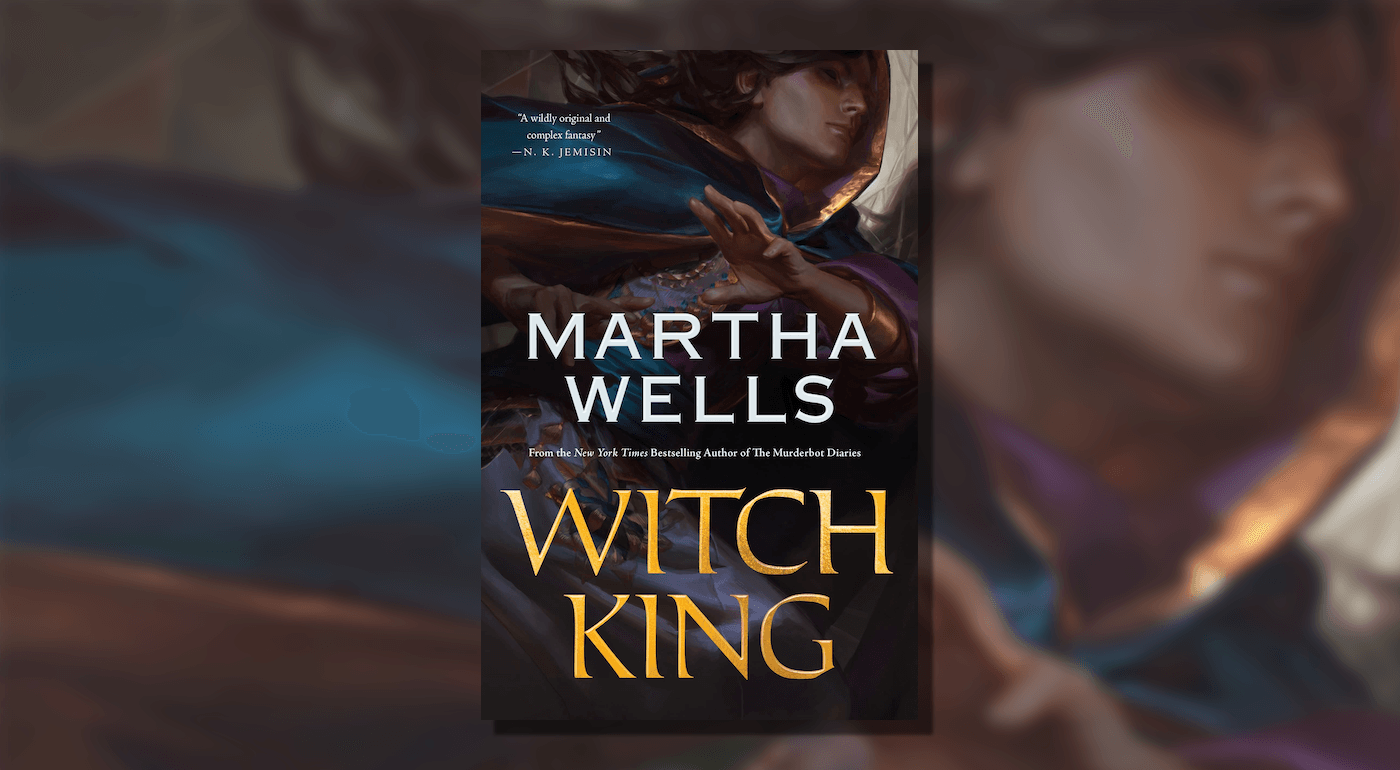
The novel’s temporal structure, characterized by frequent shifts between past and present, is enhanced by epigraphs from cultural documents of the Rising World preceding the historical sections. Initially, these excerpts may seem disparate, ranging from an Enalin chronicler’s observations on the Arike people’s binary gender system, signaled by clothing, to discussions of Enalin political leadership. However, as the narrative progresses and the scattered details woven into conversations and experiences begin to coalesce, the significance of these epigraphs becomes increasingly apparent, enriching the reader’s understanding of the world’s cultural nuances.
The exploration of gender is a particularly striking element within "Witch King." The novel showcases how different societies within the Rising World interpret and express gender identity and expression. Some cultures disregard traditional markers of gender in attire or physical form, while others adhere to them. The protagonists encounter soldiers who, by tradition, would have been women but now present as men, prompting Kai to question whether these individuals are truly men or were coerced into changing their gender. This reflects a broader cultural context where, for demons and the Saredi people, an ancient agreement allowed demons to inhabit the bodies of deceased Saredi without regard for gender matching. The biological characteristics of the human form are secondary to societal perceptions of gender. This explains Kai’s presence in the body of Enna, a young woman, where he, as Kai-Enna, was consistently referred to using he/him pronouns. Similarly, another female demon inhabits the body of an elderly man, yet is consistently referred to as "she."
Beyond gender, queerness is woven into the fabric of the narrative in multiple ways. Kai, experiencing attraction to men regardless of the gender of the body he inhabits (as Kai-Enna and later in male bodies), expresses no attraction towards individuals using she/her pronouns. Ziede and Tahren, both women, are married to each other. Several characters utilize they/them pronouns, and Kai employs neutral terminology like "the person" when unable to immediately identify a character’s gender. The novel presents a world where queerness exists not as a radical identity requiring a fight against societal norms, but as an inherent aspect of existence. The absence of explicit queerphobia or legislated discrimination against diverse identities is a refreshing element in speculative fiction, offering readers a respite from narratives centered on bigotry and instead showcasing characters living authentically.
The prevalence and nuanced portrayal of queerness in "Witch King," mirroring its depiction in the "Murderbot Diaries," stands in contrast to some of Wells’s earlier works, where such representation was less pronounced. While acknowledging the historical context of speculative fiction publishing in the late 20th and early 21st centuries, the author’s recent commitment to diversity across various aspects, including disability, is commendable. Tenes, for instance, is mute and communicates through sign language, referred to as Witchspeak. The fact that other non-disabled characters also utilize this form of communication and that no negative commentary is directed at Tenes’s disability highlights the novel’s broader theme: the absence of various forms of prejudice, including queerphobia and ableism, within the Rising World.
Since its publication in 2023, "Witch King" has garnered a range of reviews. While some critics have offered lukewarm assessments, citing elements such as the extensive cultural and societal details, the gradual revelation of the Rising World’s magical systems, a less overtly humorous or action-packed pace compared to the "Murderbot Diaries," a large cast of characters, and the prevalence of unresolved questions, these aspects are precisely what many readers, including the facilitator of the Martha Wells Book Club, find compelling. These characteristics are not unique to "Witch King" but are present across Wells’s fantasy works, aligning it with her standalones like "City of Bones" and "Wheel of the Infinite." The novel’s rich tapestry of world-building and character development has solidified its position as a highly regarded work, ranking as the facilitator’s second favorite among Wells’s published books to date.
The Martha Wells Book Club will continue its exploration of "The Rising World" series next month with "Queen Demon," a novel the facilitator has intentionally saved for this discussion. The anticipation for this next installment, and the continuation of the immersive world Wells has created, is palpable among the book club’s members.