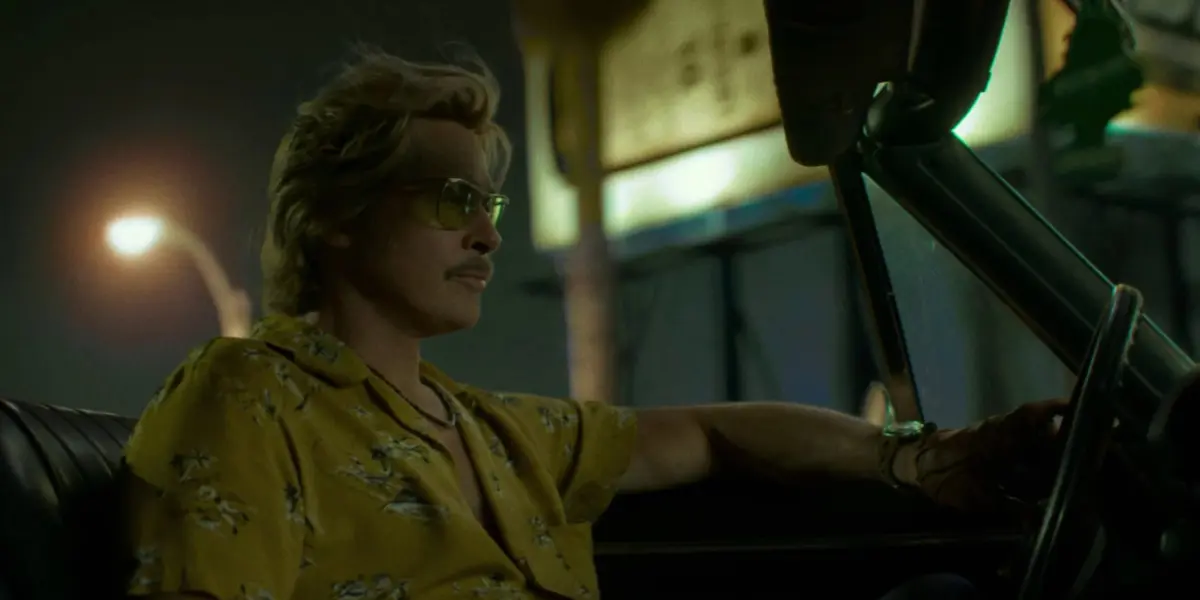
Eight years after the seismic cultural shifts of 1969 depicted in Quentin Tarantino’s ninth feature film, the fictionalized landscape of Los Angeles undergoes a gritty evolution in the newly minted production, The Further Mis-Adventures of Cliff Booth. Bypassing his self-imposed career restriction regarding a ten-film limit, Tarantino returns not as a director, but exclusively as a screenwriter, handing over directorial reigns to frequent collaborator and cinematic stylist David Fincher. Running at a substantial 143 minutes, the film positions Brad Pitt’s iconic character, former stuntman and shadow operative Cliff Booth, at the center of a sprawling paperback-noir narrative set against the backdrop of a changing entertainment industry.
The production boasts an expansive ensemble cast featuring Elizabeth Debicki, Scott Caan, Yahya Abdul-Mateen II, Carla Gugino, Peter Weller, Matt Groove, JB Tadena, Corey Fogelmanis, and Karren Karagulian. Distributed with significant anticipation, the project merges the distinct literary sensibilities of Tarantino’s Elmore Leonard-inspired dialogue with the precise, hyper-controlled visual architecture characteristic of Fincher’s extensive filmography.
Narrative Framework and Chronology
The chronological timeline of the narrative places Cliff Booth in the year 1977. Long removed from his days doubling for fading television star Rick Dalton and neutralizing members of the Manson family, Booth operates in the shadows as a studio fixer. His daily routine reflects a transient, blue-collar existence mixed with high-stakes underworld mediation. He splits his time between operating the projection booth at the historic New Beverly Cinema—a tangible nod to Tarantino’s real-life preservation efforts—and moonlighting as a bartender mixing tropical cocktails.
The narrative structure follows a days-of-the-week progression, tracking Booth as he navigates disparate socio-economic strata across Southern California. From race car derbies to exclusive, pompous country clubs, Booth is summoned by industry executives seeking the specific brand of discretion and violence he provides. Throughout this journey, he interacts with a diverse roster of characters:
- Gus Booth: Cliff’s gruff, pawn-shop-owning father, portrayed by Peter Weller.
- Karen Crosby: A sultry and commanding Hollywood agent, played by Elizabeth Debicki, whose dynamic with Booth forms the emotional core of the film.
- Charlie Peters: A short-fused, egotistical television star desperate for counsel, brought to life by Scott Caan.
- Roderick “Hot Rod” Harrison: A blaxploitation star portrayed by Yahya Abdul-Mateen II, whose films provide a recurring cinematic backdrop for Booth’s solitary hours.
Behind the Scenes: The Tarantino-Fincher Collaboration
The genesis of the project surprised industry observers given Tarantino’s frequent public assertions that his tenth directorial outing would conclude his feature filmmaking career. By drafting a screenplay and stepping aside, Tarantino allowed Fincher to interpret a text that leans heavily into literary crime fiction, bearing structural similarities to Tarantino’s 1997 adaptation, Jackie Brown.
Production logistics brought together two distinct visual languages. Principal cinematography was helmed by Erik Messerschmidt, whose digital-first approach establishes the sullied, late-1970s California aesthetic. Due to scheduling conflicts and subsequent reshoots, cinematographer Jeff Cronenweth stepped in temporarily, creating slight visual divergences noted by critics. Furthermore, the production incorporates generative artificial intelligence applications in select sequences—a choice aligned with Fincher’s historical adoption of cutting-edge production technology, though one that has prompted debate among critics regarding aesthetic integration.
Industry Implications and Cultural Context
The release of The Further Mis-Adventures of Cliff Booth serves as a deliberate companion piece to 2019’s Once Upon a Time in Hollywood, a film that grossed over $377 million worldwide and earned ten Academy Award nominations, securing wins for Pitt as Best Supporting Actor and Barbara Ling and Nancy Haigh for Production Design.
Analysts view this collaboration as a significant moment for major studio streaming and theatrical strategies, uniting three major creative forces—Pitt, Tarantino, and Fincher—who have individually shaped contemporary American cinema over the past three decades. The narrative explicitly interrogates the longevity of the 1960s counter-cultural shift, questioning whether the violent resolution of the previous film fundamentally altered the trajectory of the entertainment industry or merely delayed inevitable systemic decay.
Critical Reception and Audience Response
Early assessments from trade publications and festival screenings highlight the strength of Pitt’s central performance, noting a renewed physical and charismatic presence not fully utilized since his appearance in Damien Chazelle’s Babylon. Debicki’s performance as Karen Crosby has similarly drawn praise, with industry commentators noting thematic connections to elements of Tarantino’s famously abandoned script, The Movie Critic.
While pacing critiques have emerged regarding the film’s meandering, episodic structure, the synthesis of Tarantino’s ear for vernacular dialogue and Fincher’s meticulous pacing establishes The Further Mis-Adventures of Cliff Booth as a notable entry in modern neo-noir cinema. The film’s theatrical and streaming rollout is managed by Netflix, marking another major collaboration between the platform and Fincher following works such as Mank, The Killer, and the television series Mindhunter.