The 93-minute contemporary European art-house drama My Wife Cries, written and directed by acclaimed auteur Angela Schanelec, centers on a sudden domestic disruption that ripples through the predictable routine of a forty-year-old crane operator. Premiering on the international festival circuit, the film features performances by Vladimir Vulević as Thomas, Agathe Bonitzer as his wife Carla, and Birte Schnöink. Produced within the tradition of minimalist European cinema, the feature-length project explores grief, communication breakdowns, and the absurdities of modern existential angst through meticulously framed long takes and tangential dialogue. While industry critics have praised Schanelec’s rigorous visual compositions and distinct directorial voice, general audiences and reviewers remain divided over its pacing, narrative opacity, and heavy reliance on discursive, philosophy-laden exchanges that bypass direct emotional engagement.
Synopsis and Plot Development
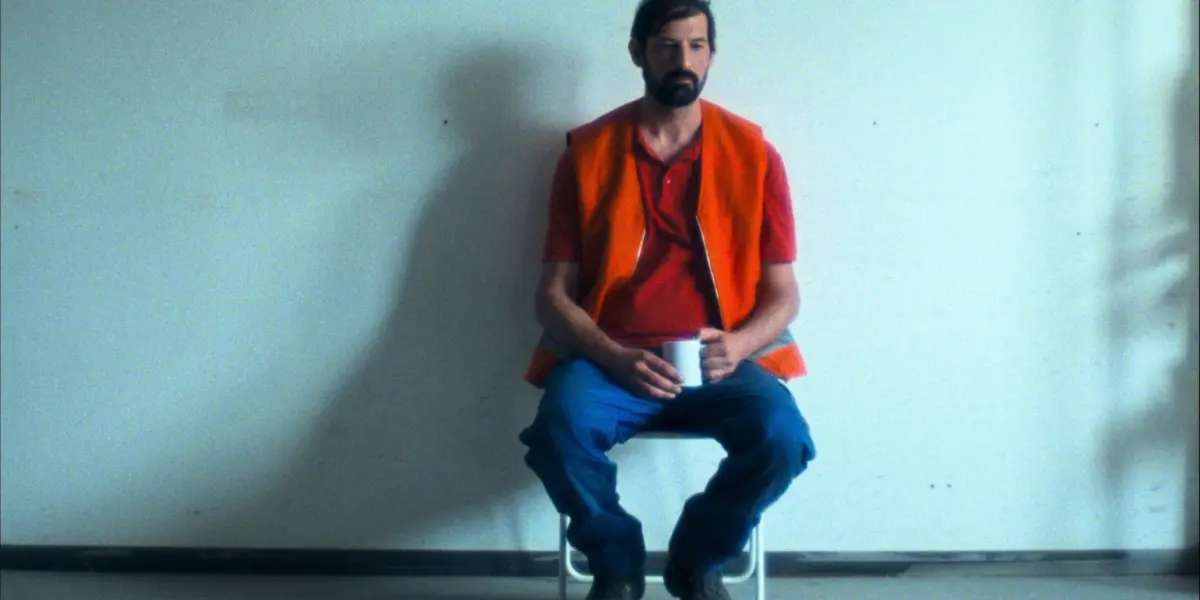
The narrative framework of My Wife Cries establishes its premise during an ordinary workday on a bustling construction site. Thomas, portrayed with a drolly withdrawn demeanor by Vladimir Vulević, operates a crane high above the ground, executing his daily labor with detached precision. The equilibrium of his routine is abruptly broken by an incoming phone call directing him to leave his post and report to the site office. Upon arrival, Thomas learns that his wife, Carla—played by Agathe Bonitzer with a captivatingly unstable intensity—has been hospitalized and requires immediate transportation home.
In the interim moments before locating her, Thomas engages in seemingly inconsequential small talk with office assistants. He discusses mundane topics, including Carla’s profession as a kindergarten teacher and hypothetical scenarios regarding the psychological weight of child loss, while casually displaying photographs of his family on his mobile device. His attempts to reach Carla directly via phone go unanswered, amplifying a quiet, mounting tension that contrasts sharply with the steady, unassuming hum of the construction yard outside the window.
A sudden, jarring cut shifts the narrative perspective to Carla, who is discovered sitting alone on an outdoor bench. Once Thomas locates her, the emotional dam breaks; overwhelmed by unspoken turmoil, Carla begins to weep uncontrollably. As the narrative unfolds, the underlying cause of her distress is revealed: an unshared emotional affair with a man from her local dance class, with whom she had recently been involved in a severe automobile accident. While Thomas survived the physical and emotional shock of discovery, the other driver succumbed to his injuries, compounding Carla’s profound sense of grief and isolation.
Chronology and Production Context
Director Angela Schanelec, known for her contributions to the Berlin School of filmmaking—a movement characterized by austere realism, long takes, and elliptical storytelling—approaches the production with a distinct temporal rhythm. The 93-minute runtime is structured not around traditional dramatic peaks and resolutions, but rather around lingering observational moments that stretch the boundaries of conventional cinematic pacing.
Production timelines for European art-house features of this scale typically span several months of principal photography, followed by protracted post-production periods focused on sound design and color grading. In My Wife Cries, the chronology of the narrative is deliberately fractured. Rather than focusing immediately on the aftermath of the fatal collision or the mechanics of the marital infidelity, Schanelec prioritizes spatial awareness and peripheral details. The inclusion of seemingly disjointed sequences—such as lengthy conversations about generational friendships, the semantic definition of failure, or the fluctuating market prices of household furniture—serves to disorient the viewer, reflecting the characters’ internal disconnection from their own immediate crises.
Directional Style and Cinematography
From a technical standpoint, Schanelec’s direction represents the most universally acknowledged strength of the production. The film’s cinematography utilizes a blend of static framing and deep focus composition, creating an aesthetic akin to a series of living paintings. Several shots are held for such extended durations that they border on freeze-frames, forcing the audience to scrutinize the background details and subtle micro-expressions of the actors.
This rigorous compositional strategy is paired with deliberate editing choices. Notably, Schanelec frequently opts against cutting away from characters during group dialogues, as demonstrated in the opening office sequence where the camera remains fixed on Thomas, who sits passively scrolling through his phone while female colleagues converse entirely around him. This technique subverts standard shot-reverse-shot conventions, emphasizing alienation and social detachment.
Further enhancing the film’s unique tone are moments of deadpan surrealism, highlighted by unexpected narrative interventions such as the sudden appearance of a marching brass band, and a climactic, unchoreographed dance sequence set to Leonard Cohen’s song Lover, Lover, Lover. In this scene, Thomas, Carla, and their acquaintances abruptly abandon their solemn demeanor to engage in awkward, unself-conscious movement, encapsulating the film’s thematic exploration of human vulnerability and emotional release.
Critical Reception and Industry Implications
Upon its exhibition, My Wife Cries has generated substantial discourse among film critics, programmers, and cultural analysts, highlighting a persistent ideological divide within contemporary cinema. Supporters of the Berlin School aesthetic champion Schanelec’s refusal to pander to conventional narrative satisfaction, viewing the film’s discursive dialogue and slow pacing as a sophisticated intellectual exercise. Proponents argue that the characters’ tendencies to converse about abstract philosophical concepts rather than their immediate trauma mirrors real-world human defense mechanisms, where verbal articulation often fails to bridge profound interpersonal chasms.
Conversely, detractors point to the script’s dialogue as a significant barrier to viewer engagement. Critics note that the verbal exchanges—touching upon the philosophy of language, interpersonal dynamics, and existential failure—frequently sound artificial, resembling academic discourse rather than natural human speech. This stylistic choice has led some reviewers to characterize the viewing experience as arduous, noting that the absence of traditional narrative progression leaves the 93-minute runtime feeling exceptionally prolonged.
Furthermore, film industry analysts have positioned My Wife Cries as a representative text of modern European state-funded arthouse cinema. While such projects secure critical prestige and reinforce festival circuits across Europe, they consistently face challenges regarding broader commercial viability and mainstream audience retention. The reliance on atmospheric tension, minimal exposition, and ambiguous emotional resolutions ensures that the film will remain a niche title, appreciated primarily by scholars and dedicated cinephiles rather than general theatrical audiences. Ultimately, Schanelec’s latest work endures as a polarizing case study in the tension between rigorous visual formalism and narrative accessibility.