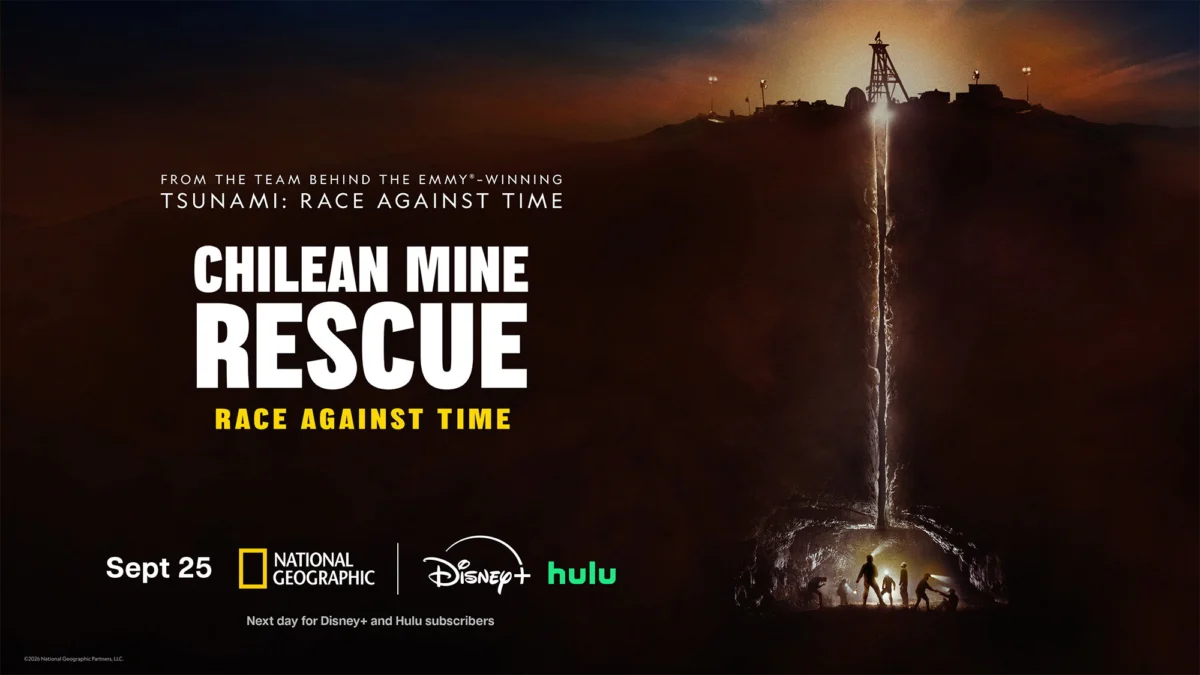
National Geographic has officially released the trailer for its upcoming documentary series, Chilean Mine Rescue: Out of Time (also referred to in promotional materials as Chilean Mine Rescue: Race Against Time). Set to premiere on Disney+ and Hulu on September 25, 2026, the series serves as the latest installment in the network’s Emmy Award-winning "Race Against Time" franchise. Sixteen years after a global audience fixated on the San José Mine in northern Chile, the new multi-part project seeks to provide the definitive historical account of the disaster, the 69 days of subterranean survival, and the monumental engineering feat that ultimately brought all 33 trapped miners back to the surface.
The series is co-directed by documentary filmmakers Chloe Campbell, known for Murder in the Pacific, and James Parris, whose credits include Tsunami: Race Against Time. Production was handled by Blast Films for National Geographic, with Tanya Winston, Shona Thompson, Danny Horan, and Carolyn Payne serving as executive producers. Featuring never-before-seen cell phone footage captured deep within the mine, alongside extensive interviews with survivors, their families, rescue workers, and key international journalists, the project promises an unprecedented, deeply intimate look at one of the most remarkable rescue operations in modern history.
The Main Facts of the 2010 San José Mine Collapse
The incident that forms the subject of the documentary occurred on August 5, 2010, when a catastrophic collapse took place at the San José copper and gold mine, located near the city of Copiapó in the Atacama Desert of northern Chile. A massive section of the mountain, weighing approximately 700,000 tons—roughly equivalent in weight to the Empire State Building—sheared off from the ceiling of the mine, crashing down more than 2,000 feet into the subterranean tunnels.
At the time of the cave-in, 33 miners were working far below the surface. The collapse destroyed the primary spiral ramp used for both vehicle access and evacuation, sealing the men inside a network of tunnels beneath a half-mile of solid rock. Initial rescue efforts were immediately stymied by subsequent rockfalls and the sheer instability of the remaining shaft structure. For the first 17 days, the fate of the miners remained entirely unknown to the outside world, sparking intense anxiety, international media scrutiny, and widespread grief in Chile and abroad.

A Chronology of Subterranean Survival and Global Rescue Efforts
The timeline of the Copiapó mining accident is divided into distinct, highly dramatic phases that captured the world’s attention across more than two months:
August 5, 2010: The catastrophic structural failure occurs at the San José Mine, trapping 33 men deep underground. Emergency response teams attempt to drill exploratory shafts, but early attempts are thwarted by unstable geological conditions and additional rock movements.
August 22, 2010: Seventeen days after the initial collapse, a narrow exploratory drill, known as a Plan B probe, breaks through into a workshop area where the miners had gathered. Moments later, rescuers pull the drill back up to find a small piece of paper taped to the metal pipe. Written in red marker, the now-iconic message reads: "Estamos bien en el refugio los 33" (We are fine in the shelter, the 33 of us). The note proves that all 33 men are alive.
Late August to September 2010: Rescuers establish a lifeline known as "palomas" (doves)—small, narrow PVC pipes dropped down the drill holes used to send high-calorie gel, water, medical supplies, letters from family members, and lighting equipment to the trapped men. Psychologists, naval doctors, and engineers work around the clock to manage the miners’ physical health and declining mental well-being in the hot, humid, and dark environment.
October 2010: Three separate engineering projects, designated Plans A, B, and C, race to drill large-diameter rescue shafts down to the refuge. Plan B, utilizing a Schramm T130 heavy-duty drill, ultimately breaks through to the underground chamber on October 9, initiating the final phase of the operation.

October 12–13, 2010: Over a continuous 22-hour period, a custom-built steel rescue capsule named Fénix 2 (Phoenix 2) is lowered repeatedly into the shaft. One by one, all 33 miners are hoisted to the surface to the jubilation of waiting family members, Chilean President Sebastián Piñera, and an estimated one billion television viewers worldwide.
Supporting Data and Scale of the Operation
The logistical and technical challenges of the San José Mine rescue were unprecedented in mining history. The rescue operation required a coordinated international effort involving the Chilean state-owned copper mining corporation Codelco, private domestic and international mining firms, the Chilean Navy, and specialized engineering contractors from the United States and other nations.
Key data points illustrating the scale of the rescue include:
- Depth: The miners were trapped approximately 688 meters (2,257 feet) below the surface.
- Duration: The men spent a total of 69 days underground, setting a world record for the longest survival period of trapped miners following a structural collapse.
- Drilling Logistics: The successful rescue shaft required drilling a pilot hole of roughly 12 inches in diameter, which was subsequently reamed out to a diameter of 28 inches to accommodate the rescue capsule.
- Global Media Reach: The extraction broadcast on October 13, 2010, was watched by a cumulative global television audience estimated at more than one billion people, ranking it among the most-watched news events of the early 21st century.
Official Responses and Perspectives Featured in the Series
National Geographic’s Chilean Mine Rescue: Out of Time aims to move beyond the triumphant television broadcasts of 2010 to explore the complex psychological, physical, and structural realities faced by the participants. The documentary series incorporates rare, personal cell phone footage recorded by the miners themselves while they were cut off from the world, providing a raw window into how the men organized themselves, rationed meager food supplies, and maintained hope during the initial weeks of uncertainty.

Furthermore, the production features extensive interviews with survivors, their families, and rescue personnel. Notably, several individuals are speaking publicly outside of the local Chilean press for the first time in the series. Among the prominent figures interviewed is Jeff Kofman, who served as ABC News’ International Correspondent in 2010. As the first international journalist to arrive at the scene, Kofman provides an eyewitness perspective on how the media environment evolved alongside the technical rescue efforts over the 69-day ordeal.
Broader Impact and Historical Implications
The 2010 Copiapó mining accident had profound implications for industrial safety regulations, labor standards, and government oversight, particularly within the mining sector in Latin America. In the immediate aftermath of the disaster, the Chilean government faced intense criticism regarding lax enforcement of safety protocols at private mining operations. The San José Mine, owned by the San Esteban Mining Company, had a history of safety violations and prior accidents before the catastrophic failure in August 2010.
In response to the global outcry, the Chilean government enacted sweeping reforms to overhaul the National Geology and Mining Service (Sernageomin), significantly increasing the number of safety inspectors, levying harsher penalties for regulatory non-compliance, and temporarily shutting down dozens of mines deemed unsafe. The incident also triggered a re-evaluation of emergency preparedness standards in deep underground mining operations globally, accelerating the adoption of advanced subterranean communication systems, reinforced emergency shelters, and pre-positioned supply caches.
Beyond its industrial and regulatory consequences, the event left a complex legacy for the 33 survivors. While hailed as national heroes, many of the miners struggled significantly in the years that followed with severe post-traumatic stress disorder (PTSD), physical ailments related to their time underground, economic difficulties, and the overwhelming pressures of sudden international celebrity. Dramatizations such as the 2015 feature film The 33, directed by Patricia Riggen and starring Antonio Banderas, brought the narrative to Hollywood audiences, but the upcoming National Geographic series aims to ground the story firmly in historical documentary rigor.
By combining newly unearthed personal archives with comprehensive retrospective analysis, Chilean Mine Rescue: Out of Time offers a detailed examination of human endurance, technological innovation, and institutional accountability. The complete documentary series will be available for streaming globally on Disney+ and Hulu beginning September 25, 2026.