The expansive multimedia franchise born from Nickelodeon’s critically acclaimed animated series continues to grow at an unprecedented pace, marking a major milestone for Avatar Studios. Following the July release of Avatar Aang: The Last Airbender—the inaugural project from the dedicated studio established by original creators Michael Dante DiMartino and Bryan Konietzko—Paramount Plus is preparing to launch the franchise’s next major television event. Titled Avatar: Seven Havens, the upcoming animated series shifts the timeline forward by approximately 225 years past the era of Avatar Korra, thrusting viewers into a fractured, post-cataclysmic world where the once-revered title of the Avatar carries a terrifying stigma.
Set to premiere globally on Paramount Plus this October, the 13-episode first season, designated as Book 1, introduces a distinct narrative tone that leans heavily into investigative mystery and survival drama. According to series creators and production executives, this latest chapter deliberately subverts decades of franchise convention. Rather than introducing a world ready to be saved by a unifying diplomatic figure, Seven Havens presents an environment where the Avatar is hunted, feared, and viewed by a desperate populace as an agent of ultimate destruction.
A Fractured World and a Burdened New Protagonist
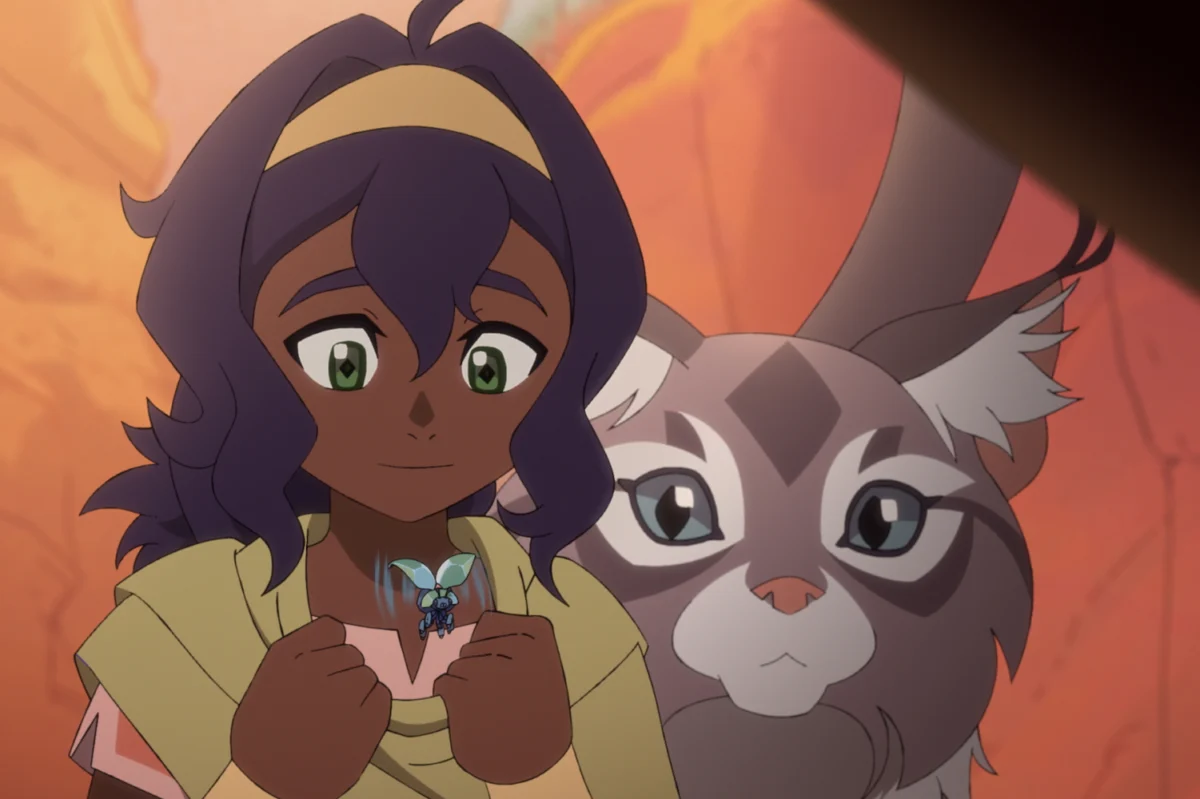
At the narrative center of Seven Havens is Pavi, a young Earthbender voiced by newcomer Saheli Khan. Pavi’s ordinary life is upended when she discovers she is the successor to the Avatar lineage, inheriting a cycle that has remained dormant or unaccounted for since the tumultuous tenure of Korra. However, this revelation arrives not as a gift, but as a death sentence. In the wake of an unspecified historical cataclysm that devastated global civilization, humanity has retreated into fortified bastions known as the Seven Havens. Within these fragile strongholds, the collective memory of the Avatar has been warped into folklore depicting the elemental master as the architect of the world’s downfall.
The atmospheric tension of the series is compounded by a striking teaser and trailer campaign that hints at dark historical revisionism. Most alarming to long-time followers of the franchise is a fleeting glimpse of Korra herself, bearing a distinct white streak in her hair and appearing to unleash devastating elemental chaos. While executive producers and creators have kept precise plot details under tight security, this imagery suggests that the geopolitical and spiritual stability achieved at the conclusion of The Legend of Korra unraveled catastrophically in the intervening two centuries.
Pavi’s harrowing journey is not undertaken in isolation. The recently released promotional material reveals that she crosses paths with her long-lost twin sister, Nisha, voiced by Aishu Devan. Together, the siblings navigate a landscape populated by hostile human factions and predatory spirits. Adding a touch of classic franchise levity amidst the grim backdrop are their respective animal companions, Geet and Ruhi. Both creatures are brought to life by legendary voice actor Dee Bradley Baker, a franchise veteran renowned for his extensive vocal work across both Avatar: The Last Airbender and The Legend of Korra.
Chronology and Strategic Release Schedule
The chronology of the Avatar universe has always been defined by generational shifts, moving from the hundred-year war of Aang’s era to the industrializing, politically complex 1920s-analog world of Korra’s generation. Seven Havens represents the most significant temporal leap in the franchise’s history, placing the narrative roughly two centuries past Korra’s lifetime. This vast gap allows the creative team to wipe the slate clean of existing political structures while leaving tantalizing archaeological and historical mysteries for the protagonists—and the audience—to unravel.
Paramount has structured an unconventional release cadence for the 13-episode first run of Avatar: Seven Havens Book 1. Rather than dropping the full season simultaneously or adhering to a traditional one-episode-per-week format, the platform has opted for a multi-part rollout designed to sustain viewer engagement throughout the month:
- October 9: Series premiere featuring the first three episodes.
- October 16: Three additional episodes released.
- October 23: Three additional episodes released.
- October 30: Season finale block consisting of the final four episodes.
Following the conclusion of Book 1, Book 2 has already been slated for future development, ensuring a continuous stream of content as Avatar Studios builds out its long-term narrative roadmap.
Creative Vision and the Shift Toward Mystery
Co-creators Michael Dante DiMartino and Bryan Konietzko have emphasized that Seven Havens was conceived with a deliberate structural pivot in mind. Speaking in recent interviews, DiMartino explained that the foundational concept originated from a desire to examine the immediate aftermath of a global catastrophe and to challenge the audience’s assumptions about the universe’s mechanics.
"This idea started with the setting and the desire to drop the viewer into a world that had experienced a cataclysmic event," DiMartino noted. He further elaborated on the intentional tonal shift: "Early on, we also decided we wanted this to be more of a mystery show than the last two series, so that a viewer would enter the story with a lot of questions: How did the world get so bad? Why does everyone hate the Avatar? How did Pavi lose her leg? We want the audience to always hunger to know more."
This emphasis on environmental storytelling and psychological intrigue marks a maturation of the franchise’s target demographic. By introducing physical trauma—such as Pavi’s prosthetic or injured leg—alongside deep-seated societal hostility, the creators are leaning into mature narrative stakes that mirror contemporary anxieties regarding systemic collapse and historical misinformation.
Supporting Factions and Potential Alliances
As Pavi and Nisha strive to uncover the truth behind their origins and prevent the collapse of the remaining human strongholds, they will not be entirely without institutional support. Executive producer Sehaj Sethi and promotional materials point toward potential aid from the Order of the White Lotus. In previous iterations of the franchise, this ancient, transnational secret society operated as a neutral network dedicated to philosophy, arts, and protecting the Avatar. However, given the anti-Avatar sentiment prevalent in the Seven Havens, the role of the White Lotus in this era remains ambiguous and potentially compromised, adding another layer of suspense to the sisters’ quest.
Conversely, the twins will face relentless pursuit from antagonists spanning both the physical and spiritual realms. Human factions within the fortified cities view the Avatar’s resurgence as an existential threat to their fragile security, while corrupted spirits roaming the shattered wilderness present a constant, unpredictable danger.
Implications for the Expanding Franchise
The launch of Avatar: Seven Havens carries significant weight for Paramount Global and Avatar Studios, which was formed in 2021 to oversee the creation of original content spanning animated films, television series, and theatrical releases. Following the mixed commercial and critical reception of various legacy media experiments over the past decade, the rapid deployment of Avatar Aang: The Last Airbender in July followed immediately by Seven Havens in October demonstrates a robust, aggressive production pipeline.
Financially and strategically, the success of Seven Havens will test the resilience of the Avatar intellectual property when completely severed from the nostalgic crutches of its original casts. By pushing the timeline centuries forward and prioritizing a dark, serialized mystery over episodic adventure, the creators are testing whether the fanbase will embrace systemic reinvention. If Book 1 successfully engages both long-time adherents and new demographic cohorts, it could cement Avatar Studios as a premier anchor for Paramount Plus, proving that the elemental magic of bending holds enduring viability in increasingly complex, serialized storytelling formats.