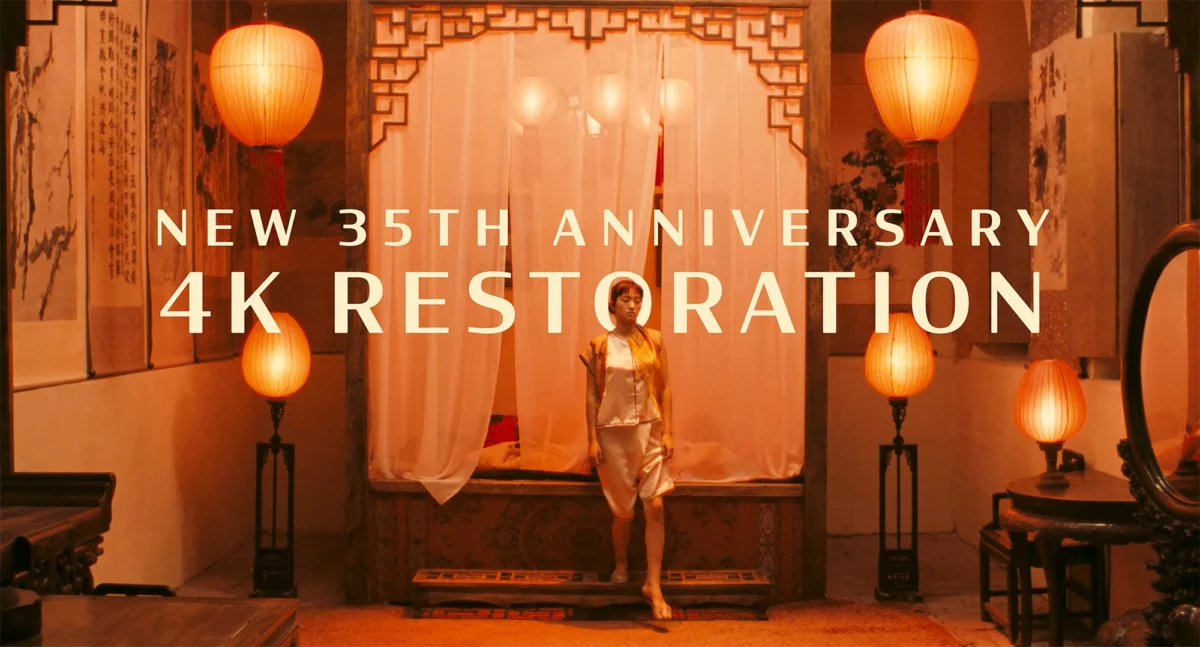
Distributor Film Movement has officially unveiled a new trailer, official poster, and theatrical release schedule for the pristine 4K restoration of Zhang Yimou’s 1991 cinematic masterpiece, Raise the Red Lantern. Widely regarded as a landmark achievement in international cinema, the film is scheduled to return to select United States theaters beginning November 6, 2026. This cinematic re-release gives contemporary audiences an opportunity to experience one of the defining works of the Fifth Generation of Chinese filmmakers in a definitive presentation meticulously sourced from the original film and sound negatives.
The upcoming theatrical run follows a rigorous preservation effort completed in 2024 by L’Immagine Ritrovata on the occasion of the 26th edition of the Udine Far East Film Festival. Supervised directly by director Zhang Yimou, the restoration process utilized the original camera and sound negatives to maximize visual and acoustic fidelity. To ensure historical authenticity, restoration technicians relied on a vintage positive copy—specifically the print screened at the 1991 Venice Film Festival, which has been preserved within the Historical Archive of Contemporary Arts at the Venice Biennale—as the definitive color reference.
Main Facts and Narrative Premise
Set in 1920s warlord-era China, Raise the Red Lantern adapts Su Tong’s acclaimed 1990 novel, Wives and Concubines. The narrative centers on Songlian, a 19-year-old university student whose life is upended by the sudden death of her father and the subsequent financial ruin of her family. Forced to abandon her formal education, Songlian is married off to become the fourth concubine of the wealthy, aging, and largely unseen patriarch, Master Chen.

Upon entering the sprawling, labyrinthine fortress of the Chen estate, Songlian is immediately thrust into a rigid, cutthroat hierarchy governed by a psychological and physical ritual. Each evening, red lanterns are illuminated outside the living quarters of the wife whom Master Chen chooses to visit. This glowing symbol confers immense status, favor, and special privileges upon the chosen woman, while casting the neglected wives and concubines into deep isolation, vulnerability, and cold irrelevance.
What begins as a reluctant entry into a toxic domestic environment quickly devolves into a fierce, survivalist competition. The women scheme, trade favors, and weaponize secrets to secure the master’s fleeting attention. Initially determined to remain above the psychological games of the courtyard, Songlian is gradually worn down by systemic humiliation and profound loneliness. As she plays the game to protect herself, petty cruelties escalate into dire consequences, ultimately forcing Songlian to reckon with the heavy toll that her desperate measures have exacted on her humanity.
The film features a powerhouse ensemble cast led by international icon Gong Li in a transcendent central performance as Songlian. She is supported by a distinguished cast that includes Ma Jingwu, He Saifei, Cao Cuifen, and Jin Shuyuan. The screenplay was penned by Ni Zhen, and the production was guided by notable producers including Hou Hsiao-hsien, Chiu Fu-sheng, and Zhang Wenze.
Chronological Context and Festival History
Raise the Red Lantern occupies a pivotal position in the early filmography of director Zhang Yimou. Released as his fourth feature film, it immediately followed his striking directorial debut Red Sorghum (1987), the historical drama Codename Cougar (1989), and the acclaimed rural tragedy Ju Dou (1990). It immediately preceded his contemporary neorealist masterpiece, The Story of Qiu Ju (1992).

The film’s international rollout began in the autumn of 1991 with prestigious back-to-back festival premieres. It competed at the 48th Venice International Film Festival, where it captured widespread critical acclaim and the Silver Lion award for Zhang Yimou, alongside a technical grand prize. Shortly thereafter, it screened at the Toronto International Film Festival, cementing its status as a global phenomenon before securing a commercial theatrical release in the United States in February 1992.
The cultural footprint of the film expanded significantly when it achieved widespread international recognition, including an Academy Award nomination for Best Foreign Language Film at the 64th Academy Awards. It marked only the second time a mainland Chinese film had received an Oscar nomination in the category, following the submission of Ju Dou the previous year.
Restoration and Preservation Data
The painstaking work required to bring Raise the Red Lantern back to the silver screen in pristine 4K resolution highlights the ongoing importance of international film archiving partnerships. The Udine Far East Film Festival commissioned the project for its 26th iteration, partnering with Bologna’s renowned restoration laboratory, L’Immagine Ritrovata.
Because celluloid prints degrade over decades due to chemical breakdown and physical wear, the preservation team undertook an exhaustive forensic analysis of surviving archival materials. By employing the original camera and optical sound negatives, engineers were able to eliminate dust, scratches, and flicker while retaining the natural grain structure of the 35mm film stock. The side-by-side color grading process—cross-referencing the 1991 Venice Festival print archived by the Venice Biennale—ensured that the film’s striking color palette remained true to the director’s original vision.

Cinematographer Zhao Fei’s brilliant framing relies heavily on architectural symmetry, deep shadows, and explosive splashes of crimson against monochromatic grey courtyards. The 4K digital intermediate enhances these contrasts, allowing viewers to appreciate the intricate textures of silk garments, weathered brickwork, and the iconic glowing paper lanterns that serve as the film’s central visual motif.
Critical Analysis and Industry Implications
Film historians often categorize Raise the Red Lantern as a masterclass in cinematic spatial politics. The walled compound serves as a microcosm of patriarchal authority and broader sociopolitical control in early 20th-century China. Through precise compositions, high-angle master shots that trap the characters within geometric courtyards, and rhythmic editing, Zhang Yimou constructs an oppressive atmosphere where architecture itself becomes an antagonistic force.
The decision by Film Movement to distribute the 4K restoration to select US theaters starting November 6, 2026, reflects a growing commercial and cultural appetite for definitive restorations of classic world cinema. In an era dominated by streaming algorithms and rapid digital consumption, theatrical runs for revived masterworks offer audiences a communal, immersive environment to engage with cinematic history.
Furthermore, the re-release serves an educational purpose for younger generations of cinephiles discovering the foundational works of Asian auteur cinema. As global distribution companies continue to invest in high-end 4K restorations, films like Raise the Red Lantern are rescued from obscurity or substandard home-video transfers, ensuring that their visual splendor and thematic resonance endure for decades to come.

Tickets, theater listings, and additional promotional materials for the upcoming theatrical run can be accessed through Film Movement’s official platform. Fans of classic international cinema and newcomers alike will soon have the opportunity to witness the red lanterns glow once more on the big screen.