The intersection of psychological suspense and biographical fiction has long provided fertile ground for cinematic exploration, and the newly released feature film A Talent for Murder brings this dynamic to the forefront. Directed by acclaimed Dutch filmmaker Anton Corbijn and adapted by playwright Joanna Murray-Smith from her acclaimed stage production Switzerland, the 106-minute psychological thriller transports audiences to the isolated Swiss Alps of 1995. The narrative chronicles the final, twilight year of celebrated American author Patricia Highsmith, examining the fragile boundary between literary creation and dark reality. Featuring an all-star cast led by Academy Award winner Dame Helen Mirren alongside Alden Ehrenreich, Olivia Cooke, and Juliet Stevenson, the film delivers a masterclass in tension, intellectual sparring, and deceptive psychological gamesmanship. Distributed by Bleecker Street, the project has drawn substantial critical attention for its meticulous atmospheric design and the razor-sharp interplay between its two central performances.
Main Facts and Narrative Premise
At its core, A Talent for Murder examines the complex psychological chess match between a reclusive, misanthropic literary icon and an ambitious young emissary dispatched from the corporate publishing world. Set against the stark, snow-draped backdrop of Highsmith’s secluded Swiss chalet, the plot initiates when a New York publishing house, starved for new material from their most lucrative asset, sends junior employee Edward Ridgeway, played by Alden Ehrenreich. Ridgeway’s mandate is straightforward yet formidable: secure Highsmith’s signature on a contract for one final installment in her iconic, genre-defining Tom Ripley series, featuring the charming, amoral con artist who cemented her legacy as a titan of suspense.
Highsmith, portrayed with ferocious wit by Mirren, flatly refuses the overture. However, rather than dismissing the young envoy outright, she proposes a darkly eccentric bargain. She agrees to consider penning the novel on the condition that Ridgeway assists her in conceptualizing and plotting the narrative’s central homicide. The creative exercise quickly takes on a life of its own, drawing inspiration from a chance encounter Ridgeway experienced on his train journey to the Alps. That encounter involved a fellow American traveler, played by Olivia Cooke, who was en route to secure an early inheritance from a wealthy relative.
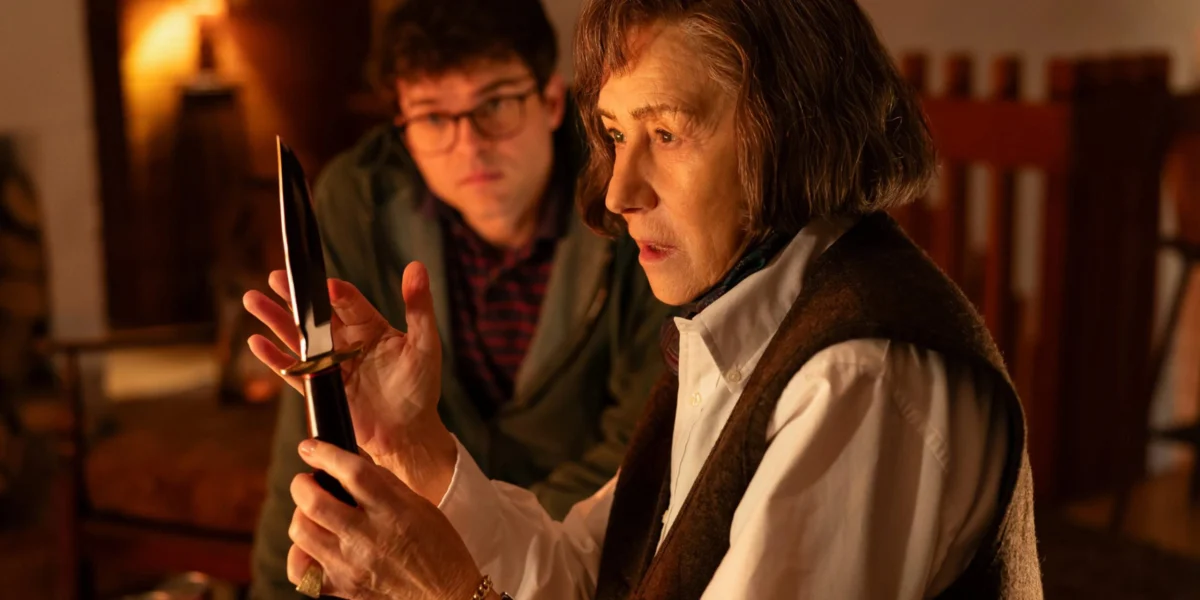
As Highsmith and Ridgeway weave these real-world observations into their fictional outline—which plays out visually for the audience as they conceive it—the boundary separating fiction from fact begins to dissolve. Highsmith alternates between intellectual collaboration and psychological torture, deploying her collection of vintage daggers, casual references to household poisons, and abrupt jump scares to keep the young man perpetually off-balance. Concurrently, Ridgeway undergoes a behavioral transformation, shedding his initial timidity for a darker, more assertive persona. This escalating psychological warfare forces both characters—and the viewing audience—to continuously question Ridgeway’s true identity, his underlying motives, and the extent of the danger he poses to the ailing author.
Chronology and Historical Context
To fully appreciate the narrative framework of A Talent for Murder, industry analysts and literary historians look closely at the final years of Patricia Highsmith’s actual life. Born in Fort Worth, Texas, in 1921, Highsmith spent the majority of her adult years living as an expatriate in Europe, seeking refuge from the conservative social mores of mid-century America and finding creative affinity abroad. After relocating to England in 1963 and subsequently to France in 1967, she ultimately established her permanent residence in the remote Swiss canton of Ticino in 1982. It was within the quiet, isolated confines of this Swiss sanctuary that she spent her final years, continuing to write until her death from aplastic anemia and lung cancer on February 4, 1995, at the age of 73.
Playwright Joanna Murray-Smith originally seized upon this biographical anchor for her theatrical drama Switzerland, which premiered to critical acclaim before being meticulously restructured for the screen by Corbijn and Murray-Smith herself. The film’s timeline is deliberately compressed into the waning months of Highsmith’s life, utilizing her actual physical decline as an amplifier for her fierce, unyielding intellectual vitality. The chronological progression of the film mirrors the structural construction of a suspense novel, moving systematically through distinct narrative phases:
- The Arrival: Edward Ridgeway breaches the isolation of the Swiss chalet, representing the commercial pressures of the New York literary establishment against Highsmith’s fiercely guarded autonomy.
- The Collaboration: The adversarial dynamic shifts into a creative partnership, wherein Highsmith and Ridgeway construct the framework of a fictional murder using external observations and psychological projection.
- The Blur: Reality and imagination intertwine as Ridgeway’s demeanor alters, and Highsmith’s domestic environment transforms from a sanctuary into a psychological pressure cooker.
- The Climax and Revelation: The ultimate confrontation between author and emissary, culminating in a sequence of narrative twists that recontextualize the entire preceding exchange.
Supporting Data and Production Metrics
Behind the camera, director Anton Corbijn assembled a formidable technical team to bring the claustrophobic Swiss landscape and the inner workings of Highsmith’s imagination to life. Cinematographer Robbie Ryan utilizes a distinct visual dichotomy throughout the 106-minute runtime. The real-world scenes within the Swiss chalet are characterized by deep, inky black shadows and austere, naturalistic lighting that underscores the isolation and physical decay of the setting. Conversely, the sequences depicting the fictionalized novel within the film are awash in warmer, saturated hues. This deliberate aesthetic choice pays subtle homage to Anthony Minghella’s acclaimed 1999 cinematic adaptation The Talented Mr. Ripley, evoking the sun-drenched Italian vistas associated with Highsmith’s most famous literary creation, despite the geographical shift to the Swiss mountains.
The production also benefits from precise pacing and tight spatial framing. Corbijn deliberately avoids excessive camera movement or overly complex visual effects, choosing instead to rely on the tension inherent in Murray-Smith’s dialogue and the chemistry between his lead actors. The film’s official runtime of 106 minutes maintains a brisk momentum, ensuring that the chamber-drama format remains engaging without fatiguing the audience.
Cast Performances and Critical Reception
Industry response to the central performances has been overwhelmingly positive, with particular praise directed toward Dame Helen Mirren and Alden Ehrenreich. Mirren’s portrayal of Highsmith has been lauded for capturing the author’s legendary abrasiveness, biting misanthropy, and profound intellectual rigor without sliding into caricature. Film critics have noted that Mirren commands the screen from the opening sequence—a sustained, unblinking close-up of the actress glaring down a typewriter as if it were a worthy adversary—and maintains that combative, electrifying energy throughout the production.
Simultaneously, Alden Ehrenreich has received widespread acclaim for executing a demanding dual performance. As the mild-mannered, cautious Edward Ridgeway, Ehrenreich projects an unassuming vulnerability, reacting with palpable unease to Highsmith’s unpredictable theatricality. In stark contrast, when embodying the fictional avatar of Tom Ripley, Ehrenreich transforms his physical carriage, adopting the polished, muscular confidence, sharp suits, and signature sideways smirk reminiscent of classic cinematic spies like James Bond. This seamless transition between characters continuously destabilizes the audience’s perception, leaving viewers uncertain where the timid publishing employee ends and the sociopathic literary creation begins.
Supporting players Olivia Cooke and Juliet Stevenson round out the ensemble, providing necessary narrative friction and expanding the thematic scope of the story beyond the immediate confines of the chalet. Cooke’s brief yet impactful appearances inject crucial plot momentum, serving as the catalyst for the fictional murder plot that drives the psychological duel between the lead characters.
Broader Impact and Literary Implications
The release of A Talent for Murder arrives at a time of renewed public and academic interest in Patricia Highsmith’s literary legacy, catalyzed in part by recent documentary projects and the enduring popularity of screen adaptations featuring Tom Ripley. By placing the author herself inside a narrative framework that mirrors the exact psychological structures of her own novels, Murray-Smith and Corbijn offer a meta-textual commentary on the nature of authorship, creativity, and the human impulse toward violence.
From an analytical perspective, the film explores the symbiotic relationship between creators and their creations. Highsmith famously maintained a complex, often antagonistic relationship with the public and her own characters, particularly Ripley, whom she once described as a congenial criminal who managed to evade moral retribution. By dramatizing a scenario where an external force attempts to extract one final chapter from her, the film touches upon themes of artistic control, legacy, and the fear of creative exhaustion.
Furthermore, the stylistic choices of the production highlight the viability of intelligent, dialogue-driven thrillers in the contemporary cinematic landscape. Eschewing large-scale action set-pieces in favor of intense psychological confrontation, A Talent for Murder demonstrates that narrative tension can be successfully sustained through strong performances, sharp screenwriting, and atmospheric direction. As the film continues its theatrical and digital rollout via Bleecker Street, industry observers anticipate that its clever tonal balancing act—blending high-minded literary references with the guilty pleasures of a pulpy cat-and-mouse game—will secure its position as a notable entry in the psychological thriller genre for years to come.