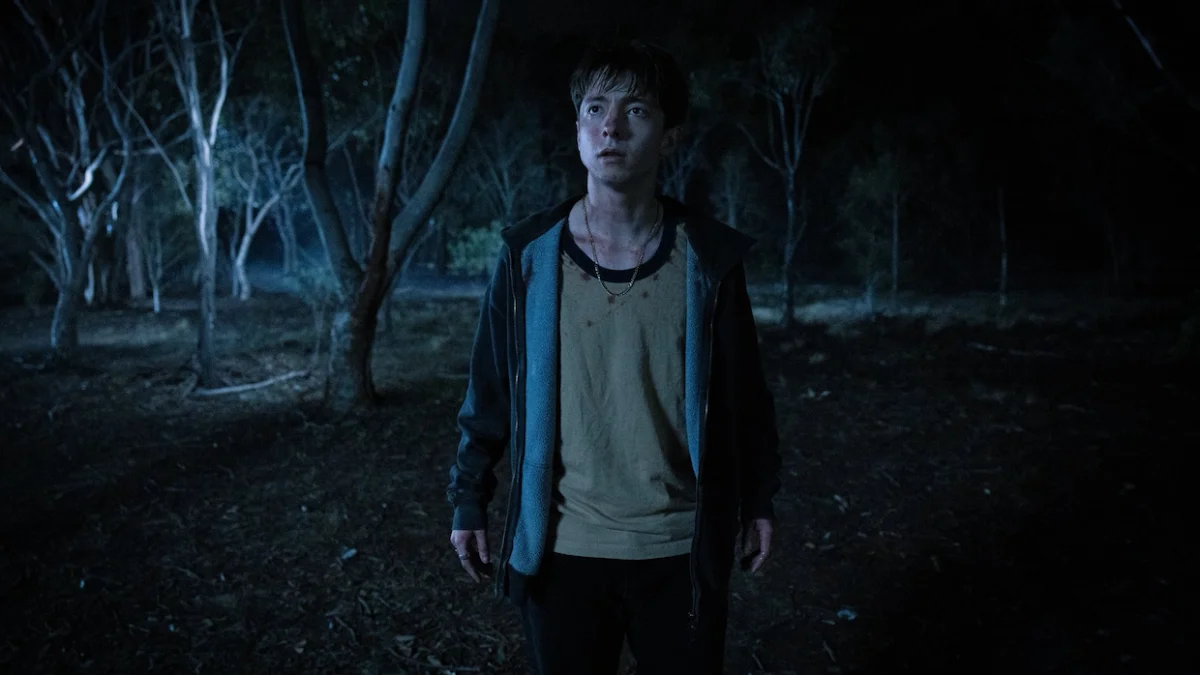
The cinematic landscape of 2026 welcomes a distinct and provocative addition with the premiere of Leviticus, the feature-length directorial debut of filmmaker Adrian Chiarella. Blending genre conventions with sharp social commentary, the film utilizes the grammar of traditional horror to examine contemporary anxieties surrounding the resurgence of institutional bigotry and anti-LGBTQ+ sentiment. Rather than relying solely on abstract allegory, Chiarella’s work grounds its supernatural terror in the rigid, oppressive confines of an industrial Australian backcountry, creating a narrative space where systemic prejudice manifests as a physical and psychological entity.
Main Facts and Narrative Premise
Leviticus opens with a chilling premise that immediately establishes the film’s thematic stakes. In a cold-open sequence, a female lifeguard is targeted and murdered by an invisible entity in a poolside shower. This supernatural predator possesses a terrifying characteristic: it assumes the physical form of whatever person its victim desires most.
The origin of this malevolent force is rooted in a localized act of cruelty—a hex cast upon queer teenagers by a fundamentalist church operating a form of conversion therapy. The narrative weaponizes a common trope of religious rhetoric, specifically the pious dictum that queer desires lead inevitably to destruction.
The story primarily follows Naim, played by Joe Bird, a shy newcomer navigating the desolate landscape of an industrial town. Naim finds himself drawn to Ryan, a brash and charismatic classmate portrayed by Stacey Clausen. Their burgeoning romance is complicated by the intrusion of Hunter, the local preacher’s closeted son, played by Jeremy Blewitt. Driven by jealousy, Naim exposes the dynamic, setting off a chain reaction of supernatural terror and forced atonement. The monster stalking the teenagers operates on isolation, appearing only when characters are alone and exploiting their deepest vulnerabilities by mimicking trusted loved ones.
Background Context and Cinematic Influences
The genesis of Leviticus stems from Chiarella’s observations of a broader cultural and political shift over the past decade. Despite significant strides toward LGBTQ+ legal protections and social acceptance in various parts of the world, recent years have witnessed a measurable resurgence in organized bigotry, legislative pushback against queer rights, and the mainstreaming of extremist rhetoric.
In developing the project, Chiarella drew inspiration from foundational horror cinema that historically resonated with marginalized audiences. The director has frequently cited genre milestones such as John Carpenter’s The Thing (1982) and Wes Craven’s A Nightmare on Elm Street Part 2: Freddy’s Revenge (1985). Both films are widely analyzed by film historians and queer theorists for their subtextual explorations of identity, paranoia, and the psychological burden of the closet.
"I started thinking about what would be personal for me," Chiarella explains regarding the creative impulsion behind the film. "Horror movies were something that I turned to as a young queer teenager. I don’t think I was alone in that. The genre has been important to the community for a very, very long time."
The director notes that being forbidden from watching these films during his youth only heightened their allure, establishing a parallel between the censorship of genre cinema and the suppression of queer identity.
Production Design and Visual Symbolism
Leviticus relies heavily on environmental storytelling, utilizing its physical locations to reinforce the psychological imprisonment of its characters. Set within a geographically isolated Australian industrial town characterized by weathered architecture and barren landscapes, the production design deliberately contrasts man-made structures with untamed pastoral elements.
Cinematically, the film plays extensively with themes of perception and visibility. The supernatural entity operates exclusively within the sightlines of those affected by the curse, while individuals unburdened or willfully ignorant of the phenomenon remain entirely blind to the threat. This visual metaphor mirrors the gaslighting and denial frequently experienced by queer youth, whose realities are often dismissed by authority figures as fleeting phases or outside influences.
The cast features prominent supporting performances, including Mia Wasikowska as Naim’s mother, whose interactions with her son blur the boundaries between maternal protection and psychological oppression. Through framing devices such as windows, mirrors, and surveillance perspectives, Chiarella constructs a claustrophobic aesthetic where characters—and the audience—can never fully trust their immediate environment.
Industry Implications and Contemporary Reception
The release of Leviticus arrives at a pivotal moment in contemporary cinema. In recent years, queer media has increasingly gravitated toward narratives focused on celebration, romance, and triumph, moving away from historical trauma and crisis-driven storytelling. By intentionally returning to a baseline of peril and disquietude, Chiarella’s debut challenges the assumption that systemic adversity is entirely a thing of the past.
Film critics and industry analysts have noted that the picture’s success lies in its refusal to offer simplistic resolutions. Rather than adopting the bleak, inescapable doom characteristic of mid-to-late 20th-century queer cinema, Leviticus opts for a complex, ambiguously hopeful conclusion.
Discussing the film’s final moments, Chiarella points to traditional horror tropes where a defeated monster crawls back into frame, signaling that the threat has not been entirely eradicated. In the context of Leviticus, this convention serves as a poignant commentary on trauma. The resolution suggests that while the immediate supernatural threat may be mitigated, the psychological scars inflicted by institutional homophobia and internalized fear do not simply vanish; they persist as enduring realities for survivors.
By fusing visceral genre tremors with intricate figurative design, Leviticus establishes itself as a notable contribution to modern horror, utilizing the language of terror to interrogate the very real vulnerabilities faced by marginalized youth in an increasingly polarized world.