The landscape of digital entertainment is currently undergoing a significant shift as platforms move away from static, linear media toward immersive, user-driven narratives. At the forefront of this evolution is OOC: The Playable Anime, an application that leverages advanced artificial intelligence to offer users an unprecedented level of agency within anime-inspired storytelling. By allowing participants to dictate plot direction, character development, and world-building in real-time, the platform seeks to solve the persistent issue of narrative predictability that has long characterized traditional interactive fiction.
The Mechanics of Agency and Narrative Depth
Unlike conventional visual novels or choose-your-own-adventure games, which rely on a finite set of branching paths pre-authored by developers, OOC utilizes generative AI to facilitate fluid, open-ended storytelling. The platform’s core value proposition lies in its capacity for "emergent narrative," where the consequences of a user’s actions ripple throughout the fictional environment.
The system operates on a proprietary architecture referred to as "Deep Memory." This feature serves as the technical backbone of the experience, ensuring that historical context, past dialogue, and established relationships are consistently maintained across long-form interactions. By mitigating the "amnesia effect"—a common technical limitation in early chatbot models where characters fail to recall previous plot points—the platform provides a cohesive and sustained narrative arc. Data from the developer indicates that the platform currently supports over 58,848 distinct characters, each capable of nuanced social interaction, emotional growth, and reactionary feedback that adapts to the specific tone set by the user.
Strategic Expansion and Content Diversity
The breadth of content available on OOC spans a wide array of genre conventions, catering to a diverse user base. Current metrics highlight a library of over 409 original, pre-designed stories, covering archetypes ranging from slice-of-life and romance to high-fantasy and isekai. The technical implementation of these stories is augmented by visual assets, including character portraits and situation-specific illustrations, which trigger based on the sentiment and outcome of the user’s choices.
The platform’s functionality extends beyond mere participation. A robust suite of "commands" allows users to manipulate the story environment directly. These include the ability to assume different roles, inquire about the internal perspectives of non-player characters (NPCs), or inject entirely new elements into the scene. This "god-mode" functionality, coupled with the ability to create and upload custom characters and personalities, positions the application as both a consumer product and a creative suite. By allowing users to publish their own custom-built stories, the platform has cultivated a creator economy where top-performing narratives are surfaced through a daily ranking system, incentivizing high-quality, community-driven content.

Halloween Campaign and Promotional Timeline
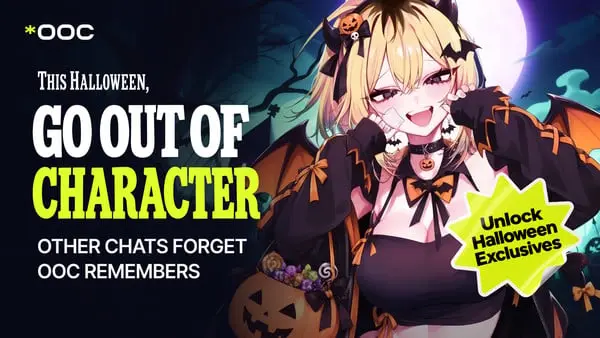
In line with the platform’s ongoing commitment to seasonal engagement, the developers have announced a comprehensive promotional event scheduled for late October through early November 2026. This campaign serves as a strategic effort to increase user retention and attract new demographics through limited-time incentives.
The event is structured across two primary phases:
- October 25 – October 31: Users participating in the daily check-in feature will receive double the standard allotment of digital credits, facilitating greater access to premium narrative features.
- October 29 – November 8: The platform will provide seven free responses for any OOC Original story that the user has not previously engaged with, encouraging exploration of the wider library.
This temporal strategy reflects a broader industry trend of "live-service" maintenance, where developers utilize holiday-themed content—such as the "Halloween Kitchen" and "Haunted Renovation" spotlights—to maintain a dynamic relationship with their user base. These videos serve as case studies in how the platform handles tonal shifts, demonstrating the AI’s capability to pivot from standard drama to horror-fantasy environments without requiring a fundamental change in the underlying game engine.
Fact-Based Analysis of AI-Driven Interactive Media
The rise of platforms like OOC signifies a departure from traditional software development cycles. In a standard interactive medium, the "cost" of content increases linearly with the complexity of the narrative. However, by offloading the generation of dialogue and plot progression to an LLM-based (Large Language Model) framework, the developers have drastically reduced the barriers to scale.
From an industry standpoint, the implications are twofold:
- Lowered Production Costs: By focusing on the infrastructure of interaction rather than the manual writing of every possible dialogue line, the developer can support a significantly larger volume of content than traditional studios.
- User-Centric Customization: The shift from "reader" to "co-author" creates a higher level of psychological investment. Because the world reacts to the specific input of the individual, the platform fosters a personalized experience that is difficult to replicate through static media.
However, this model faces technical challenges, primarily regarding content moderation and the maintenance of narrative coherence over extremely long durations. While the "Deep Memory" system addresses the latter, the former remains a critical focus for developers as they expand their user-generated content features. The ability for users to create and share their own characters requires robust safety guardrails to ensure the platform remains suitable for its intended demographic.

Chronology of Platform Development
The development of OOC can be viewed through the lens of recent advancements in generative AI. The initial phase focused on building the core "Playable Anime" framework, establishing the visual fidelity and character-interaction interface. The subsequent phase, currently ongoing, involves the expansion of the creative ecosystem, where the focus has shifted toward user-generated content (UGC) and social sharing.
- Launch Phase: Establishment of core AI interactions and the initial database of characters and genre tags.
- System Refinement: Integration of "Deep Memory" and persistent world-state tracking to allow for long-term narrative consistency.
- Community Integration: Introduction of the publishing system, daily rankings, and custom command functionality.
- Promotional Expansion (Q4 2026): Implementation of seasonal event cycles and cross-platform marketing initiatives, including the Halloween 2026 campaign.
Future Outlook and Community Engagement
As the platform continues to grow, the developer has emphasized the importance of community feedback channels. By maintaining an active presence on platforms such as Discord, TikTok, and Instagram, the OOC team is able to conduct real-time sentiment analysis, allowing them to adjust the AI’s response parameters and introduce new features based on user requests.
The availability of the app on both Google Play and the Apple App Store underscores its accessibility, aiming to reach a global audience of anime enthusiasts and interactive media consumers. Whether the platform will successfully transition from a niche interest tool to a mainstream entertainment staple will depend on its ability to balance the technical demands of high-level AI processing with the creative demands of a community that expects high-quality, emotionally resonant storytelling.
For those interested in exploring the platform’s capabilities, the official website (ooc.ai) serves as the central hub for technical documentation, community guidelines, and updates. With the upcoming Halloween events serving as a litmus test for the platform’s scalability and user engagement levels, OOC: The Playable Anime remains a project of significant interest to observers of the intersection between creative writing, artificial intelligence, and digital entertainment. The convergence of these technologies suggests that the future of storytelling may not be written by authors alone, but negotiated between the creator and the audience in a digital space that never truly reaches a final conclusion.