Humanity has long maintained a deeply anthropocentric perspective, viewing the globe through a lens driven largely by creature comforts, survival biases, and an ingrained assumption that human civilization forms the axis around which all earthly experiences revolve. However, speculative fiction has increasingly turned toward an entirely different dimension of storytelling by decentering humanity altogether. By shifting narrative agency to the animal kingdom, authors explore profound philosophical and sociological questions: How would a wild wolf perceive the historical domestication of canine species? What mythologies and sociopolitical structures would emerge in a society where every participant is a lagomorph? How does a practitioner of magic navigate a spellcasting system entirely dependent on wands when they possess no opposable thumbs?
Literary critics and publishing analysts note that animal-based fantasy has evolved significantly from the gentle, moralizing fables of previous centuries into sophisticated, genre-bending epics. These narratives leverage animal protagonists not merely as anthropomorphized human stand-ins, but as windows into genuinely alien sensory and cognitive frameworks. Examining the world through non-human eyes allows creators to deconstruct human institutions, ecological degradation, urban expansion, and mortality with striking emotional resonance. Below is an examination of seven seminal and contemporary animal-based fantasies that successfully challenge human-centric viewpoints by offering alien, eye-opening perspectives on familiar concepts.

Blacktail by Scott Hawkins
The long-awaited sophomore novel by cult favorite author Scott Hawkins, who previously gained critical acclaim for The Library at Mount Char, marks a profound departure into dark, animal-centric fantasia. Published by prominent imprints, the work immediately establishes a bleak and unsettling tone within its opening chapters. The narrative swiftly transitions from a stark folk-horror interlude—featuring an automobile interpreted by wildlife as a towering, malevolent deity—into the awkward yet strangely comedic mating experiences of the protagonist, Blacktail, and his domesticated canine companion, Renren.
The plot takes a sharp turn into visceral weird horror following the tragic death of Renren due to a botched veterinary procedure. Grief-stricken and enraged, Blacktail slaughters her human caretakers, curses the divine order, and embarks on an arduous, mythic quest to awaken the dormant Forest God. Literary analysts recommend pairing the reading experience with atmospheric sonic landscapes, such as the album Deathconsciousness or the recordings of black metal outfit Wolves in the Throne Room, to fully capture the novel’s tone. Hawkins expertly balances wrenching emotional devastation, off-kilter dark comedy, and brutal horror in rapid succession, cementing Blacktail as a triumphant return that rewards the extended anticipation of his readership.
Watership Down by Richard Adams
First published in 1972, Richard Adams’ enduring classic Watership Down remains a foundational pillar of modern animal fantasy. The novel commences with deceptive simplicity, depicting two rabbits foraging in a pastoral English meadow. This tranquility is abruptly shattered when one of the rabbits, Fiver, experiences a terrifying prophetic vision of a field submerged in blood, signaling an ominous shift in the narrative landscape.

When human real estate development and construction threaten to destroy their warren, Hazel, Fiver, and a band of loyal companions are forced into a perilous exodus to find a new home. Adams constructs a vast, intricate culture complete with its own language, folklore, and religious mythology that deliberately mirrors the structural scale of classical Greek and Roman epics. By blending pastoral beauty with stark, unflinching depictions of violence and territorial struggle, Watership Down functions as a sophisticated exploration of heroism, tyranny, and community. The enduring popularity of the novel, underscored by major anniversary editions and screen adaptations, demonstrates the timeless power of viewing monumental political and survival struggles through the vulnerable perspective of small prey animals.
Duncton Wood by William Horwood
While Richard Adams explored the mythological and epic dimensions of animal societies, William Horwood’s 1980 publication Duncton Wood approaches the subgenre through the lens of medieval romanticism and English mysticism. Set deep beneath the surface of a historic English forest, the novel details the intricate, subterranean society of moles. The narrative centers on Bracken and Rebecca, two fated lovers who encounter one another in the shadow of an ancient standing stone, quickly becoming entangled in the high-stakes political intrigue of the Duncton Moles’ Ancient System—a sprawling network of tunnels running beneath the entire woodland.
Horwood employs a Tolkien-esque world-building methodology, creating a multilayered history where natural predators such as owls are elevated to the status of terrifying mythological monsters, and the daily survival of the characters relies heavily on a diet of earthworms. While critics have occasionally noted the dense, sometimes idiosyncratic linguistic choices within the text—such as the fascist antagonist Mandrake utilizing ancient Welsh to terrorize rival moles—the overall literary achievement lies in its deep emotional resonance. Duncton Wood successfully translates medieval court intrigue, religious dogmatism, and sweeping romantic tragedy into a subterranean ecosystem.

Beasts of Burden by Evan Dorkin and Jill Thompson
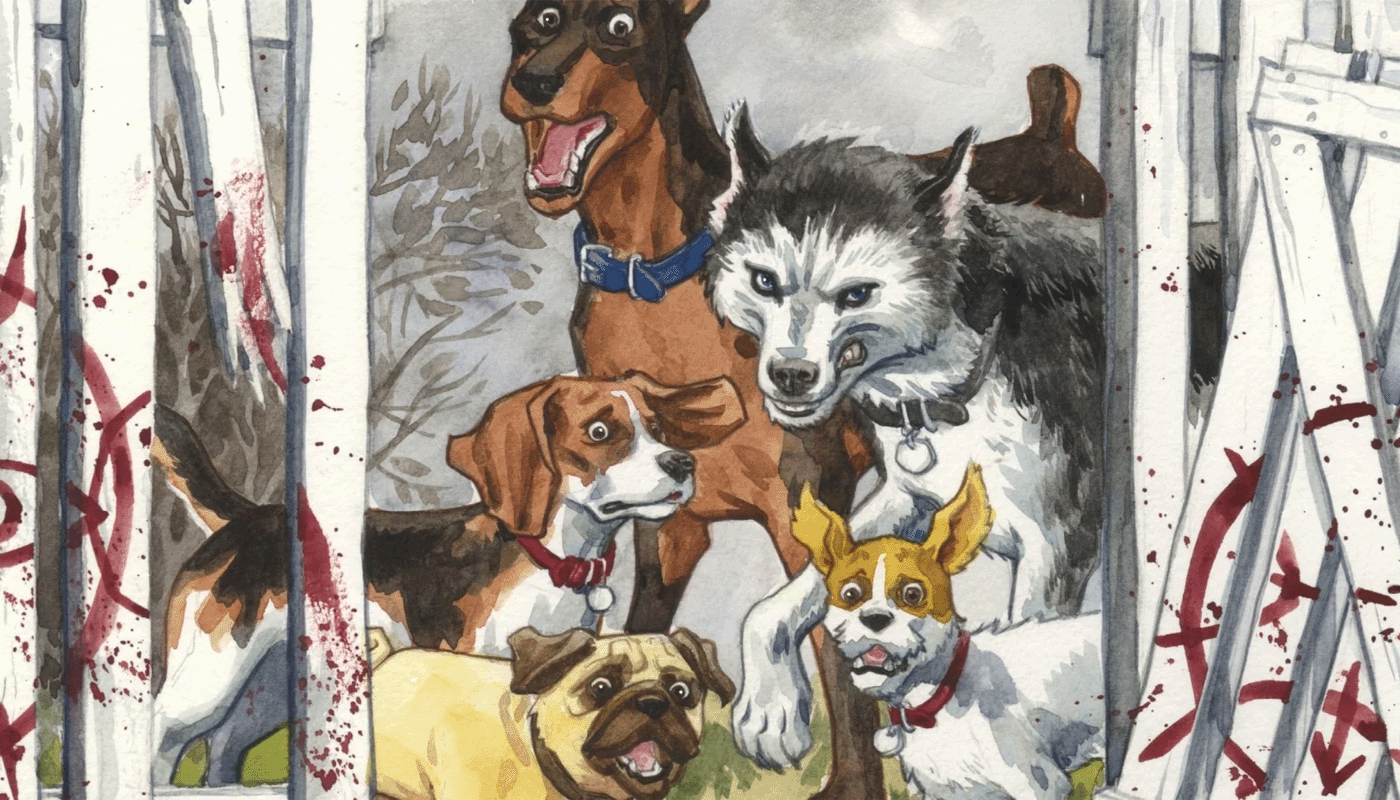
Shifting the medium from prose to graphic fiction, Evan Dorkin and Jill Thompson’s Beasts of Burden offers a chilling yet deeply compassionate look at the paranormal through the eyes of domestic animals. Set in the seemingly idyllic, pastoral community of Burden Hill, the narrative reveals a region that serves as a powerful nexus for dark supernatural phenomena. From the restless ghosts of neglected puppies and a local witch’s feline familiar to demonic hellhounds and the eldritch entity known as the Rat King, the neighborhood faces constant peril.
To combat these otherworldly threats, a dedicated collective of local dogs and cats—operating as the Wise Dogs Society—takes up arms to protect their human owners and territory. Thompson’s picturesque, watercolor-infused artwork seamlessly transitions from cozy suburban realism to grotesque, horrifying imagery, perfectly matching Dorkin’s scripts. The series stands out for its balanced emotional payload, ensuring that the heavy toll of supernatural warfare is continually met with moments of canine and feline loyalty, humor, and domestic warmth, establishing Burden Hill as a complex intersection of the mundane and the macabre.
The Book of Night with Moon by Diane Duane
Expanding upon the expansive universe of Duane’s established Young Wizards book series, The Book of Night with Moon—set chronologically between the events of the fourth and fifth main novels—transports readers into the hidden, magical underbelly of Manhattan as managed exclusively by felines. The plot follows Rhiow and a cadre of cat-wizards who utilize their heightened sensory perceptions and innate, methodical approach to spellcasting to safeguard New York City from metaphysical threats imperceptible to human eyes. Furthermore, these feline guardians are tasked with the critical maintenance of dimensional "worldgates" that facilitate transit between various cosmic realms.

Duane applies an anthropological level of detail to feline behavioral patterns, translating human concepts, urban landmarks, and sociological terminology into distinct cat phonemes. By emphasizing the acute olfactory and auditory capabilities of cats, the novel reimagines urban fantasy entirely. Human society, urban wildlife, and refuse management are reframed through a pragmatic, feline worldview, offering a uniquely grounded yet profoundly strange perspective on magic, urban habitation, and inter-species coexistence.
Ka: Dar Oakley in the Ruin of Ymir by John Crowley
Acclaimed speculative fiction author John Crowley presents a sweeping, melancholic meditation on mortality, memory, and mythology in Ka: Dar Oakley in the Ruin of Ymir. Set against the backdrop of a world slowly succumbing to ecological collapse, the narrative begins when an aging, ailing man discovers a dying crow in his backyard and nurses it back to health. In an act of avian gratitude, the crow—Dar Oakley, the first of his kind to possess an individual name—recounts his extraordinary life story.
Spanning over two thousand years of recorded and unrecorded history, Dar’s narrative traverses the liminal spaces between human civilization and the natural world, moving fluidly between the metaphysical realms of Ka and Ymir. Having inadvertently secured his own immortality, Dar has witnessed the rise and fall of human empires, the shifting boundaries of nature, and the relentless march of time. Crowley’s characteristic lyrical prose elevates the work into a modern mythological masterpiece, functioning simultaneously as a retro-fantasy fable, an ecological lament, and a profound philosophical inquiry into the necessity of storytelling to ensure mutual understanding across species boundaries.

Hollow Kingdom by Kira Jane Buxton
Injecting dark humor and apocalyptic terror into the animal fantasy landscape, Kira Jane Buxton’s debut novel Hollow Kingdom chronicles a global extinction-level event from the bewildered perspective of a domesticated crow. The narrative establishes its uncompromising tone immediately: S.T., a foulmouthed, internet-culture-obsessed crow living in Seattle, watches in horror as his human roommate, Big Jim, begins exhibiting classic signs of zombification—culminating in his eyeball detaching, much to the immediate culinary interest of their dimwitted bloodhound roommate, Dennis.
As the human population of Seattle rapidly devolves into shambling, mindless corpses, S.T. and Dennis realize that the domestic arrangement they have long taken for granted has permanently collapsed. Forced to navigate a rapidly rewilding urban environment alongside other surviving animals, S.T. relies on an avian telepathic information network he terms "Aura." Buxton utilizes a distinctly irreverent narrative voice and sharp satirical observations to examine the fragility of human civilization, presenting a fresh, darkly comedic, and ultimately poignant look at an Earth learning to heal in the wake of human extinction.