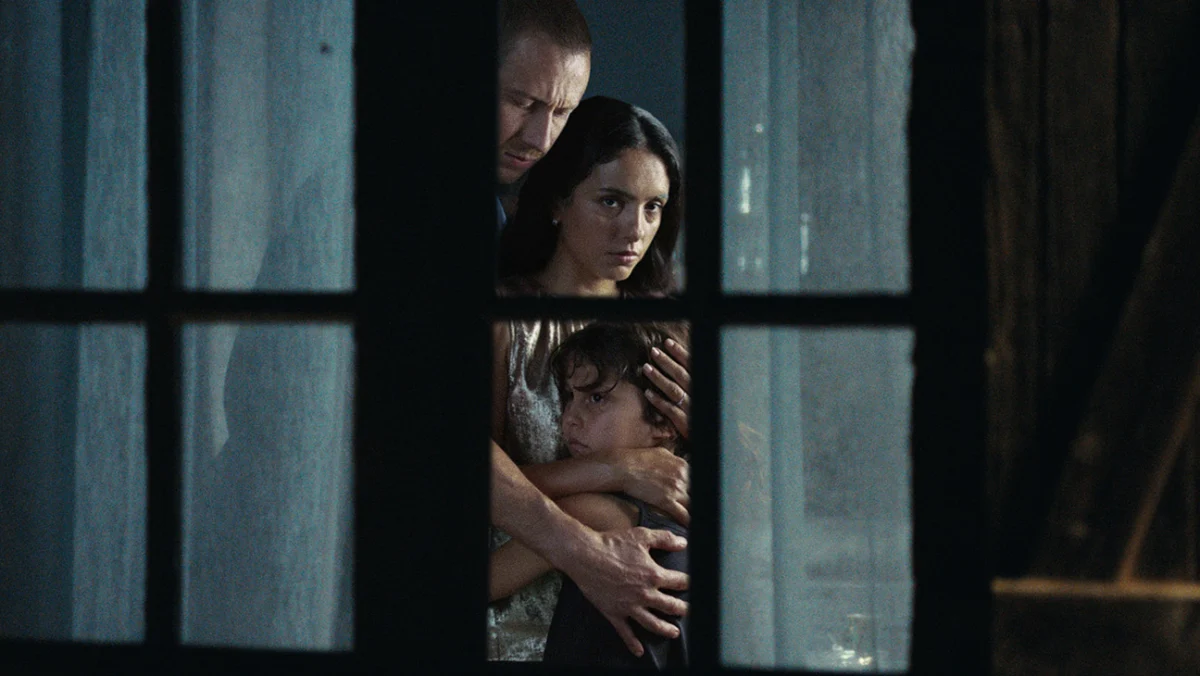
Léa Mysius’s third feature film, The Birthday Party (original French Histoires de la nuit), premiered at the prestigious Cannes Film Festival, marking a significant entry into the psychological home-invasion thriller genre. The film, adapted from Laurent Mauvignier’s acclaimed French bestseller, delivers a lean, mean, and frequently terrifying narrative that has drawn comparisons to chilling modern classics such as Michael Haneke’s Funny Games and Christian Tafdrup’s Speak No Evil. While it navigates similar thematic waters of domestic sanctity under siege, Mysius’s vision stops well short of the overtly sadistic shocks characteristic of its more brutal predecessors, opting instead for a simmering dread rooted deeply in psychological violation and the unsettling revelation of hidden histories.
Director’s Vision and Thematic Depth
Léa Mysius, a rising voice in contemporary French cinema, brings to The Birthday Party a distinctive directorial sensibility that blends genre conventions with an art-house aesthetic. Her previous work, particularly the 2022 fantasy drama The Five Devils (Les Cinq Diables), showcased her fascination with remote settings, an appetite for darkness, and a penchant for exploring the complexities of human relationships within heightened realities. The Birthday Party resonates with these thematic interests, though critics have noted its more cohesive narrative structure compared to the somewhat "scattershot genre-bender" nature of The Five Devils. Mysius, co-writing the screenplay based on Mauvignier’s novel, meticulously crafts a narrative that prioritizes the psychological unraveling of its characters over gratuitous violence, transforming a familiar genre into a vehicle for examining trust, identity, and the fragile veneer of domestic peace.
The adaptation of Laurent Mauvignier’s Histoires de la Nuit is a crucial element of the film’s foundation. Mauvignier is renowned in French literature for his intense, often claustrophobic narratives that delve into the human psyche under duress. His novels frequently explore themes of memory, trauma, and the insidious nature of secrets, making his work a fertile ground for cinematic exploration, especially within a thriller framework. The novel’s critical reception in France underscored its capacity to build unbearable tension through character interaction and atmospheric dread, qualities Mysius appears to have faithfully translated to the screen while infusing her own visual and narrative flair.
The Home-Invasion Genre: A Contextual Analysis
The home-invasion thriller occupies a unique and potent space within the horror and suspense genres, tapping into primal fears surrounding the sanctity of one’s personal space and the vulnerability of the family unit. Historically, films like Wait Until Dark (1967) and Straw Dogs (1971) explored the psychological terror of intruders. More recently, the genre has seen a resurgence with titles that push boundaries, such as The Strangers (2008), which emphasized anonymous, motiveless evil, and You’re Next (2011), which added a darkly comedic, survivalist twist.
The Birthday Party distinguishes itself by leaning heavily into the psychological aspect, aligning more closely with the intellectual horror of Funny Games, which dissects audience expectations and the mechanics of violence, and Speak No Evil, a recent Danish-Dutch co-production that shocked audiences with its slow-burn descent into horrific social awkwardness and ultimate brutality. Mysius, however, seems to consciously pull back from the extreme sadism of these films, choosing to amplify the dread through the intruders’ intimate knowledge of their victims and the ensuing marital and familial tensions. This approach resonates with a growing critical interest in "elevated horror" or "post-horror" films that use genre tropes to explore deeper societal or psychological anxieties, offering more than just jump scares or gore.
Unveiling the Bergogne Family: Life in Rural Western France
The film introduces the Bergogne family, whose seemingly idyllic life in rural Western France forms the tranquil backdrop soon to be shattered. Thomas (Bastien Bouillon), the hardworking patriarch, manages a small dairy farm, a profession often romanticized but in reality fraught with economic challenges. The agricultural sector in regions like Western France has faced significant pressures in recent decades, including fluctuating market prices, stringent environmental regulations, and competition from larger industrial operations. Small family farms frequently grapple with debt, succession issues, and the sheer physical toll of the work. This socio-economic context provides a subtle but potent undercurrent to Thomas’s character, highlighting his financial vulnerability which, as the narrative unfolds, becomes a tool in the hands of the intruders.
His wife, Nora (Hafsia Herzi), is celebrating her 40th birthday, a milestone marked by a professional promotion to head of town-planning at her office job. This achievement signifies a different kind of ambition and success, contrasting with Thomas’s more traditional, land-bound livelihood. Their daughter, Ida (Tawba El Gharchi), is portrayed as a smart preteen, navigating the digital age with an online presence, a detail that initially appears innocuous but later serves as a key piece of foreshadowing regarding privacy and exposure.
The family’s isolation is underscored by their sole neighbor, Cristina (Monica Bellucci), a well-heeled Italian artist living in a "distressed-chic" studio, likely a converted barn. Cristina represents an external, somewhat bohemian influence, a figure whose presence provides both a sense of community and, eventually, another layer of vulnerability to the unfolding drama. Ida’s habit of stopping by Cristina’s studio to paint on her way home from school establishes a bond that becomes crucial during the night of terror.
The Seeds of Dread: Foreshadowing and Intrusion
Mysius skillfully plants seeds of dread early in the narrative, subtly building tension before the explicit home invasion begins. One significant moment involves Nora’s vehement reaction to a video Ida posts online of the family dancing. Despite Ida’s protestations about losing 60,000 views, Nora demands its immediate removal, clearly articulating her discomfort with being seen on social media. This incident not only establishes Nora’s guarded nature but also hints at a past she wishes to keep hidden, foreshadowing the core conflict that will emerge.
Another crucial plot signal is the arrival of Flo (Paul Hamy), a shifty-looking individual, while the family is out. He claims to Cristina that he’s there to inspect the farmhouse for sale, a claim Cristina intuitively dismisses, knowing the Bergognes have no such plans. Her eagerness to see him off proves to be a sharp intuition, as Flo’s presence is unequivocally sinister.
The initial intrusion is not a sudden, violent breach but a creeping, calculated maneuver. Flo soon returns, first with his seemingly dim-witted younger brother Bègue (Alane Delhaye), whose history includes a two-year stint in a psychiatric ward, and then with their eldest sibling, Franck (Benoît Magimel), the clear leader of the trio. The brothers’ method is chillingly strategic. When Ida arrives at Cristina’s studio after school, she finds it seemingly empty, even the painter’s dog gone. The brothers, however, have merely hidden Cristina, preventing her from warning Thomas upon his return home. This act establishes the intruders’ cold efficiency and their control over the isolated environment.
A Night of Psychological Warfare
What sets The Birthday Party apart is Mysius’s deep dive into the psychological violation inflicted by the intruders. The script emphasizes that these aren’t random assailants; they possess extensive, intimate knowledge of the Bergogne family. They are aware of Thomas’s precarious financial situation, knowing he bought the family farm at a time when the agricultural sector was struggling. This personal information is weaponized, creating a sense of inescapable vulnerability for the family. The intruders allow Thomas to enter the farmhouse and even begin stringing up decorations for Nora’s birthday party before making their presence explicitly felt, amplifying the terror through a perverse subversion of domestic celebration.
Nora’s delayed arrival due to a flat tire on her way home from work further ratchets up the tension. When she finally returns, Franck greets her with an unnerving familiarity, calling her "Leïla." Nora vehemently denies this identity, insisting he has the wrong person. However, Franck’s persistence and his subtle allusions to a shared past create a palpable tension, igniting a devastating marital crisis amidst the home invasion. Thomas is forced to question how well he truly knows his wife, transforming the external threat into an internal breakdown of trust and identity. This sophisticated layering of external danger with internal conflict elevates the film beyond a simple genre exercise.
The Role of Women: Strategy Amidst Terror
One of the film’s most compelling aspects is Mysius’s intentional investment in the female characters. Unlike many home-invasion thrillers where women are often relegated to roles of trembling victims, Nora, Ida, and Cristina are portrayed as actively strategizing, keenly observing their captors, and searching for any weakness to exploit. This focus on female agency in the face of terror offers a refreshing and empowering perspective.
Some of the most engaging scenes involve Bègue, left alone in the studio to guard Cristina. Despite his attempts to project toughness, Cristina expertly identifies his vulnerability. She coos sympathetically over the demeaning treatment he receives from his brothers, exploiting his evident lack of self-assurance. Monica Bellucci, known for her iconic roles in films like Malèna and The Matrix Reloaded, delivers a nuanced performance as Cristina. She is depicted as smart and calculating, appearing to plot a move but patiently waiting for the opportune moment. Her conversations with Bègue about her art treat him with a respect and intelligence he is clearly unaccustomed to receiving. A shared glass of wine and a joint momentarily transform their interaction into an almost mellow, unsettling hang, highlighting the psychological manipulation at play.
Next door, Nora is relentlessly "needled" by Franck about parts of her past she has meticulously kept secret from her family. When she is ultimately forced to acknowledge her history with Franck, the marital tensions and trust issues intertwine with the unpredictable volatility of the intruders. This double-edged conflict – external survival and internal marital struggle – creates a complex and emotionally resonant narrative. Even Ida, encouraged to watch cartoons in the living room, remains alert to everything unfolding, demonstrating a child’s keen observational skills and inherent resilience.
Performances that Anchor the Narrative
The film’s tautness and psychological depth are significantly bolstered by its strong ensemble cast. Benoît Magimel, who has entered what critics describe as his "Brando phase," delivers an imposing performance as Franck. His physical presence is as unsettling as his menacing words, embodying a cold, calculated threat. Paul Hamy, as Flo, is a magnetic livewire, a bundle of cocky charm and inherent danger, adding an unpredictable element to the trio of thugs. Alane Delhaye’s portrayal of Bègue is almost touching; his lack of self-assurance makes him a poor fit for the criminal life, a fact he seems painfully aware of, adding a layer of tragic humanity to the antagonist group.
However, the standout performance, widely lauded, comes from Hafsia Herzi as Nora. Herzi, who gained international recognition in Abdellatif Kechiche’s The Secret of the Grain and most recently impressed at Cannes with her directorial work on the exquisite queer coming-of-age drama The Little Sister, solidifies her status as a major talent. Her portrayal of Nora—a woman navigating professional success, familial loyalty, and a devastatingly exposed past—is a masterclass in controlled intensity and emotional vulnerability. Herzi’s ability to convey a complex emotional landscape under extreme duress makes her a compelling anchor for the film, and critics suggest she is long overdue for wider recognition on both sides of the camera. Monica Bellucci, as Cristina, also adds a layer of international star power and gravitas, delivering a performance that is both elegant and cunning.
The Critical Divide: A Flawed Climax
Despite its many strengths—the compelling performances, Mysius’s skillful direction, and the efficient build-up of dread—The Birthday Party faces a significant critical hurdle concerning its climactic act. Critics have pointed out that after meticulously crafting a suspenseful and psychologically rich narrative, Mysius "fumbles the big finish." The film, which "crackles through the set-up and into the uncomfortable midsection in which anything could happen," unfortunately introduces "movie-ish improbabilities" that jar the audience out of the immersive experience.
Specific critiques highlight a "nagging inattention to verisimilitude," such as a character bleeding profusely from a gunshot wound yet inexplicably putting their pain on hold to address "matters of the heart." Another noted cliché involves the "unlikely skill with a rifle of another character," which is described as something out of a "hoariest Western," a narrative contrivance that would be scrutinized in even a basic screenwriting class. These moments of narrative convenience and lack of realism undermine the carefully constructed tension and the film’s earlier commitment to psychological authenticity. For a film competing at a festival as prestigious as Cannes, such criticisms regarding structural integrity in the final act can significantly impact its overall critical reception and its trajectory in the global market.
Broader Implications and Future Prospects
The premiere of The Birthday Party at the Cannes Film Festival’s main competition is a testament to Léa Mysius’s growing reputation as a significant voice in European cinema. Being selected for competition provides immense exposure and validation, even if the critical consensus highlights a flawed ending. For a genre film, particularly one with a strong psychological bent, a Cannes slot signifies its artistic ambition and ability to transcend typical genre confines.
The critical assessment of the "wobbly third act" does, however, present implications for the film’s commercial viability and potential awards recognition. While strong performances and a compelling premise can attract audiences and distributors, a perceived narrative weakness in the climax might temper broader appeal. The article suggests that "the track record of European genre movies being remade in America is all over the place," but posits that The Birthday Party is "one case in which some smart retooling of the wobbly third act could yield a viable property." This analysis implies that the core concept, the characters, and the initial execution are strong enough to warrant a potential remake, provided the ending is re-imagined to maintain the integrity and realism established in the film’s earlier segments.
This scenario is not uncommon in the film industry, where promising European films with minor structural issues are often eyed for American remakes, allowing for a fresh take on the narrative while capitalizing on proven thematic appeal. The challenge would be to retain Mysius’s nuanced psychological approach and focus on female agency while crafting a more satisfying and believable resolution that resonates with a wider audience.
In conclusion, The Birthday Party stands as a testament to Léa Mysius’s directorial talent and her ability to craft a deeply unsettling psychological thriller. With its chilling premise, powerful performances—especially from Hafsia Herzi—and its insightful exploration of hidden pasts and domestic vulnerability, the film offers a compelling, albeit imperfect, addition to the home-invasion genre. Its critical reception at Cannes underscores its strengths in character development and tension building, while also highlighting the enduring challenge of delivering a truly satisfying and coherent resolution in high-stakes genre cinema.