The 83rd Venice International Film Festival concluded its annual cinematic showcase on the historic Lido with a meticulously balanced awards ceremony that effectively quieted months of intense industry criticism regarding gender representation and the selection of its competition slate. By awarding its highest accolade, the Golden Lion, to Danish-Egyptian filmmaker May el-Toukhy for her psychological thriller Woman Unknown, the festival demonstrated a decisive pivot toward recognizing diverse directorial voices while simultaneously honoring works of distinct artistic merit, political urgency, and commercial viability.
The grand conclusion of the 11-day festival comes after a turbulent build-up that saw organizers heavily pilloried by international film critics, advocacy groups, and industry insiders for failing to curate a sufficient number of female filmmakers within the primary competition line-up. As the oldest film festival in the world—inaugurated in 1932—the Venice Biennale has historically served as a critical launchpad for the autumn awards season, often dictating the conversation for the Academy Awards. However, in recent years, the event has faced mounting scrutiny over a persistent structural imbalance that critics argued favored the perpetuation of a "cult of male genius." The triumphant evening of awards distribution, therefore, functioned not merely as a celebration of cinematic achievement, but as an institutional recalibration for the festival management under the direction of the Biennale board.
At the center of this redemption was el-Toukhy’s gripping and stylish drama-thriller, Woman Unknown, which explores themes of sexual shame, political paranoia, and the complex psychological inheritance of post-World War II Denmark. The narrative carries an elegant, unmistakable nod to Alfred Hitchcock’s classic psychological masterpiece Rebecca. The plot centers on a wealthy factory owner and widower who preserved his substantial fortune through calculated business arrangements with German wartime occupiers. Desiring to marry Marie, the young nanny of his infant daughter—brilliantly portrayed by Mathilde Arcel—he forces her into a traditional domestic arrangement. Complications arise when Marie is tasked with taking the pristine white wedding gown of her employer’s deceased first wife to a local dressmaker for alterations, a chilling mandate from her prospective husband that triggers a haunting escalation of suspense.
Mathilde Arcel’s commanding lead performance earned her the prestigious Volpi Cup for Best Actress, cementing her status as a formidable international talent. Industry analysts have praised el-Toukhy’s film not only for its atmospheric tension and high production values, but for its sharp, unflinching insights into the sexual hypocrisy and moral compromises that characterized the postwar prosecution and punishment of collaboration. While some high-brow purists initially argued that the film leaned toward mainstream accessibility when compared to the more radical arthouse features scattered across the competition slate, its ultimate selection proved universally defensible, bridging the often-impenetrable gap between rarefied festival cinema and mainstream commercial appeal.

Chronology and Key Winners of the 83rd Edition
The festival’s competition calendar unfolded over nearly two weeks of rigorous screenings, press conferences, and red-carpet premieres, culminating in a weekend of high-profile prize distributions evaluated by the international jury.
The Silver Lion Grand Jury Prize was awarded to veteran South Korean auteur Lee Chang-dong for Possible Love, an expansive, ruminative, and novelistic exploration of class exploitation and human connection. The film follows a working-class family, profoundly traumatized by a bitter recent strike at the factory that once employed the patriarch. They are subsequently befriended—and ultimately exploited—by a wealthy, avant-garde couple intent on capturing their struggles in a documentary. Lee’s signature subtlety avoids the trap of simplistic moral condemnation, offering instead a meandering, deliberate narrative pace that challenges audiences to confront the uncomfortable boundaries between empathy and voyeurism.
Meanwhile, the Silver Lion for Best Director went to visionary Russian artist Ilya Khrzhanovsky for his staggering epic DAU, a fictionalized, quasi-biographical deep dive into the life of Soviet theoretical physicist Lev Landau. Representing the monumental narrative centerpiece of Khrzhanovsky’s colossal, multi-year multimedia project, the film eschews digital effects in favor of extensive, real-world analogue set reconstructions and historical stagings. The resulting cinematic artifact captures the terrifying, mesmerizing atmospheric gravity of Stalinist tyranny through the lens of one brilliant, eccentric scientific mind.
Political Urgency and Investigative Cinema on the Lido

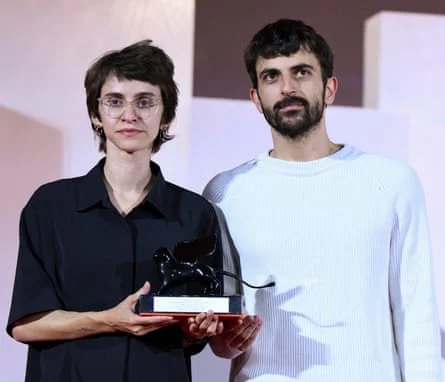
Beyond traditional dramatic fiction, the 2026 Venice Film Festival demonstrated an unwavering commitment to urgent geopolitical discourse by elevating investigative cinema to the highest tiers of recognition. The Special Jury Prize was awarded to NAZA, a lacerating and deeply disturbing documentary directed by Yuval Abraham and Rachel Szor. Produced in collaboration with the Guardian, the film exposes the systematic implementation of artificial intelligence systems in military operations during Israel’s ongoing conflict in Gaza.
The documentary’s inclusion and subsequent victory arrived amid an intensely charged political climate across major European film festivals, where events have increasingly become flashpoints for debates surrounding artistic censorship, geopolitical neutrality, and institutional silence regarding Middle Eastern conflicts. NAZA was met with a thunderous, emotionally charged 24-minute standing ovation during its festival premiere, a visceral reaction that signaled deep audience resonance with its harrowing findings. While some activist groups and attendees argued that an even higher accolade would have been a more appropriate acknowledgment of the film’s moral and journalistic weight, the jury’s decision to honor the investigative project proved that Venice was capable of platforming vital, non-virtue-signalling political truths on an international stage.
Hollywood Flavor and Supporting Category Triumphs
While political documentaries and European arthouse masterworks dominated the artistic conversation, the festival retained a touch of Hollywood prestige and awards-season prognostication through the widespread popularity of Martin McDonagh’s Wild Horse Nine. A raucous, dark political satire, the film stars John Malkovich and Sam Rockwell as two bleary, disaffected CIA operatives navigating the tense sociopolitical landscape of 1973 Chile after a lifetime of executing deniable black ops and state-sanctioned wet jobs.
While critics remained divided on whether the film’s comedic tone fully justified its inclusion for the festival’s top-tier prizes, the jury recognized its stellar performances. John Malkovich secured the Volpi Cup for Best Actor, an achievement that immediately positions the veteran actor as a frontrunner for the upcoming Academy Award race. Historically, the Venice Film Festival has functioned as the definitive starting gun for Oscar campaigns, though industry observers noted a comparative scarcity of traditional Hollywood glamour and overt awards-season scuttlebutt on the Lido this year, allowing the cinema itself to command the primary narrative.

Broader Implications and Industry Analysis
The conclusion of the 83rd Venice Film Festival marks a significant turning point for the institution’s cultural relevance and administrative strategy. By directly addressing historical criticisms regarding gender parity through substantive, high-profile awards rather than symbolic gestures, the festival leadership has successfully navigated a potentially damaging public relations crisis.
Furthermore, the triumphant international reception of May el-Toukhy’s Woman Unknown and the journalistic bravery embodied by Yuval Abraham and Rachel Szor’s NAZA illustrate a shifting paradigm within global film curation. Audiences and critics alike are increasingly demanding that major cultural institutions not only entertain, but also engage deeply with historical accountability, systemic political crises, and diverse storytelling perspectives. As these awarded films transition from the exclusive waters of the Venetian lagoon to commercial distribution networks across the United Kingdom and the broader international market, the 2026 edition of the festival will likely be remembered as the moment Venice decisively restored its artistic integrity and reclaimed its status as a fearless leader in global cinema.